Spooky and Spine-Chilling: Our Most Popular Microscope Images for October 2021
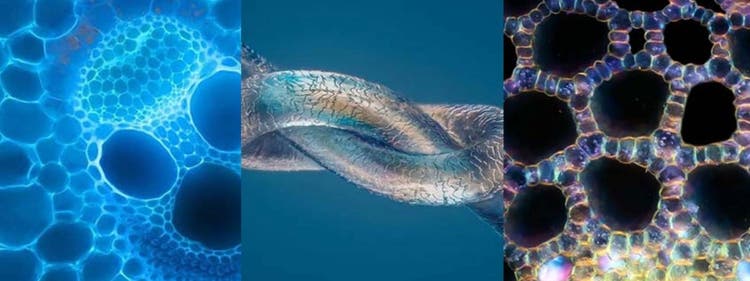

It seems our followers are fans of the supernatural and things that go bump in the night! In celebration of the season, we shared some spine-chilling images of weird, spooky, and sometimes terrifying specimens found under an Evident microscope, and a number of them made it to the top this month!
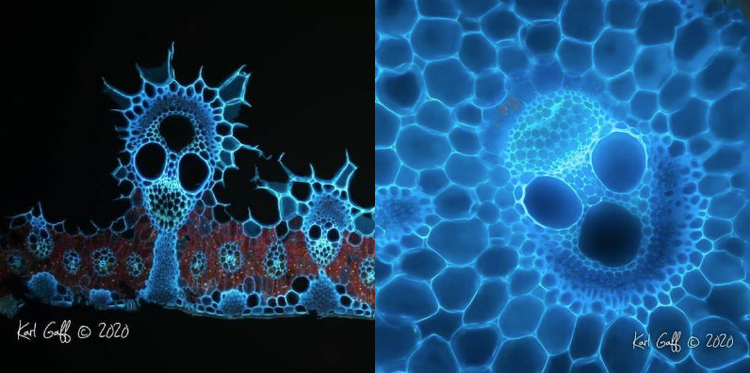
While these microscopic skeleton-like figures look like something that haunt your dreams, they are actually harmless! These images are a UV-induced fluorescence of a 20-micron section of bulrush, a wetland grass-like plant found in swamps, ponds, and wet meadows.
Images courtesy of Karl Gaff. Captured using an Evident BX51 (formerly Olympus BX51) microscope.
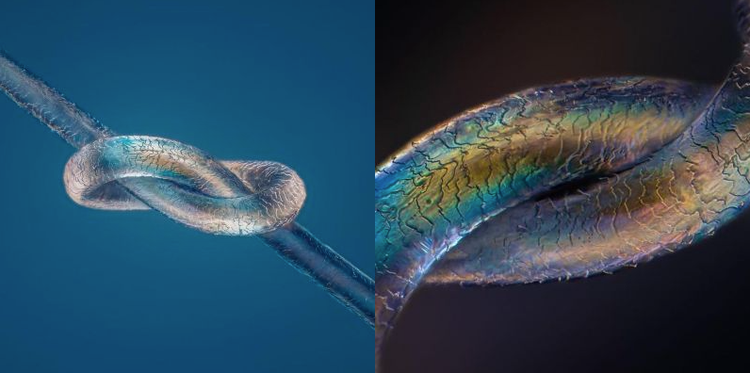
Our next image this month may not be spooky, but it’s certainly hair-raising! Håkan Kvarnstrom examined his daughter's hair under his Evident microscope, and the result is beautiful! The small knot he managed to secure on a single strand of hair perfectly captures the rainbow of colors from his polarized image.
Images courtesy of Håkan Kvarnström. Captured using polarized light with 20X and 50X objectives.
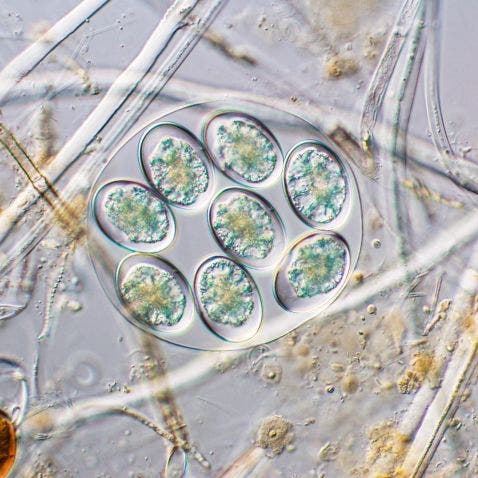
Glaucophtye algae—a small group of freshwater unicellular algae—are unusual due to their chloroplasts. Known as muroplasts, cyanoplasts, or cyanelles, they are unlike chloroplasts in other organisms because they have a peptidoglycan layer, believed to be a relic of the endosymbiotic origin of plastids from cyanobacteria.
Image courtesy of Glenn McGregor.
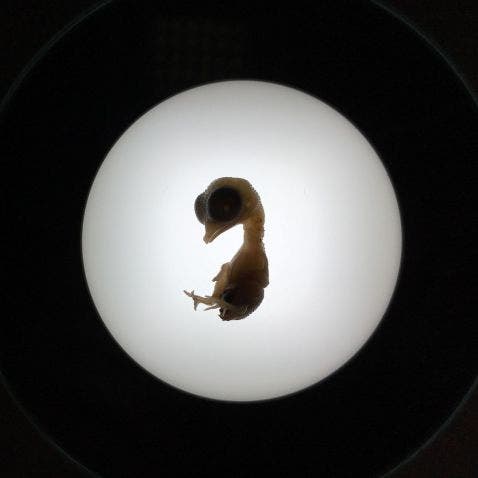
This image may look like the silhoutte of an alien, but is actually a chicken embryo on the ninth embryonic day. Which came first, the chicken or our interest in researching their eggs?
Writings on embryonic development go back as far as Greek philosopher Aristotle, who noted the changes in the embryo as he opened eggs at various stages of incubation. By day 9, the chick will not yet have developed feathers, but the claws will begin to show.
Image courtesy of Eva Petrovova, 2019 Image of the Year Award Submission. Captured using an Evident SZ61 (formerly Olympus SZ61) microscope.
Our 2021 Image of the Year Competition is now accepting entries! Learn more at https://evidentscientific.com/ioty-gallery
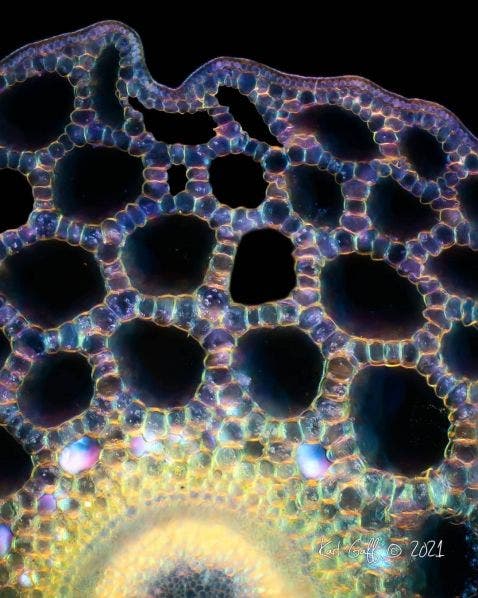
In a less ghostly but equally pretty post, Karl Gaff again manages to capture the microscopic beauty of plant life. This unstained image shows a transverse slice through the stem of the aquatic plant, Hippuris vulgaris, more commonly known as mare’s tail.
Image courtesy of Karl Gaff. Captured using an Evident BX51 (formerly Olympus BX51) microscope with an X Line objective.
We all love water bears, but their adorable appearance may be a facade. These cute little tardigrades are microscopic vampires! Their needle-like stylets in their mouths allow them to drink nutrients from both friend and foe.
Video courtesy of Hunter Hines. Captured with an Evident BX53 (formerly Olympus BX53) microscope.
To see more images like these, be sure to follow us on Instagram at @evidentmicroscopy!
Interested in sharing your own images? Visit our image submission site or submit your image to the 2021 Image of the Year contest.