2014 BioScapes Winners
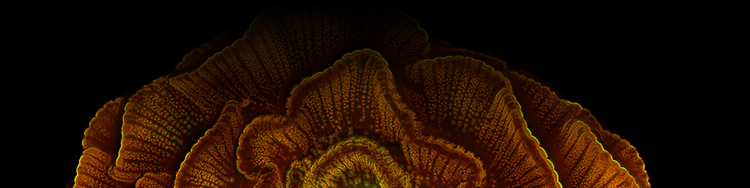
Winner
Dr. William Lemon
HHMI Janelia Research Campus
Ashburn, VA, USA
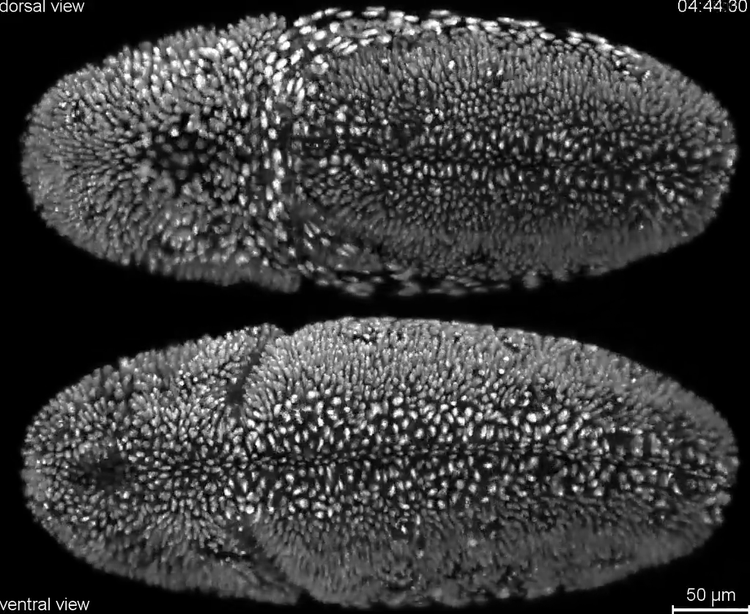
Specimen: Multiple views of Drosophila embryonic development. This embryo was recorded in 30-second intervals over a period of 24 hours, starting three hours after egg laying. The video may help reveal cell lineages, cell differentiation and whole-embryo morphogenesis, essential aspects of developmental biology. The newly hatched larva begins to crawl off screen at the end of the video.
Technique: Custom-built simultaneous multi-view light sheet microscopy
Co-prizewinners: Fernando Amat, and Philipp Keller
Runners Up
2nd Place
Mr. Thomas Deerinck
National Center for Microscopy and Imaging Research, University of California
San Diego, CA, USA
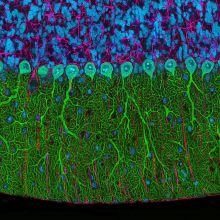
Specimen: Rat brain cerebellum
Technique: Multiphoton photography, 300x
3rd Place
Dr. Igor Siwanowicz
HHMI Janelia Research Campus
Ashburn, VA, USA
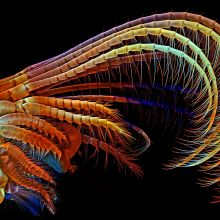
Specimen: Barnacle appendages that sweep plankton and other food into the barnacle's shell for consumption
Technique: Confocal microscopy, 100x
4th Place
Dr. Csaba Pinter
Keszthely, Hungary
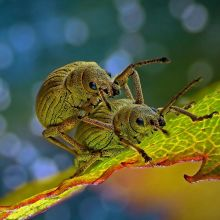
Specimen: Phyllobius roboretanus weevils
Technique: Stereo microscopy
5th Place
Miss Madelyn May
Hanover, NH, USA
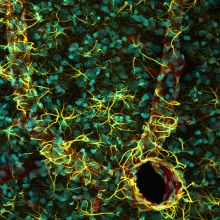
Specimen: Rat brain cerebral cortex depicting cell nuclei (cyan), astrocytes (GFAP, yellow), and blood vessels (EBA, red)
Technique: Confocal microscopy
6th Place
Dr. David Johnston
Southampton General Hospital Biomedical Imaging Unit
Southampton, UK
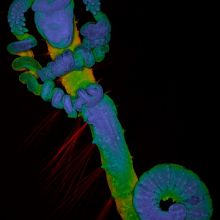
Specimen: Magelonid polychaete worm larva from a plankton sample collected in Southampton Water off the south coast of the UK. Actual specimen size approx 2mm
Technique: Confocal microscopy using a 10x objective
7th Place
Mr. Oleksandr Holovachov
Ekuddsvagen, Sweden
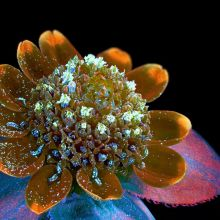
Specimen: Butter daisy (Melampodium divaricatum) flower at 2x magnification
Technique: Fluorescence
8th Place
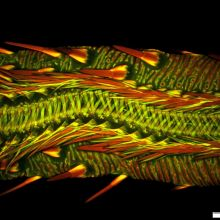
Dr. Matthew S. Lehnert
Kent State University at Stark
North Canton, OH, USA
Specimen: Proboscis (mouthparts) of a vampire moth (Calyptra thalictri). The moth was captured by Jennifer Zaspel in Russia. The proboscis was imaged at 10x and shows the dorsal legulae, tearing hooks, and erectile barbs that facilitate the acquisition of fruit juices and mammalian blood when feeding
Technique: Confocal microscopy
Co-prizewinners: Ashley L. Lash
9th Place
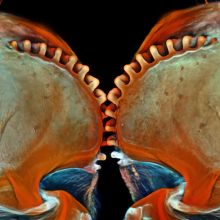
Dr. Igor Siwanowicz
HHMI Janelia Research Campus
Ashburn, VA, USA
Specimen: Green coneheaded planthopper (Acanalonia conica) nymph with its gears. The insects are accomplished jumpers, able to accelerate at staggering 500 times the force of gravity (500xg); to synchronize the movement of their hind legs, their trochanters are coupled with a pair of cogs. Image shows dorsal view of these trochanteral gears. The insect demonstrates that gears, which until recently were thought to be a human invention, exist in the natural world
Technique: Confocal microscopy, magnification ca. 200x
10th Place
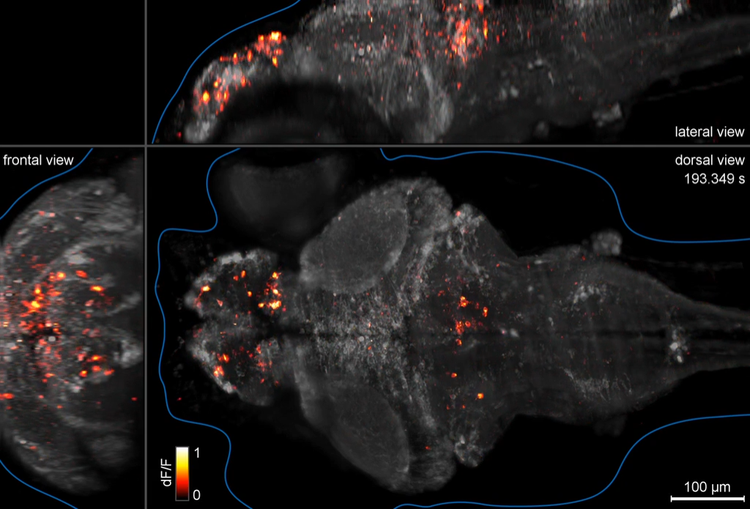
Dr. Philipp Keller
HHMI Janelia Research Campus
Ashburn, VA, USA
Specimen: Neural activity in an entire zebrafish brain in vivo. The video, which shows fast 3D recordings of the entire larval brain (ca. 100,000 neurons), depicts, for the first time, an almost exhaustive view of single-neuron activity in the brain of a living vertebrate
Technique: Custom-built simultaneous multi-view light sheet microscopy
Co-prizewinners: Fernando Amat and Misha Ahrens