
Live Super Resolution Imaging A Line Objectives and IXplore SpinSR
High-Resolution Objectives for Super Resolution
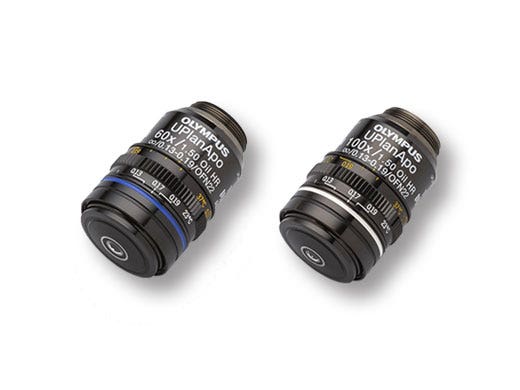
A high numerical aperture (NA) is important for super resolution images.Our proprietary polishing technology enabled us to create the world’s first plan-corrected apochromat objectives with an NA of 1.5*1. Combining this objective with the IXplore SpinSR system improves the brightness and resolution of your super resolution images. The objectives are particularly useful when visualizing surface microstructures.
*1 As of Nov. 2018, According to Olympus research.

Confocal image (left) versus super resolution image captured by UPLAPO100XOHR (right)
Scale bar: 200 nm
Super Resolution
Resolve confocal images using the confocal technique and Olympus super resolution (OSR).
Green: Alexa488 labeled Nup358 which localizes to the cytoplasmic surface of nuclear pore complex
Red: Alexa555 labeled Nup62 which localizes to the nuclear pore complex central plug
Localization of Nup358 and Nup62 can be distinguished by super resolution technique.
*Nuclear pore complex of HeLa cell
Image courtesy of: Hidetaka Kosako, Fujii Memorial Institute of Medical Sciences, Tokushima University
High-Resolution Objectives Selection Guide
(mm)
*2 Maximum field number observable through eyepiece
Silicone Immersion Objectives
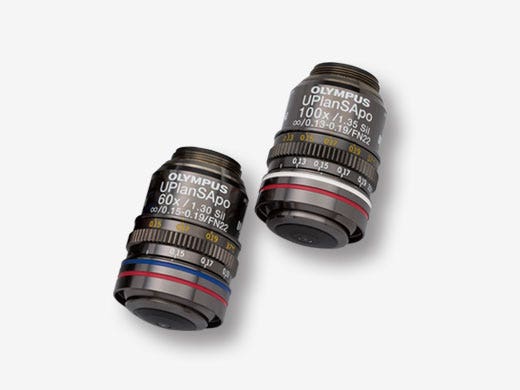
Silicone immersion objectives are optimized for live cell and live tissue imaging. By properly matching the refractive index, images are clearer and brighter, and time−lapse observations become more reliable and less complex because silicone oil does not dry at 37 °C (98.6 °F). With a high numerical aperture and long working distance, these objectives, when combined with Olympus super resolution, enable you to observe microstructures on your sample's surface as well as deep inside it. For example, both molecule localization and nerve cell microstructures can be observed with high resolution.
Related Videos
Image data courtesy of:Yuji Ikegaya, PhDLaboratory of Chemical Pharmacology, Graduate School of Pharmaceutical Sciences, The University of Tokyo
3D Time-Lapse of a Neuron
Obtain detailed three-dimensional super resolution image data during time-lapse imaging.
Sample: A time-lapse image of a mouse’s primary neuron labeled by EGFP after coculture with astrocyte for 3 weeks. 0.2 µm Z-steps for 26 slices.
Silicone Immersion Objectives Selection Guide
(mm)
*3 Maximum field number observable through eyepiece.
Related Products
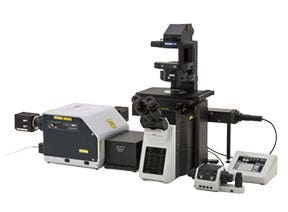
IXplore SpinSR
- Super resolution down to 120 nm XY resolution
- Prolonged cell viability in confocal time-lapse imaging due to less phototoxicity and bleaching
- Switch between widefield, confocal, and super resolution observations in the IXplore SpinSR system in one step
- Accurate 3D reconstruction with Olympus silicone oil immersion objectives
*Banner Image: Fluorescent staining of microtubules (red: Alexa 594) and actin (green: Alexa 488 phalloidin) in growth cone of NG108 cells.
By courtesy of: Dr.Kaoru Katoh , Biomedical Research Institute,National Institute of Advanced Industrial Sciences and Technology