White Paper
The Hidden Cost of Slide Rescanning
How AI Changes Rescan Requirements in Digital Pathology
In clinical pathology, whole slide rescan rates are a significant yet often underestimated operational cost. Many laboratories only discover the true cost of rescans after implementing a digital workflow.
As artificial intelligence (AI) is adopted in pathology, this challenge becomes more pronounced. AI-based analysis may be more sensitive to image quality variation across the whole slide image than traditional spot-check approaches, creating a need for more consistent image quality verification.
Explore this white paper to learn how in-line quality control (QC) and autonomous rescan capabilities can help whole slide images meet diagnostic and analytical requirements earlier in the digital workflow.
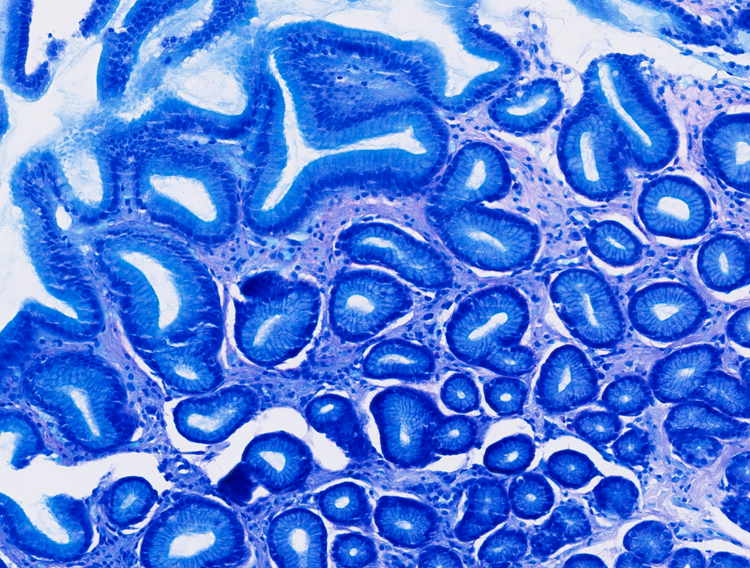
Intestine, Alcian blue stain, 20X
What You’ll Learn in This White Paper
- Why rescan rates continue to rise: Learn how AI adoption can increase the need for rigorous quality verification across whole slide images.
- How conventional scanner workflows create external rescan loops: See how post-scan QC can add workflow steps, manual handling, and delays when quality issues are identified after scanning.
- How in-line QC changes the workflow: Explore how whole slide imaging (WSI) scanners with in-line QC and autonomous rescan capabilities can address image quality during scanning rather than after acquisition.
- The real cost of QC and rescanning: Understand how manual QC, slide retrieval, rescanning, and repeated QC for flagged slides can contribute to labor cost and workflow complexity.
Who Should Read This White Paper
Clinical pathology laboratories, digital pathology teams, laboratory operations leaders, and organizations evaluating or expanding AI-enabled pathology workflows. It may be especially relevant for teams assessing whole slide imaging quality control, rescan rates, scanner throughput, and workflow predictability as AI use increases.
Download the Full White Paper
Get technical insight into how slide rescanning affects digital pathology operations and how in-line QC with autonomous rescans can support more predictable workflows.