White Paper
The Optics Imperative in Digital Pathology
Why Numerical Aperture Matters in Your 40X Imaging Setup
Digital pathology is transforming how tissue specimens are reviewed, shared, and archived. However, within whole slide imaging, optical resolution is a key factor in whether subtle structural variations can be visualized reliably.
Optical resolution is governed by the numerical aperture (NA) of the objective lens—not by stated magnification alone. Although a 20X objective lens paired with a doubler can produce “40X equivalent” magnification, the doubler does not increase the objective lens’s optical resolving power.
Explore this white paper to learn how numerical aperture affects the visualization of fine morphological details and why objective lens selection should be considered alongside scan speed and laboratory throughput when evaluating a whole slide imaging system.
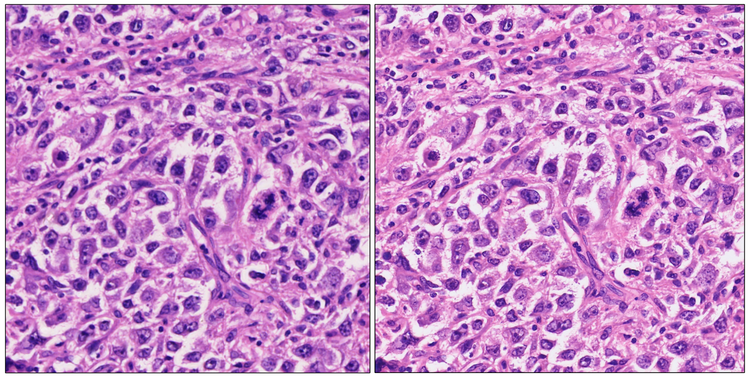
Chromatin texture of tumor cells in carcinoma colon, captured using a 20X doubler (left, 0.80 NA) versus a true 40X scan (right, 0.95 NA). In the true 40X scan, chromatin distribution and nucleoli are more clearly visualized, supporting accurate tumor grading.
What You’ll Learn in This White Paper
- Why numerical aperture matters in digital pathology: Review the relationship between objective-lens NA and the minimum distance at which two structures can be resolved.
- How 40X imaging approaches differ: Compare imaging with a 20X, 0.80 NA objective lens and doubler with imaging using a true 40X, 0.95 NA objective lens.
- What additional magnification can—and cannot—provide: Learn why enlarging an image does not increase its underlying optical resolving power when the objective lens’s NA remains unchanged.
- How optical resolution may affect morphological visualization: Examine image comparisons involving nuclear chromatin, lymphocytes, eosinophils, glomerular basement membranes, and neuropil.
- How image quality and throughput can be addressed together: Explore how high-NA optics and multi-head scanning architectures can support high-resolution imaging while responding to laboratory throughput requirements.
Who Should Read This White Paper
Pathologists, laboratory directors, digital pathology teams, laboratory operations leaders, and organizations evaluating or expanding whole slide imaging workflows. The paper may be especially helpful for teams comparing 40X imaging technologies, assessing objective-lens specifications, or considering how optical resolution affects digital pathology workflows.
Download the Full White Paper
Learn how numerical aperture influences optical resolution in whole slide imaging. See side-by-side examples comparing a 20X objective lens with a doubler and a true 40X objective lens. Explore considerations for selecting an imaging system that balances image-quality requirements with laboratory throughput.