Super-Resolution Microscopes
Imagine seeing fast dynamic processes inside a cell with striking detail down to the nanoscale. With super‑resolution microscopes from Evident, researchers can quickly reveal ultra-small cellular dynamics in 3D samples and live-cell experiments.
Combining fast image acquisition, advanced algorithms, and XY resolution down to 120 nm, Evident super‑resolution microscope systems are designed to reveal fine details at high speed. Whether you need rapid time-lapse imaging for live cells, organoids, or plate screening, these tools open new windows into the unseen. By combining precision optics with optimized workflows, Evident super-resolution microscopes help turn stunning detail into scientific insight.
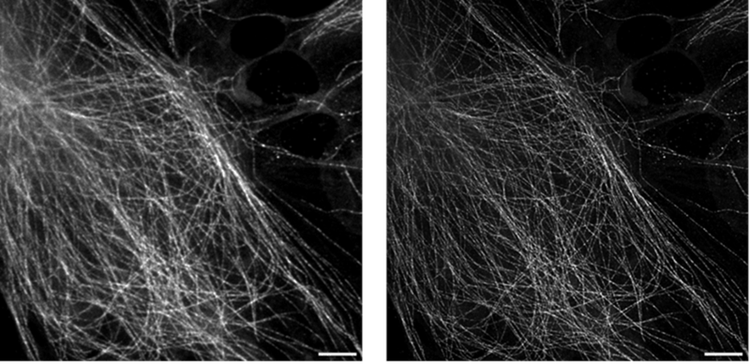
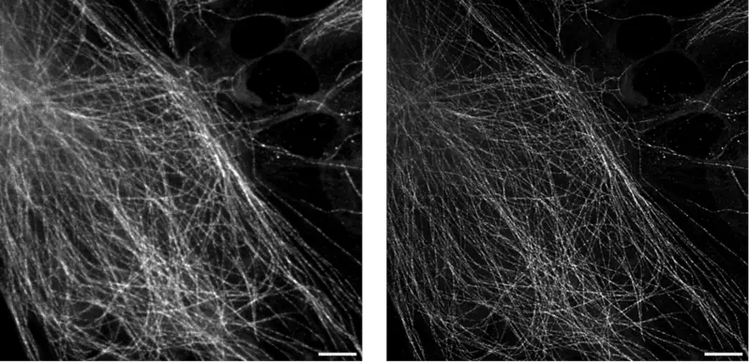
Microtubules of PtK2 cells.
Left: Spinning disk confocal image (digitally enlarged 2.8X) acquired using the IXplore IX85 Spin (50 µm disk).
Right: Super-resolution image acquired using the IXplore IX85 SpinSR (SoRa disk, projection lens: 2.8X).
Objective: UPLXAPO100XO (NA 1.45). Scale bar: 5 µm.
Super-Resolution Microscope Systems
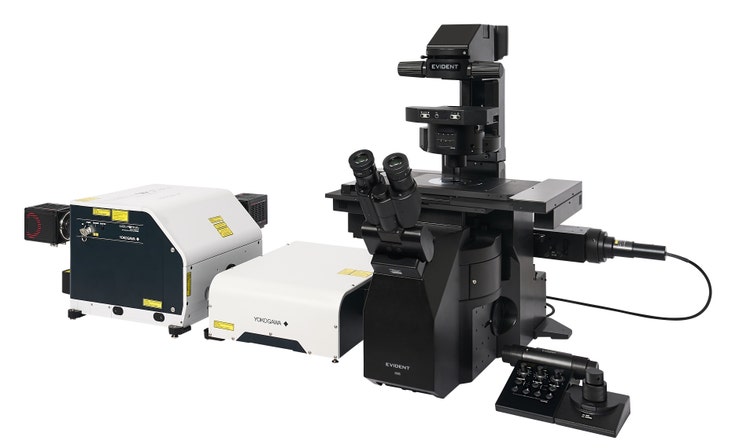
IXplore IX85 SpinSR
Capture ultra-small cellular dynamics in stunning super-resolution detail.
- Discover more with high-speed imaging in resolution down to 120 nm
- Designed for prolonged cell viability in long-term time-lapse experiments
- Powered by Yokogawa spinning disk technology
- Enhanced with the IXplore™ IX85 platform and Evident’s TruSight™ SR super-resolution algorithm
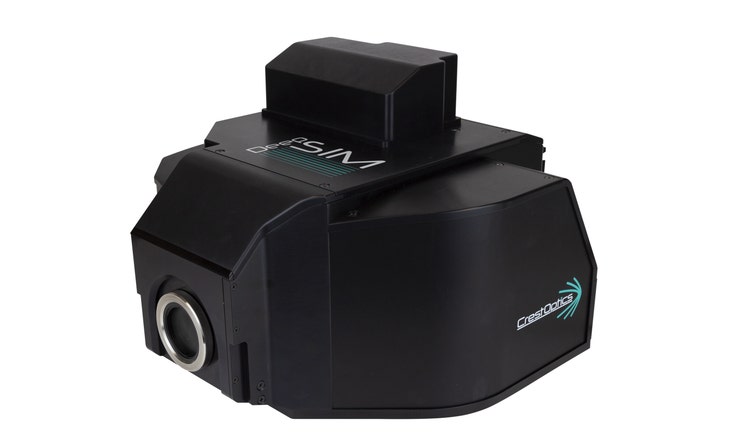
CrestOptics DeepSIM
Structured Illumination Microscopy that answers the deep biological questions effortlessly.
- Resolve fine detail down to 100 nm laterally and 300 nm axially
- Designed for deep imaging; Super-resolve data over 50 μm Z-depth in thick, conventionally prepared samples
- Gentle lattice illumination at over 10 fps for live-cell and time-lapse work
- Powered by 2D Lattice SIM technology, compatible with any upright or inverted frame with a camera port
Super-Resolution Microscopy Resources
The Race to Super-Resolution Microscopy: Is Deconvolution Enough?
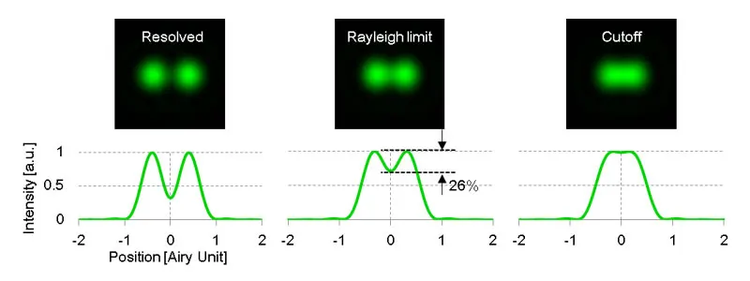
Super-resolution microscopy refers to any optical technique used to view samples at a higher resolution than the diffraction limit of conventional light microscopes. Learn about the limitations of super-resolution microscopes and discover ways to enable super-resolution imaging on your existing microscope system.
How Evident Super Resolution and Spinning Disk Technology Achieves Fast, Deep, and Reliable Live Cell Super Resolution Imaging
Evident Super Resolution (OSR) is the predecessor technology to Evident’s TruSight SR super-resolution algorithm. In this white paper, discover the principles behind OSR technology and the optimized optical design that paved the way for our latest cutting-edge algorithm.
How the TruSight™ SR Algorithm Achieves Super-Resolution Imaging in Confocal Spinning Disk Microscopy
Evident’s TruSight SR algorithm is a novel super-resolution technology evolved from Evident Super Resolution (OSR) and integrated into the IXplore IX85 SpinSR microscope. Read this white paper to learn how TruSight SR contributes to the improvement of microscope image quality.
Super-Resolution Microscopy FAQs
What is super-resolution microscopy used for?
How can I improve my image resolution with Evident's super-resolution microscope solutions?
Since an objective’s resolution is determined by its emission wavelength and numerical aperture (NA), choosing a high NA objective lens is an effective way to improve imaging resolution. Evident X Line™ objectives and our A Line™ HR objective lens have higher numerical apertures.
To improve the resolution during 3D super-resolution of live cells, minimizing spherical aberration due to refractive index mismatch is important. Our A Line silicone oil immersion objectives provide a close refractive index match to that of live cells, enabling brighter and higher resolution 3D imaging with minimal spherical aberration.