Other Compatible LED Light Sources
These compatible LED light sources reduce running costs and feature longer lives and lower power consumption than conventional mercury lamps or metal-halide lamps. For more complex experimental protocols, ensure third-party LED light sources are compatible with cellSens software to improve your experiment efficiency.
Overview
Choosing an LED light source can help reduce running costs as they offer a longer life and lower power consumption than conventional mercury lamps or metal-halide lamps. For complex experimental protocols, third-party LED light sources are available that enable cellSens software to control the amount and wavelength of the light. Ensuring that your light source is compatible with cellSens software can further improve your experiment’s efficiency.
Reduce Running Costs
Compared with conventional mercury or metal-halide lamps, using an LED lamp as your microscope’s light source saves running costs by not only reducing power consumption (by as much as 80%), but also eliminating the need for lamp replacement.
Typical life comparison:
Related Videos
Efficient High-Speed Imaging
LED light sources also improve the efficiency of microscope imaging in terms of speed:
- They can be turned on and off without using a mechanical shutter, facilitating high-speed imaging.
- Models with wavelength control can switch to fluorescent light faster than using filter turret rotation, which is an advantage for high-speed applications such as Ca2+ or ratio imaging.
- Combined with a multiband filter, an LED light source can accelerate multicolor image stitching, improving the efficiency of experiments.
Compatible with cellSens Software
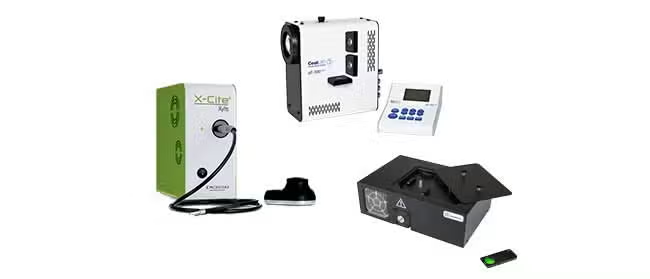
The following LED light sources can be used with Olympus cellSens software:
- Excelitas
- CoolLED
- Lumencor