Application Notes
Measuring the Layer Profiles of Thin-Film Solid-State Lithium-Ion Batteries Manufactured Using the Inkjet Technique

Thin-film solid-state battery
Application
Solid-state lithium-ion batteries are viewed as the next generation of batteries. There are several types of structures for the solid-state lithium-ion battery. While not widely available yet, the thin-film type is close to commercialization and is predicted to be primarily used in mobile equipment and home appliances. Solid-state lithium-ion batteries are expected to replace the lithium-ion batteries currently used due to the many advantages of solid-state batteries, which include:
- Reduced risk of overheating and/or fire
- Higher energy density, which increases charging capacity per weight or volume
- Slow progression of battery degradation
- Ability to operate in a wider range of ambient temperatures
However, there are some obstacles that must be overcome before these batteries can be widely used.
The first issue lays in manufacturing, as the current film deposition methods (such as sputtering and vapor deposition) are too slow to be cost-efficient in mass production. A potential solution is film deposition using inkjet devices, which can control film thickness with high precision.
The second obstacle is the inspection method. Film measurement using a contact-type roughness gage carries the risk of damaging the deposition surface. In addition, the measurement is made difficult by the black electrode materials, which cause the light of the interferometer to be absorbed.
The Evident Solution
The LEXT OLS5000 3D laser scanning microscope can measure the thickness of the deposited film and the surface roughness of formed electrodes and the electrolyte layer of a thin-film solid-state lithium-ion battery.
Product Features
- The OLS5000 microscope can detect a minute amount of reflected light, so data can be easily acquired—even for test objects less likely to reflect light, such as electrode materials.
- Thanks to the noncontact measurement, there is no risk of damaging test objects.
- For roughness measurement, the surface of a test object is scanned using laser light to acquire the planar roughness data. Planar roughness data has more information and more accurate data than line-only roughness data.
- Horizontal stitching of data and measurement across a wider area are available, helping ensure accurate stitched data.
- The stitching function enables measurement of a step between a substrate material and the back part of a negative electrode part.
- When a profile line has minute irregularities, the step can be measured by specifying the area around the point to be measured and using the average height as the height of the point.
Images

Roughness measurement of a positive electrode
The 3D shape data, laser image, and color image are simultaneously displayed, making your analysis more extensive than ever.
(Dummy sample in which lithium cobalt oxide is applied to metal foil using ink-jet coating)

Film thickness measurement of a negative electrode
(Dummy sample in which silicon is applied to metal foil using ink-jet coating)

Roughness measurement of an electrolyte
(Dummy sample in which LATP-system glass ceramic is applied to metal foil using ink-jet coating)
Related products

LEXT OLS5500
Hybrid 3D Optical Profilometer
- Traceable surface measurements from the nanometer to micrometer scale
- Laser scanning microscopy (LSM), white light interferometry (WLI), and focus variation microscopy (FVM) in one award-winning platform
- First 3D optical profilometer to offer guaranteed accuracy and repeatability* for both LSM and WLI measurements
- WLI mode delivers up to 40x faster measurement throughput than conventional LSM
- Exceptional precision across surfaces with in-house engineered optics
- Intuitive interface and smart automation streamline operation for users of all levels
- AI-enhanced and high-throughput workflows with PRECiV™ software integration
*Based on Evident’s internal research as of October 2025. The guaranteed accuracy and repeatability apply only if the device has been calibrated according to the manufacturer’s specifications and is in defect free condition. Calibration must be performed by an Evident technician or an Evident-authorized specialist.
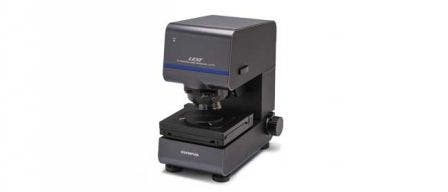
LEXT OLS5100
The LEXT™ OLS5100 laser scanning microscope combines exceptional accuracy and optical performance with smart tools that make the system easy to use. The tasks of precisely measuring shape and surface roughness at the submicron level are fast and efficient, simplifying your workflow and delivering high-quality data you can trust.