Application Notes
Using the Evident LEXT OLS5000 (formerly Olympus LEXT OLS5000) Laser Confocal Microscope to Measure Dross in Laser Cutting Applications
Background
Machining parts by punching and stamping can be problematic because the process typically creates shear droops with smooth surfaces on the punch side and burrs with serrated surfaces on the die side. This makes subsequent machining difficult if the workpiece is thick or if the material is difficult to process, such as stainless steel or titanium. In addition, the speed and accuracy of punching and press machining has remained stagnant. Because of these issues, laser cutting has become increasingly popular. Two advantages of laser cutting are that it works well on a variety of materials and yields high quality finished products. While laser cutting does not produce shear droops or burrs, the heat of the laser sometimes causes material to melt off the workpiece and adhere to the back of the laser-irradiated plane. To help prevent adhesion, molten material is blown off by an assist gas before it cools. In some cases, though, a portion of material is able to re-solidify. This unwanted material is called ‘dross.’ To ensure the accuracy of laser cuts and the quality of finished products, the amount of dross must be carefully measured (Figures 1 and 2).
The Evident solutions
The Evident LEXT 3D laser measuring microscope enables you to make non-contact, highly accurate 3D measurements on workpieces to evaluate the size and shape of dross. The microscope’s high inclination sensitivity makes accurate measurements of dross with complex geometries and steep angles.
Features of the product
The Evident LEXT makes 3D microshape, non-contact measurements. The microscope features ultra-high-resolution measurement capabilities with a high pixel density to ensure accuracy. The LEXT’s high inclination sensitivity is excellent for making accurate measurements of complex and steep-sided dross.
Image


Figure 1: High-resolution image of incoming laser side of a workpiece and associated measurements


Figure 2: High resolution image of outgoing laser side of a workpiece and associated measurements showing dross
Related Products
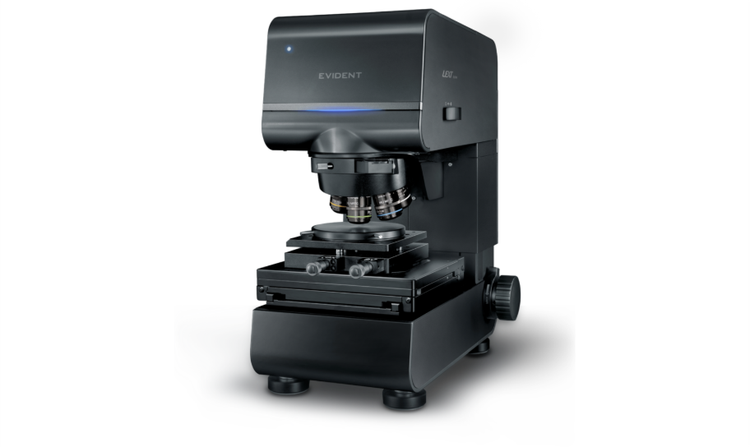
LEXT OLS5500
Hybrid 3D Optical Profilometer
- Traceable surface measurements from the nanometer to micrometer scale
- Laser scanning microscopy (LSM), white light interferometry (WLI), and focus variation microscopy (FVM) in one award-winning platform
- First 3D optical profilometer to offer guaranteed accuracy and repeatability* for both LSM and WLI measurements
- WLI mode delivers up to 40x faster measurement throughput than conventional LSM
- Exceptional precision across surfaces with in-house engineered optics
- Intuitive interface and smart automation streamline operation for users of all levels
- AI-enhanced and high-throughput workflows with PRECiV™ software integration
*Based on Evident’s internal research as of October 2025. The guaranteed accuracy and repeatability apply only if the device has been calibrated according to the manufacturer’s specifications and is in defect free condition. Calibration must be performed by an Evident technician or an Evident-authorized specialist.
LEXT OLS5100
The LEXT™ OLS5100 laser scanning microscope combines exceptional accuracy and optical performance with smart tools that make the system easy to use. The tasks of precisely measuring shape and surface roughness at the submicron level are fast and efficient, simplifying your workflow and delivering high-quality data you can trust.