Filming the Frozen World of Plankton from Pole to Pole: An Unforgettable Voyage
Image courtesy of National Geographic.
What do the North Pole, microscopes, and Will Smith all have in common?
A collaboration that brings together science and filmmaking in one of the most extreme environments on Earth.
Invited by producer Nutopia, independent filmmaker and photographer Jan van IJken joined forces with Evident to film Arctic microscopic plankton for the new National Geographic and Disney+ series, Pole to Pole with Will Smith. Jan joined renowned scientist Dr. Allison Fong aboard a one-of-a-kind icebreaker on a journey from Svalbard to the geographical North Pole.
In a project of this nature, the challenge isn’t just capturing a video or image—it’s capturing usable data in extreme conditions, from constant vibrations to subzero temperatures.
Evident microscopy expert Udo Steininger worked closely with Jan to select, prepare, and optimize the imaging equipment for this incredible voyage. We spoke with Jan and Udo to learn more about how they adapted their imaging approach from initial equipment setup to final image capture.
Welcome Jan! Could you start by telling us about your background and how you became involved in microscopy?
Jan: I've been working as a photographer since around 1996, and I started filmmaking about 15 years ago. I made a few short films. My first microscopic film was called Becoming, a story about the embryonic development of a salamander in its egg. I had a vision to capture the genesis of life, but this was a very complicated idea, so I joined the Dutch microscopy club, where I learned a lot about basic techniques and how to develop my own. My desire is to capture the mysterious secrets of nature and its beauty. This really interests me and drives my projects, like my latest work with plankton called Planktonium.
How did this microscopy work lead to your project in the Pole to Pole documentary series?
Jan: After finishing my film and photobook Planktonium about the hidden world of microscopic plankton, I was approached by Nutopia, who came across my film and wanted my advice and thoughts about how they could film at the North Pole. The idea was to capture footage of Arctic plankton to feature in their newest series called Pole to Pole with Will Smith.
Nutopia invited me to film the plankton and join this expedition as part of the project. I traveled with the team for two weeks to the geographic North Pole and back. I did all my filming for the project in a lab aboard the ship, surrounded by other scientists who were working on their own projects. Udo from Evident helped me select and prepare all the microscopy equipment that I needed to take with me to set up in the lab.
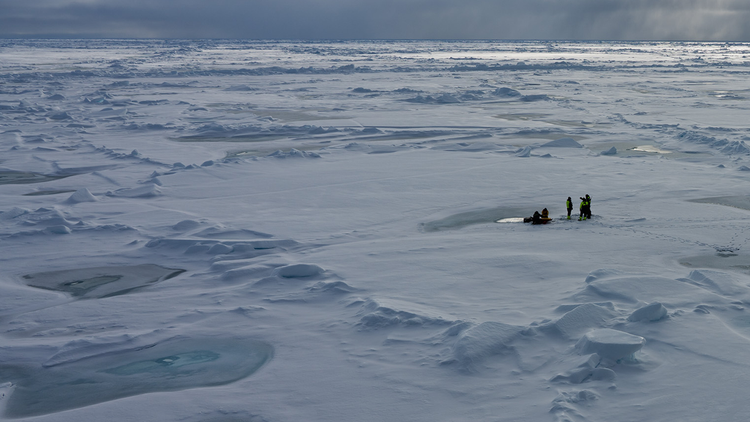
The North Pole. Image courtesy of Jan van IJken.
The Pole to Pole with Will Smith show being filmed by the crew was presented by Will Smith, who was onboard, along with scientist Dr Allison Fong. Allison was incredible. She’s an expert on the Arctic, and she knows a lot about plankton. I learned a lot from her. Oliver Müller was assisting Allison. They had done expeditions together before, so he was also able to assist me in my microscopic work and help with sampling. Oliver was also my roommate on the ship. It was amazing to work with them both!
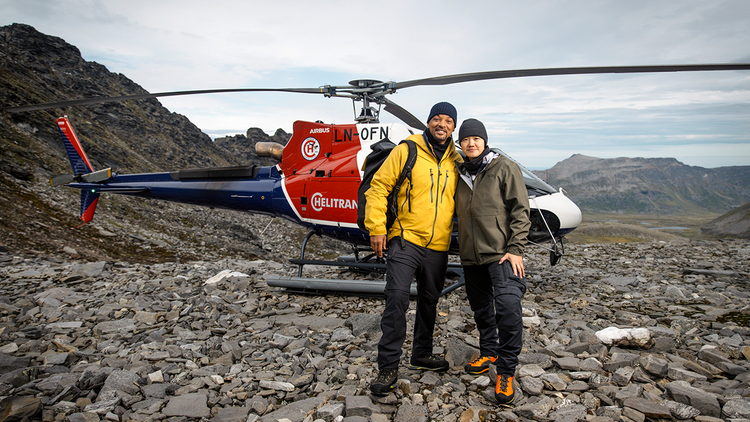
Will Smith (left) and Dr. Allison Fong (right) during their expedition to the North Pole. Image courtesy of National Geographic/Freddie Claire.
How did Evident help you prepare for this project with the constantly changing environmental conditions?
Jan: It took months of discussion and preparation, sharing my ideas and approach, including the possible difficulties we might face while filming. We knew beforehand that filming on an icebreaker would not be easy. Our main concerns were the vibrations from the ship’s engines and the larger vibrations from the ice breaking.
Udo Steininger from Evident was an incredible help. He was amazing to work with, so helpful, and I'm so grateful. I worked with him to choose two beautiful microscopes: the SZX16 stereo microscope and the BX53 fluorescence microscope.
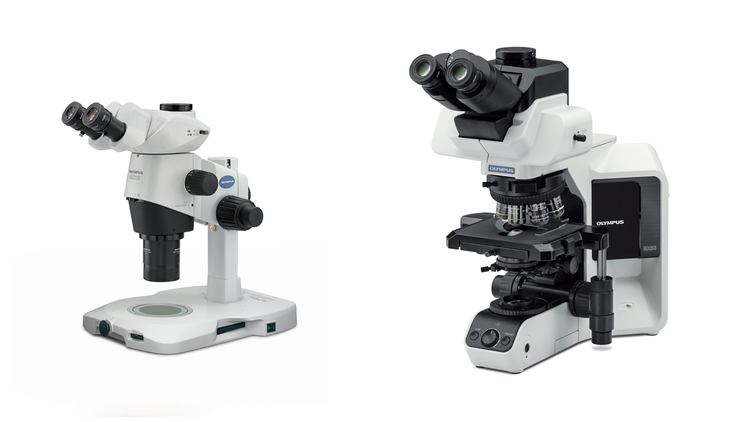
Left: To perform initial sample screening and filming of larger organisms, Jan relied on the SZX16 stereo microscope. Its mechanical stability and ease of use made it a reliable solution for the onboard lab. Right: To film smaller specimens and capture finer details, Jan switched to the BX53 upright microscope. Its stable illumination and robust optical alignment supported consistent imaging performance.
Udo also helped with choosing lenses and adapting my camera to the microscope with a special photo adapter. The microscopes were equipped with everything I needed. I even had a training day at Evident’s headquarters in Hamburg with all the equipment to prepare. It was really amazing!
Udo also conducted extensive research into anti-vibration tables and coordinated with the Nutopia team. He was available for anything I needed help with. I had some challenges when I arrived at the laboratory, but I called Udo, and he helped me resolve them. I'm really happy about the support I received.
Udo, what was your strategy to negate the vibrations?
Udo: We knew that they would need to film while the engine was running, and we knew we could cut those smaller vibrations out with either an active table or passive table. Of course, there were also constraints on size and weight since the table needed to go on a small airplane, a dinghy, and then be assembled on location without the help of a professional.
I researched many options and coordinated with Nutopia and Allison about which one we could bring. In the end, we took a passive table, but we knew that we couldn't avoid the big vibrations and bumps from the ice breaking. It was interesting, because it’s rare for someone to go out on an icebreaker to perform microscopy.
Jan, how did you overcome filming challenges caused by vibrations?
Jan: The table Udo arranged was a great solution to the ship’s engine and general vibrations. We placed all the microscopes (including two of my own) on it aboard the ship, which meant I could film while the engine was running.
But as we expected, the table wasn’t enough to counter the icebreaking. However, directly above me in the ship’s lab was a screen connected to a webcam at front of the ship. I hadn’t expected to see so many channels through the ice that the ship navigated to avoid breaking as much ice as possible. Using this screen, I could identify when the water was clear enough for filming and, in the meantime, prepare my samples from the freezer for the microscope.
How did you use the two Evident microscopes to film the plankton and other specimens?
Jan: I always use the SZX16 stereo microscope for an initial look at the samples to identify what's interesting to investigate. Then I prepare the samples for the BX53 microscope to film or take time-lapse images.
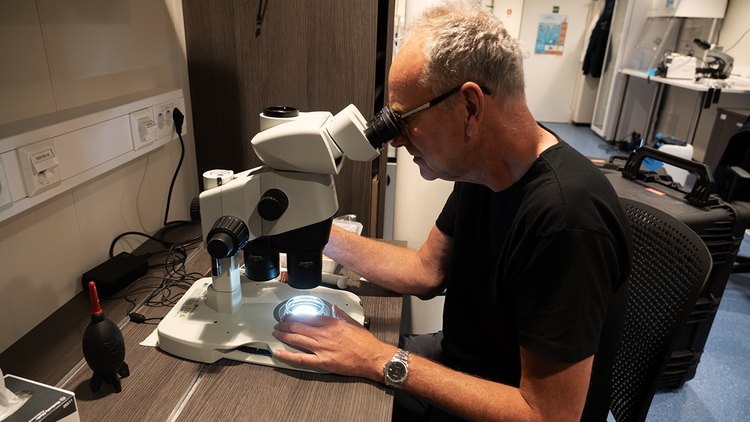
To quickly scan and identify interesting samples in a constantly changing environment, Jan relied on the SZX16 stereo microscope for its optical clarity and ultra-wide zoom range. Image courtesy of Jan van IJken.
I also used the stereo microscope for larger organisms that are too large for the transmitted light microscope. For these, I found the stereo microscope incredible. The picture quality is exceptional. For example, the stereo microscope was particularly effective for filming organisms such as brown sea slugs.
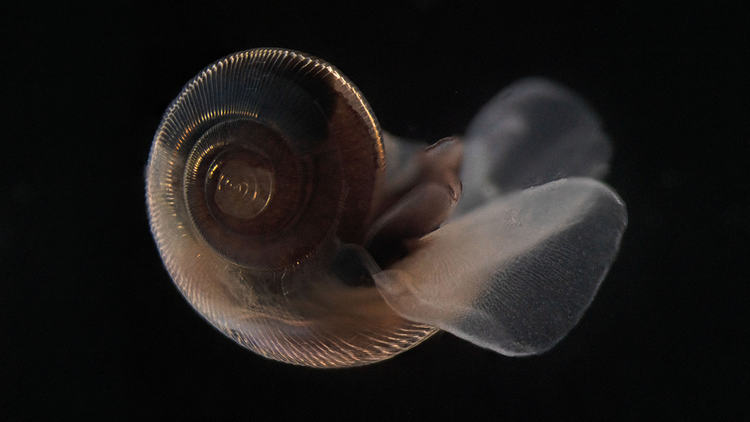
Sea slug from the High Arctic under a microscope. Image courtesy of Jan van IJken.
I used the BX53 microscope for the filming of the algae and smaller zooplankton. It was nice to have two microscopes so I could take time lapses and video at the same time. For some organisms like diatoms, I wanted to show their movement. The only way to do that is with a time lapse, where you take a lot of photos, and then put them together in a clip to show the movement.
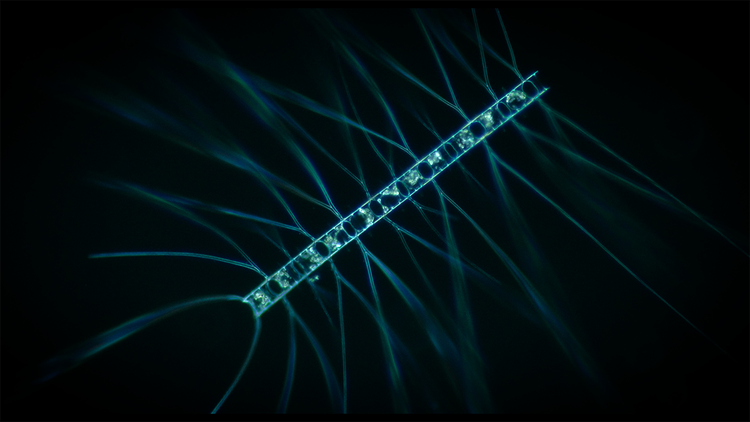
Phytoplankton samples from the High Arctic under a microscope. Image courtesy of National Geographic/Jan van IJken.
Do you have a favorite microscope feature?
Jan: For me, the best feature that I was mainly using was darkfield. I use this to create consistency in the background, which is really important to keep the same across my shots. Darkfield gives a lot of beautiful contrast to the specimens. I got amazingly brilliant images, and the BX53 was an amazing microscope for this.
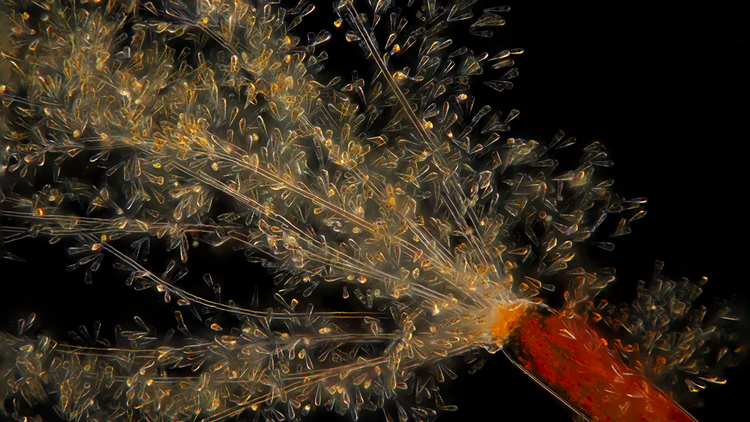
Phytoplankton samples from the High Arctic under a microscope. Image courtesy of National Geographic/Jan van IJken.
How did you collect your samples in such a harsh environment?
Jan: I brought my own small nets that I always use for collecting plankton. Allison and Oliver also had bigger nets, and they both helped me a lot. While on the ship, I took samples from deck five, which was the helicopter deck, by throwing out my long line. We had to be careful because the engines were rotating and churning the water and ice, so we coordinated with the vessel’s Science Officer Daniel Cron, who would ask the captain to either stop the engines or change the rotation direction so that we could sample.
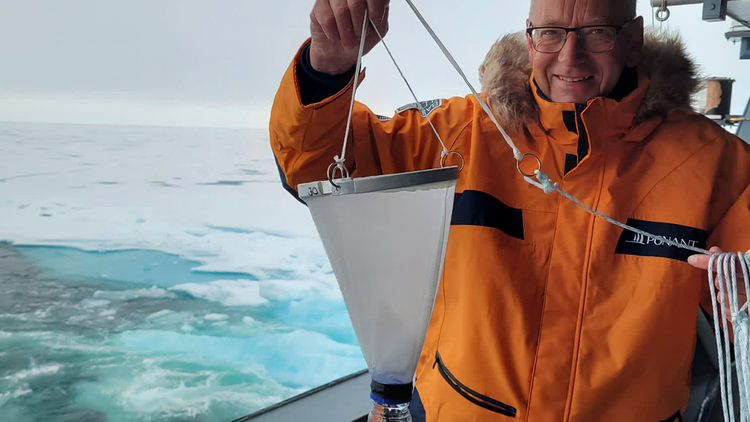
Jan holds a net to collect plankton. Image courtesy of Jan van IJken.
We also stopped at Magdalena Bay in northwest Spitsbergen to explore. Here we went with Daniel in our own scientific dinghy to do scientific sampling and collect plankton. Right from the dinghy! It was great that the ship was so well equipped for that. It was such an experience, and I’m very thankful to Daniel and his colleagues. He did an amazing job and helped us so much.
What did you find most exciting or amazing about this project?
Jan: One of the most exciting moments was when we arrived at the geographical North Pole after one week of traveling. While they were filming with Will Smith, I went out on an expedition to the North Pole so that Allison and Oliver could take ice cores for their scientific research. When Allison made the hole in the ice, I could take samples directly at the North Pole, which was amazing. It was such an incredible moment.
While there wasn't much plankton at the North Pole, the plankton that I found were very special. They were very large and had these red antennae, which was new for me to see. Back toward Svalbard, the plankton are richer and have a little bit more variation in species, like copepods, for example, that you find everywhere in the world.
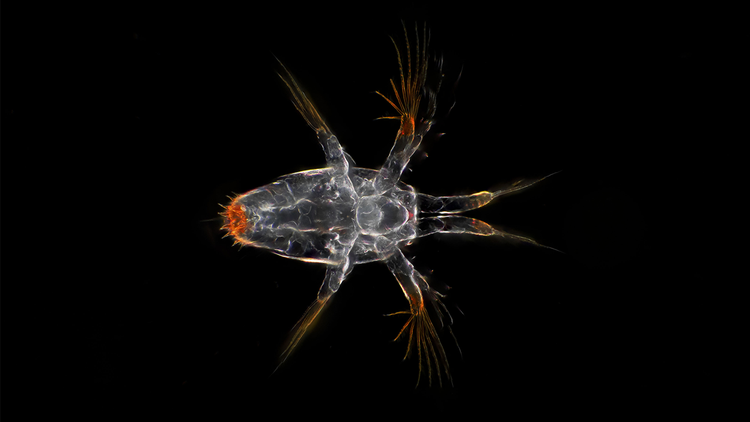
Copepod larva from the High Arctic under a microscope. Image courtesy of Jan van IJken.
Udo, what did you enjoy about assisting with this project?
Udo: One thing that I found amazing was testing the camera adapter at our Hamburg office. Since Jan wasn’t using a standard microscope camera, we didn’t have any parts in our portfolio to fit it to the microscope.
I knew a small manufacturer who makes a custom adapter, but as these are expensive, I had never tested one. It was a great opportunity to see the adapter in action. We compared it to Jan’s old adapter and to my personal DIY adapter made from telescope parts. The results were night and day. The custom adapter provided so much clarity and sharpness. It was awesome, and that confirmed it as the perfect pick for the expedition.
Another thing that I found interesting was how Jan approached things from an artistic viewpoint. For example, as a scientist myself, I’m always thinking about what contrast method will give me the highest detail or resolution. Which for semitransparent water organisms is usually DIC. But for Jan, the consistency in the background was much more important, which is something I would not have thought of.
Jan, would you like to share anything else about your overall experience?
Jan: It was the most incredible journey and assignment I have ever experienced. The amazing views of the changing landscape and the polar light on the ice were so beautiful.
The ship even had a theater, where twice we gave scientific presentations to the passengers. We could share our work with them and the other scientists, and I showed some of my pictures. They found it very interesting, and it was nice to have this integration between the passengers and the scientists. They could also learn about the environment and nature and even visit the labs where we were working.
Normally, I would have to take care of all the arrangements for a project, so being part of this team with Nutopia and Evident was really great. Everyone was so helpful with arranging everything!
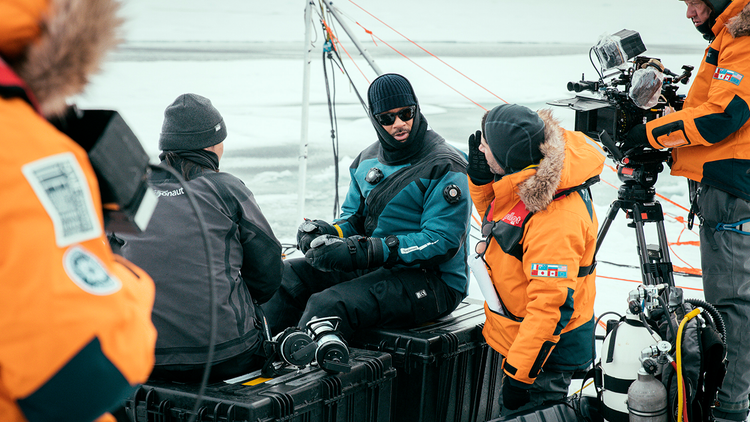
Will Smith prepares to dive under the ice with Dr. Allison Fong to collect samples in the waters of the North Pole. Image courtesy of National Geographic/Freddie Claire.
Working with the amazing film team, doing the thing I love most—filming, photography, working with plankton, and working with scientists and getting all the help I needed, was a dream come true. Being around all these camera operators, drone operators, and scientists like Allison, a real expert in the ice, I learned so much. It was incredible and unforgettable.
Featured Products
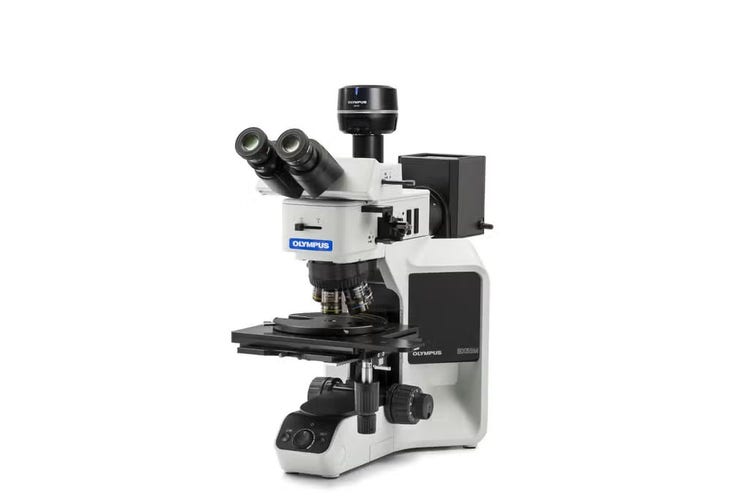
BX53
- High-luminosity True Color LED illumination
- Modular concept enables individual components to be motorized
- Easily acquire multi-color fluorescence images
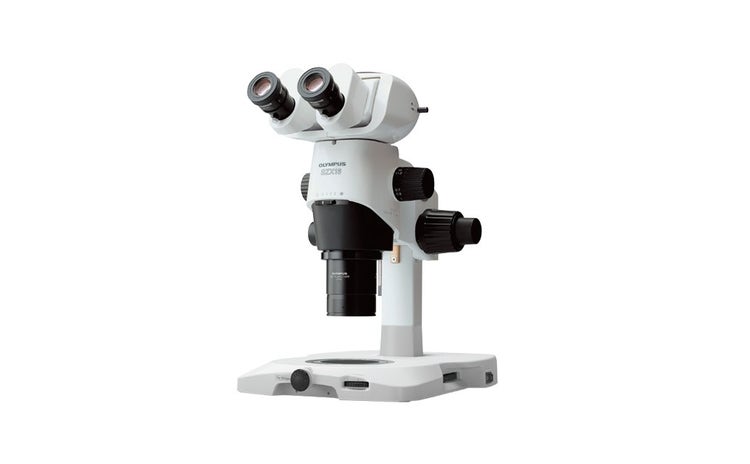
SZX16
Research Stereo Microscope System
Image macro views of whole organisms to micro views of individual cell structures using the SZX16 research stereomicroscope. Its wide zoom ratio (16.4:1) enables magnifications of 7x–115x with a 1X objective and up to 230x with a 2X objective. Clearly observe fine details owing to the apochromatic optics, reducing chromatic blur for the entire magnification range, and its 0.3 numerical aperture (NA), providing a high 900 line pairs per mm resolution.
- Advanced model offering darkfield, brightfield polarization, oblique, and advanced fluorescence observation
- Ergonomically designed and provides ample space for manual and automated manipulation and injection tools
- 2 energy-efficient, long-life LED transmitted light illumination base options