An Introduction to Technical Cleanliness Inspection


Last updated on October 2, 2026.
Component cleanliness is an integral part of industrial manufacturing processes
The cleanliness of components and parts is at the center of most industrial manufacturing processes, as these components must be free of contaminants to help ensure a high-quality finished product. Technical cleanliness inspection involves quality control, process management, and manufacturing departments taking samples from the production line and utilizing particle extraction through filter membranes to quantify contaminants that may impact the performance, lifetime, and reliability of final products.
What are the basics of technical cleanliness?
The growing complexity of today's technical products, especially within the aerospace, automotive, heavy equipment, and electrical engineering industries, has resulted in an increasingly high demand for product reliability and quality assurance. The durability and lifecycle of a finished product depend on a number of characteristics, all of which contribute to its measurable technical cleanliness:
- Quality and characteristics of the product material
- Fitting tolerances
- Overall cleanliness of a surface or particle load
How does technical cleanliness affect a product's reliability?
Product contamination, which usually occurs during manufacturing but can also be the result of storage, cleaning, or handling, has a direct influence on a finished product's reliability and its lifespan. The dangers of unclean surfaces or production liquids can range from function loss to product failure to complete breakdown.
Residues on the surface of technical devices and parts can cause unreliable and/or poor device performance; the presence of particle residue in manufacturing processes can cause downtime in production, reduced lead times, the waste of materials and energy, and returned product. Large residue particles (sometimes called "killer particles") may cause complete function loss. With the ever-decreasing size of system components, smaller residue particles can also cause catastrophic failures and lead to the breakdown of an entire end product.
In what industries is technical cleanliness the most important?
Technical cleanliness inspection applications include ABS systems, diesel injectors, brake calipers, hydraulic fluid systems, tubing, PCBs, interconnects, and large heavy machinery components. Here are a few basic illustrations of the importance of technical cleanliness in relation to specific industries:
- Heavy Machinery: Because the very large parts that make up a lot of heavy machinery can be difficult to reach and directly inspect, the inspection of these products can become very costly. Therefore, it is more cost- and time-effective to inspect used oil for particles rather than inspect the machine itself. The status of the oil is an accurate indication of the condition of a machine.
- Electrical Engineering: If there are particles on an interconnect during the production process, that is an indication that they have not been properly built. The detection of these particles, and subsequent eradication, is a good way to avoid short circuits on printed circuit boards (PCBs).
- Automotive: Within the automotive industry, many intricate systems and parts need to be free from contaminants. These may include ABS systems, fuel injectors, brake calipers, and hydraulic fluid systems.
What is the technical cleanliness inspection process?
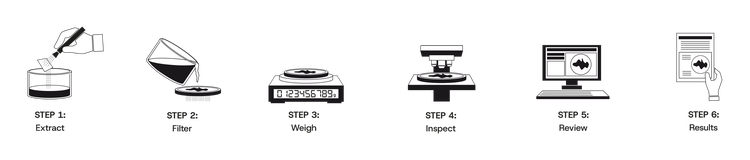
Technical cleanliness inspection is an involved process that includes a number of preparation and inspection steps. The following is an overview of this process:
Preparation
Preparing components for inspection includes the following steps:
- Parts Washing: Preparation begins when a sample of parts is pulled off the production line and washed prior to extraction.
- Extraction: Particles are removed from the components being tested in an extraction cabinet located in a clean room. Particles can be removed by flood, squirt, rinse, or ultrasonic bath.
- Filtration: The extraction rinse is filtered, and the extracted particles are collected on a membrane filter (filter materials include cellulose, polyester, glass fiber, and nylon mesh).
- Drying and Weighing: The membrane filter is dried and ready for further analysis. The dried filter, with all impurities on it, is then weighed using an analytical balance.
Inspection
The inspection process includes the following steps:
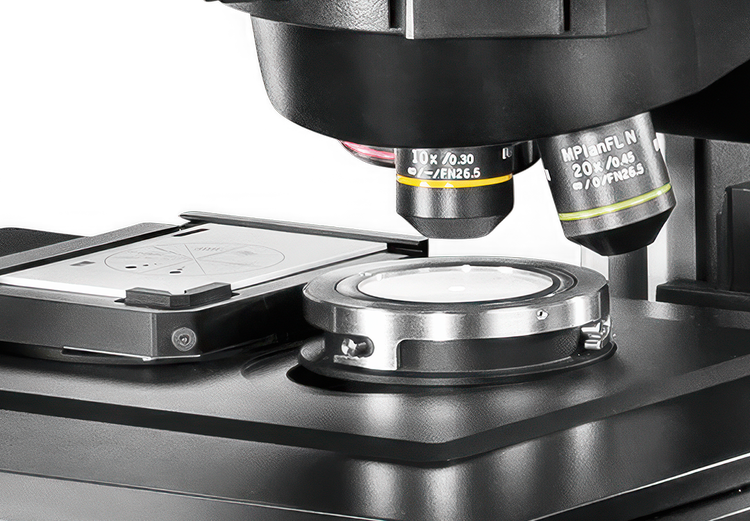
- Image Acquisition and Stage Movement: The dried membrane filter is mounted on a motorized microscope stage so that the images needed for inspection can be acquired.
- Particle Detection: Membrane filter images are examined for particles, which appear as dark areas against a bright background.
- Particle Size Measurement: Detected particles are measured according to different parameters, including Maximum Feret and Equivalent Circle diameter.
- Particle Size Classification: Once particles have been measured, they are grouped into different size classes. The two major size classes are differential (defined by a minimum and maximum size) and cumulative (defined only by a minimum particle size).
- Particle Count Extrapolation: A defined area on the membrane filter is scanned and checked for particles. These areas may include filter size (the total area of the filter), flow-through area (the filter area covered with particles), maximum scan area (the maximum possible area to be scanned for inspection), and inspection area (the actual scan area defined by the user).
- Particle Count Normalization: The extrapolated particle count is normalized to the comparison value, enabling the comparison of multiple measurements. Normalization methods include washed area (particle count is normalized on a 1000 cm 2 area), washed volume (particle count is normalized on a 100 cm 3 area), washed parts (particle count is normalized on a single sample part), and filtered fluid (particle count is normalized on a filtered fluid of 1 ml or 100 ml).
- Contamination Level Calculation: This level of classification is determined not by particle size but by the total number of particles in a defined contamination class (classes are defined for most international standards).
- Cleanliness Code Definition: Some standards reduce the representation of measured data to a brief description. This Cleanliness Code is defined by the standard and is composed of particle size classes and contamination levels.
- Maximum Approval Check: Checking for a maximum approval value is an optional step. If a maximum value is required, it is specified in the inspection configuration and may be an absolute number of particles or a maximum Cleanliness Code.
- Separation of Reflective and Non-Reflective Particles: The distinction between metallic and nonmetallic particles is made by determining whether particles reflect light or not (extremely important as metallic particles stand to cause much greater harm than nonmetallic particles).
- Fiber Identification: Fibers detected on the membrane filter often have a different origin (i.e., work clothes or rags) than the other particles found on the filter. As a result, fibers must be recognized and analyzed or disregarded depending on the standard being used to assess the cleanliness examination.
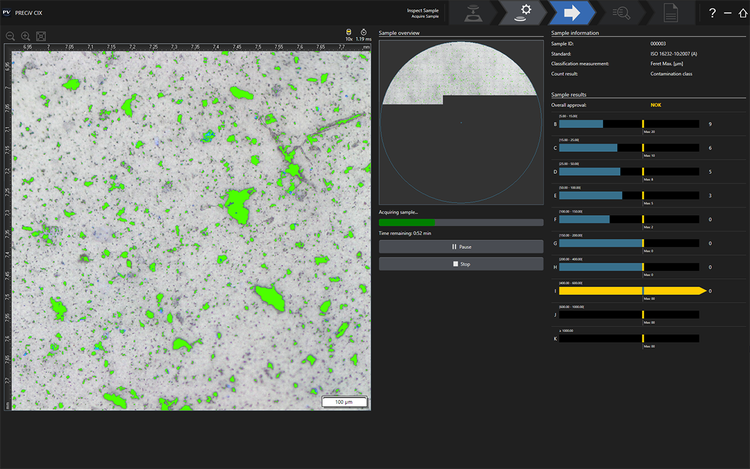
- Results Review: The following operations are possible as part of this review: the deletion of items incorrectly identified as particles; the splitting of particles located close together and incorrectly identified as a single large particle; the merging of particle segments located close together and incorrectly identified as separate particles; the correction of incorrect particle labels (i.e., metallic vs. nonmetallic).
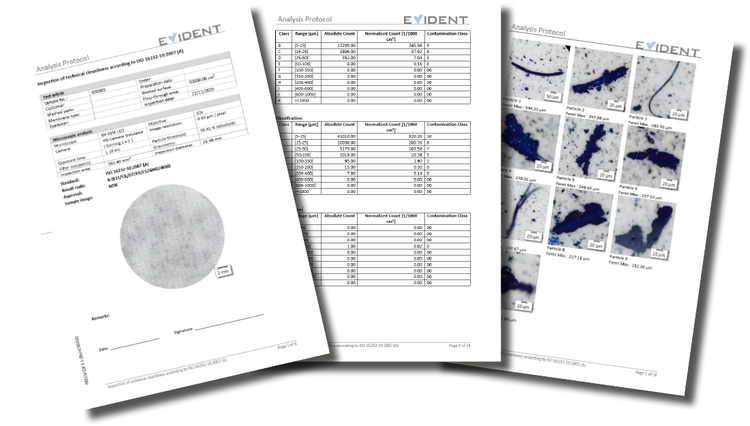
- Report Creation: A technical cleanliness inspection report may include the description of certain particle acquisition parameters, particle classification tables, particle area coverage details, and images of the largest particles. The contaminants are analyzed in accordance with international standards such as ISO 16232 (VDA 19.1) and ISO 4407.
What kind of system is required to conduct a technical cleanliness inspection?
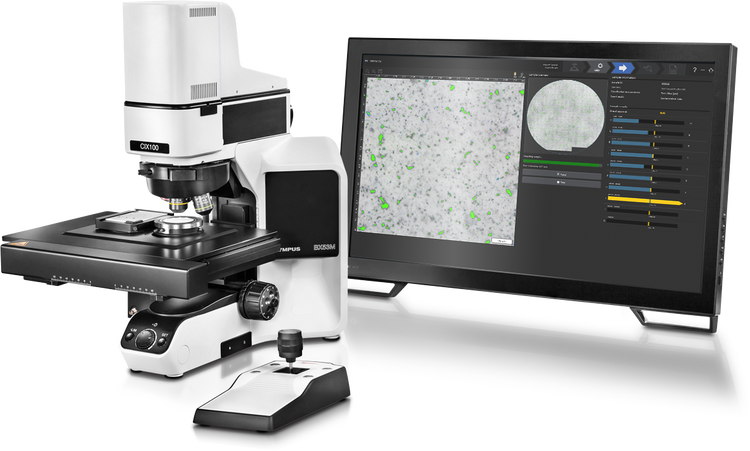
Technical cleanliness inspection presents a number of challenges, including the need to check results during inspection, view reflective and non-reflective particles at the same time, inspect multiple samples on a daily basis, revise and recalculate results based on different standards, and share results in compliance reports.
Designed specifically to address these challenges, the CIX100 inspection system is a dedicated, turnkey solution for manufacturers that need to maintain high quality standards for the cleanliness of manufactured components.
The automated system makes it easy for users of all levels to quickly acquire, process, and document technical cleanliness inspection data in compliance with company and international standards. It is intuitively designed to guide users through each step of the process so that even novice inspectors can acquire important cleanliness data easily. High-end optical components, seamless integration of hardware and software, and a robust, low-maintenance design help ensure reproducible imaging conditions and make cleanliness inspection a routine task.
To learn more about automated cleanliness analysis, reach out to our team of microscopy specialists for a demonstration or more information.
Featured Products
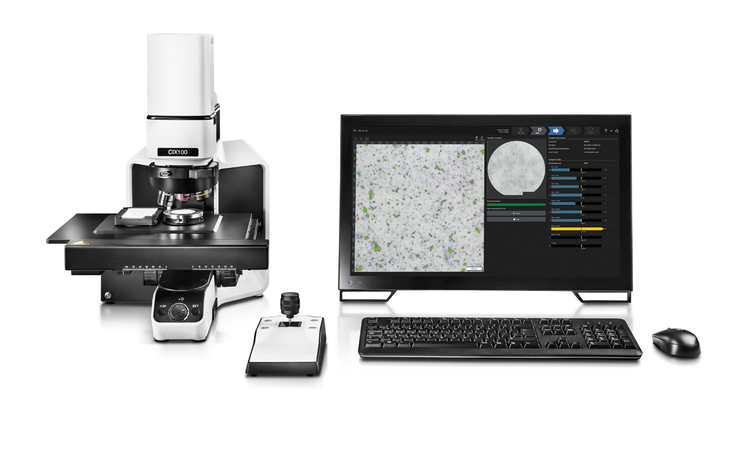
CIX100
The CIX100 inspection system supports fast, reliable technical cleanliness analysis for manufacturers with high quality standards. Designed for efficient acquisition, processing, and documentation of cleanliness data, it helps ensure compliance with company and international requirements. Paired with PRECiV™ CIX software, the system delivers guided workflows, industry-leading speed for high-throughput labs, and one-click, compliant results customizable to standards such as ISO 16232 and VDA 19—enabling even novice users to work quickly and confidently.