Scaling Microphysiological System Adoption in Drug Discovery: From Lab to Industry
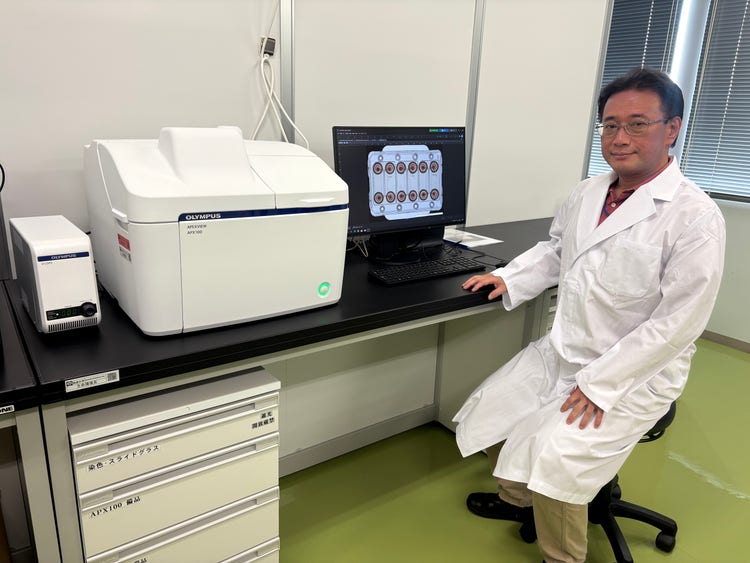

Insights from Dr. Yuzuru Ito on pioneering practical microphysiological systems for drug discovery applications
Microphysiological systems (MPS), tiny models that replicate human physiological functions, are gaining global attention as a promising alternative to animal testing in drug discovery research.
However, widespread adoption has been constrained by variability and a lack of standardized, scalable workflows.
Professor Yuzuru Ito of the University of Tsukuba is working to overcome these limitations by pioneering practical and accessible MPS platforms for pharmaceutical companies. He shares insights into the challenges of adopting these systems in drug development and how microscope imaging plays a critical role in advancing their use.
About Dr. Yuzuru Ito
Dr. Yuzuru Ito is a professor in the Faculty of Life and Environmental Sciences at the University of Tsukuba, Japan. He was appointed in November 2020 and is conducting research on various joint projects focused on the societal implementation of foundational technologies for regenerative medicine and drug discovery support technologies. He is also the lead researcher for an AMED (Japan Agency for Medical Research and Development) project titled "Proof-of-Concept for a Japanese-Made MPS-Based Drug Discovery Platform based on Commercialization Strategy," and an expert at the International Organization for Standardization (ISO). He plays a central role in promoting MPS research both in Japan and around the world.
What is your current research focus?
Dr. Ito: I'm focusing on proposing specific applications to enable the societal implementation of MPS. For these systems to be practical, they must be robust, meaning they operate consistently in a user environment, such as a pharmaceutical company's research department. Additionally, providing highly reproducible protocols is a critical prerequisite for societal implementation, as well as offering clear application proposals that make users want to try the system. To achieve this, we are pursuing the flexibility to accommodate diverse human cell models and applications, with the goal of establishing a highly practical evaluation system.
For example, our lab has developed an intestinal MPS where we seed human iPS cell-derived small intestinal epithelial cells onto the Fluid3D-X from Tokyo Ohka Kogyo Co., Ltd. This model closely mimics human intestinal physiology in terms of drug transporter and metabolic enzyme expression and shows high reproducibility in mimicking drug absorption in humans. Another key feature is its ability to flexibly set culture conditions. It has two channels, an upper one for the intestinal lumen and a lower one for blood vessels, separated by a porous membrane.
Could you elaborate on how the small intestinal epithelial cell MPS is being used?
Dr. Ito: In the early stages of drug discovery, it is crucial to accurately evaluate the absorption and metabolic properties of candidate compounds. However, traditional Caco-2 cells1 and animal models make it difficult to accurately predict drug absorption in the human intestine due to differences in enzyme expression patterns and species-specific variations. The significant differences in the expression patterns of metabolic enzymes and drug transporters, in particular, pose a risk of misjudging in vivo human behavior.
To address this, we aimed to build a new platform that combines small intestinal epithelial cells—a cell model that is more representative of human physiology—with MPS technology to enable high-precision evaluation of absorption and metabolism. As a result, Fluid3D-X has been shown to be a promising in-vitro model that can mimic human intestinal absorption, as its drug transporter function and metabolic enzyme activity have been confirmed. We believe this system can be used as a practical evaluation method for screening candidate compounds and conducting pharmacokinetic research in early-stage drug discovery.
1 Caco-2 cells: A cell line derived from a human colon carcinoma. When cultured, these cells form a monolayer resembling small intestinal epithelial cells. They are widely used as in vitro models for intestinal absorption, particularly in pharmacokinetic and food component research.
Why is advanced imaging essential in MPS development?
Dr. Ito: In the development and evaluation of MPS, imaging lets you visualize the structures and conditions that cannot be conveyed through text-based protocols alone, significantly contributing to the establishment of robustness.
MPS come in a variety of shapes depending on their application, which can make it complicated to identify the correct observation position and adjust imaging conditions. In our research, we recreated liquid-liquid and air-liquid interfaces by deciding whether or not to introduce a culture medium into the luminal (upper) channel. Air-liquid interface culturing enables cells to differentiate more stably and form a monolayer within the channel. However, observing the culture area by manually moving the view field one by one is time-consuming and can cause unnecessary stress to the cells.
The APX100 benchtop microscope enables efficient image acquisition of the culture area by taking macro images that give a bird's-eye view of the entire MPS and then seamlessly stitching them together to create a search map of the areas of interest. When checking cell morphology during a medium change, this reduces the effort required to find the correct observation spot, improving work efficiency.
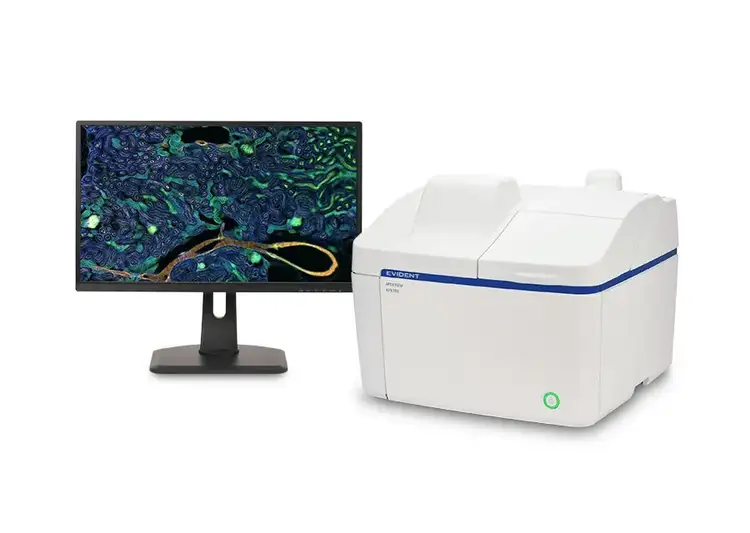
APEXVIEW APX100 benchtop fluorescence microscope
Recently, the cells used in MPS are increasingly taking on three-dimensional structures. This is driven by a growing need to more realistically reproduce the structure and function of human organs. Furthermore, many MPS are being developed with the same size as standard well plates (ANSI/SBS standards), rather than with proprietary specifications, to enable automated culturing.
The APX100 features a lineup of long working distance lenses suitable for observing three-dimensional structures. This makes it easy to adjust the imaging position and focus, enabling high-quality imaging. Since it can clearly capture complex three-dimensional structures that are often difficult to observe with a microscope, it's a huge help in increasing the design flexibility of MPS.
I believe these observation capabilities serve as a technological foundation that broadens the scope of research for both those who design and manufacture MPS and those who use them. The APX100 supports our daily research activities by enabling consistent observation from the macro to the micro level.
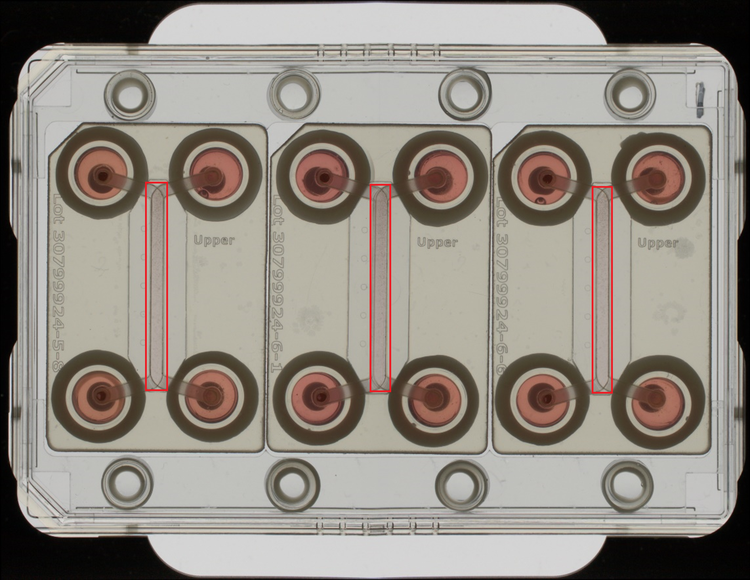
An overall macro image of an MPS captured with the APEXVIEW APX100 benchtop fluorescence microscope. Image courtesy of Dr. Reiko Nagasaki and Dr. Yuzuru Ito.
We typically place up to three MPS in a microplate type petri dish in parallel. We use the image stitching feature to acquire images of the areas within the red boxes (the linear sections where the upper and lower channels meet). The image above shows an example of culturing with Caco-2 cells.
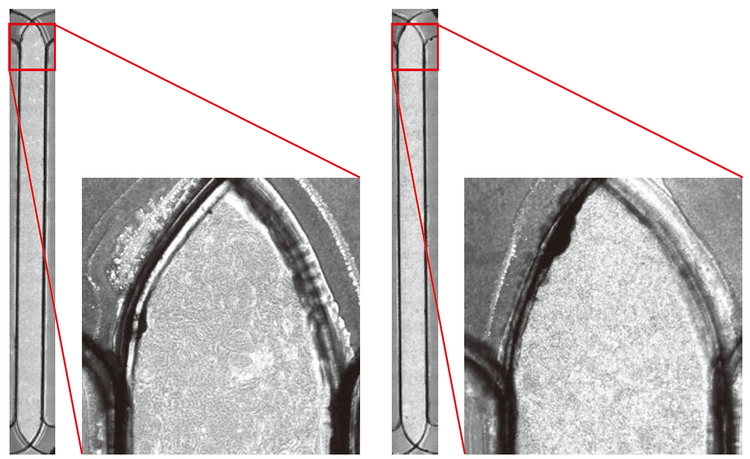
Images of the linear channel in human induced pluripotent stem cells (iPSCs)-derived small intestinal epithelial-like cells (hiSIECs) observed with the APEXVIEW APX100 benchtop fluorescence microscope. Left: Image of the cell layer cultured under liquid-liquid interface conditions. Right: Image of the cell layer cultured under air-liquid interface conditions. Images courtesy of Dr. Reiko Nagasaki and Dr. Yuzuru Ito.
Under air-liquid interface culturing conditions, the small intestinal epithelial cells adhere to the substrate and form a more uniform monolayer, confirming that the basic structure of an intestinal epithelial model has been successfully reproduced.
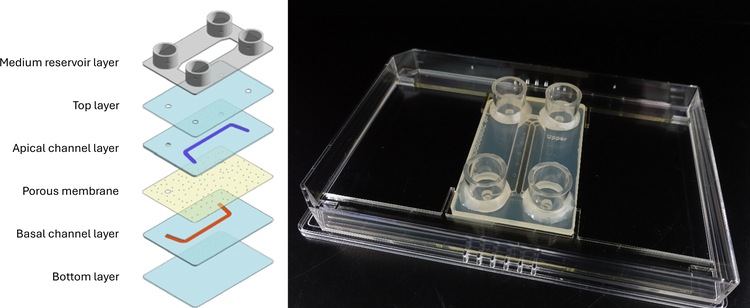
MPS placed on an ANSI/SBS standard plate. Image courtesy of Dr. Yuzuru Ito.
This MPS has a multi-layered structure and is placed in a microplate type petri dish for culturing, which increases the distance to the observation surface. Therefore, long working distance objective lenses are essential for observation.
What is your vision for future research?
Dr. Ito: Moving forward, I want to further refine our evaluation systems for drug absorption using intestinal and other organ models. I also want to develop applications with a view toward their adoption in a wide range of settings, including pharmaceutical companies, universities, and research institutions. In the process, we plan to actively pursue international standardization for the elemental technologies we develop. The creation of reproducible and robust systems is essential for the widespread adoption and societal implementation of MPS. It is important to demonstrate the validity of MPS as a means of mimicking human physiological functions from multiple perspectives, such as cell structure and protein localization. I believe that collaboration with imaging technologies, including APX100, will become increasingly valuable in the future.
Disclaimer: The opinions and statements expressed in this interview are those of the individual researcher and do not necessarily reflect the views or claims of Evident. The products and technologies mentioned are intended for research use only and are not designed for clinical or diagnostic applications.
References
Imaoka, Tomoki and Ito, Yuzuru, et al. 2024. “Development of a Novel Gut Microphysiological System That Facilitates Assessment of Drug Absorption Kinetics in Gut.” Scientific Reports 14, Article 29921.
Featured Products
APX100
Benchtop Fluorescence Microscope
The APEXVIEW APX100 benchtop fluorescence microscope makes it fast and simple to acquire expert-quality images. Built with renowned Evident optics, an intuitive user interface, a powerful AI, and a suite of smart features, the APX100 system combines ease of use with high-quality image data to fit your research needs.
- Easy-to-use, all-in-one microscope system
- Publication-quality images in a few clicks
- Fast, efficient data management