White Paper
Advancing Sedimentary Petrology with Polarized Whole Slide Imaging
A Cross-Polarization Method for Digitizing Petrographic Thin Sections
Sedimentary petrologists rely on mineral composition, texture, grain structure, and other microscopic features to interpret how rocks form and change over time. However, documenting entire petrographic samples with conventional microscopy methods can be both time-consuming and labor-intensive.
Slide scanners can be used for whole slide digitization of petrographic thin sections with scalable throughput. Whole slide imaging with polarized light can support the visual assessment of petrographic thin sections by capturing features such as birefringence, interference colors, cleavage patterns, grain texture, and changes in appearance across polarization angles.
Explore this white paper to learn how fixed-angle analyzers and a motorized polarizer were used with the SLIDEVIEW™ VS200 universal slide scanner to image petrographic thin sections at six cross-polarization angles. The paper presents the imaging method, example results, and potential applications in sedimentary petrology and related geological investigations.
We thank the British Geological Survey for providing access to thin sections from its collection.
Disclaimer: For research use only. Users should evaluate suitability for their specific geological research application or workflow.
Petrographic sample imaged on the SLIDEVIEW VS200 system at 10X magnification and with multiple cross-polarization angles: 0°, 15°, 30°, 45°, 60°, 75°. Sample courtesy of the British Geological Survey.
What You’ll Learn in This White Paper
- How cross-polarization imaging was configured: Review a method that combines six fixed-angle analyzers with a motorized, 360-degree rotatable polarizer to approximate aspects of angle-dependent polarized-light observation without manually rotating the sample.
- How petrographic thin sections can be digitized: See how the SLIDEVIEW VS200 slide scanner captures whole-sample and detailed images of geological slides.
- How minerals appear at different polarization angles: Examine images acquired at 0, 15, 30, 45, 60, and 75 degrees to observe changes in birefringence and interference colors.
- How digital imaging supports mineral assessment: Learn how cross-polarized image sets may support trained users in assessing features associated with isotropic and anisotropic minerals, as well as grain size, shape, alignment, texture, and porosity.
- Where the method may support geological research: Explore how this imaging approach may be relevant to geological research workflows where polarization imaging is required to document changes in materials.
Who Should Read This White Paper
This white paper is intended for sedimentary petrologists, petrographers, geologists, geoscience researchers, core-analysis laboratories, microscopy facility managers, and organizations evaluating digital imaging methods for geological thin sections.
It may be particularly useful for teams seeking to digitize complete petrographic samples, compare mineral features across multiple cross-polarization angles, and support more standardized image capture and easier access to digitized geological slide images.
Download the Full White Paper
Gain expert insights into a polarized whole slide imaging method for digitizing petrographic thin sections. Review the imaging configuration, cross-polarization workflow, and sample results obtained with the SLIDEVIEW VS200 slide scanner.
Authors

Dr. Anne Gesell
Imaging Specialist, Life Science Research, UK
Dr. Anne Gesell supports life science imaging for Evident in the UK and EMEA regions, specializing in widefield microscopy and the SLIDEVIEW™ VS200 universal slide scanner. With more than 15 years of microscopy experience, she brings deep technical expertise and a proactive approach to advancing imaging capabilities. Dr. Gesell holds a PhD in biology from the University of Bath, UK, and has worked in several research areas, including developmental biology, cancer, and stem cell research.

Dr. Sandrine Roy
Business Development Manager
Dr. Sandrine Roy is a business development manager at Evident, where she helps advanced microscopy users optimize image quality and develop customized solutions for their applications. Before joining Evident, Sandrine managed a large microscopy facility at the Translational Research Institute in Queensland for 10 years. In this role, she trained users and supported a wide range of light microscopy platforms, including basic, multiphoton, confocal, and super-resolution systems. She also presented to diverse audiences, ranging from doctoral candidates to primary school students through the SPARQ-ed program. This experience supported her transition from academic facility management to the microscopy industry. Earlier in her career, Sandrine completed six years of postdoctoral research at the University of Queensland and two years at Washington University in St. Louis, Missouri. Her research in molecular and cellular biology focused particularly on the MAPK signaling pathway. Across her doctoral and postdoctoral work, she contributed to 14 publications in peer-reviewed scientific journals. Sandrine remains passionate about science and microscopy and enjoys sharing that enthusiasm with others.
Products Related to This Application
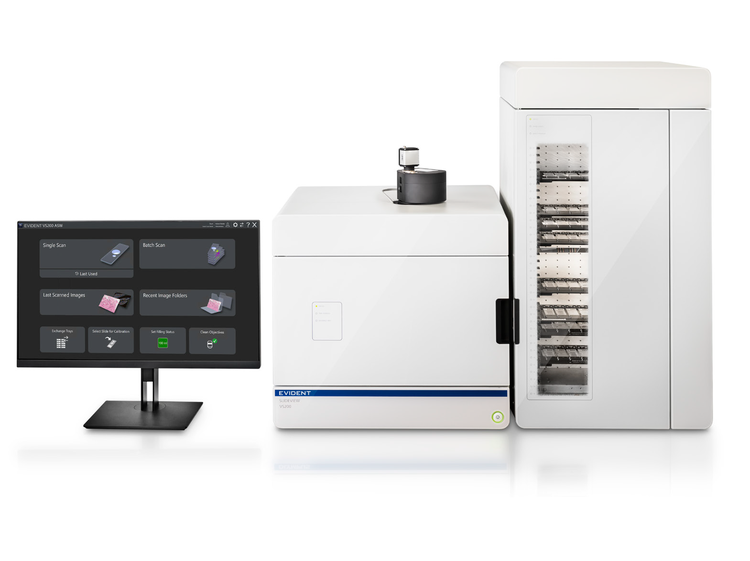
SLIDEVIEW VS200
Combining high-quality multiplex imaging, accurate color reproduction in brightfield, optical clarity in thick samples, and the broadest range of imaging modalities in one slide scanner, the SLIDEVIEW™ VS200 system enables researchers to capture more meaningful data from every sample—without complexity, manual intervention, or the need for multiple instruments. Designed to deliver consistent, repeatable results across users and workflows, the VS200 system helps you unlock more insights from your slides while supporting scalable imaging needs.