Microscope Illumination Systems for Brightfield to Fluorescence Imaging
Consistent, controlled illumination is the foundation of every reliable microscopy result.
Microscope illumination systems integrate the light source, optics, and control electronics into a single solution, delivering stable, precise light exactly where it is needed. Compared to legacy halogen or mercury and metal halide arc lamps, LED illumination systems provide instant startup, longer lifespans, and repeatable intensity, supporting efficient brightfield and fluorescence workflows.
Advancing a rich history of optical excellence, Evident conventional and LED illumination systems are purpose-built for research, clinical, and industrial microscopy imaging. Explore our lineup to find the right illumination solution for your work.
Microscope Illumination Systems
Fluorescence Light Sources
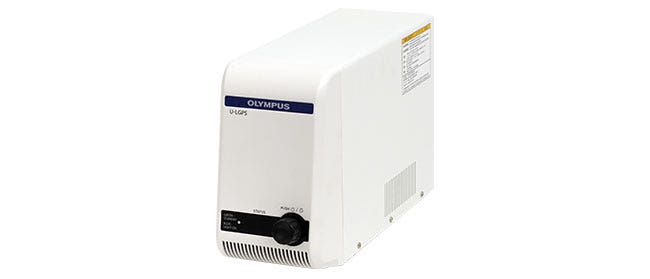
U-LGPS
A high-output fluorescence light source engineered for advanced, automated imaging workflows. Combining LED and LDP technology, U-LGPS delivers increased excitation power for live imaging, Z-stacks, and large-area scans while integrating seamlessly with motorized microscope systems.
- High-brightness LED and LDP illumination for demanding applications
- Optimized for live imaging, frequent Z-stacks, and automation
- Light-guide architecture for flexible placement and performance

U-FLLED
A compact, direct-mount LED light source designed for routine fluorescence imaging on manual and semi-motorized microscopes. With passive, fan-free cooling and modular excitation channels, U-FLLED delivers stable, uniform illumination for fixed samples and everyday workflows without added system complexity.
- Direct-mount LED illumination for integrated microscope setups
- Modular excitation channels for common fluorophores
- Quiet, fan-free operation for routine fluorescence imaging
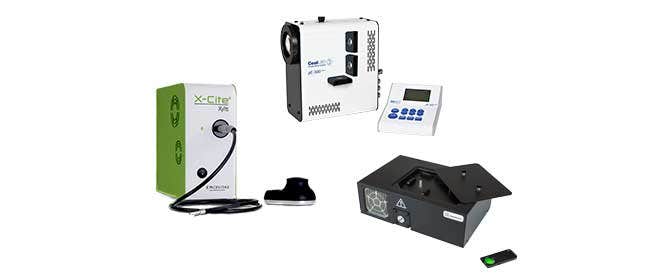
Other Compatible LED Light Sources
Fluorescence Light Source
These compatible LED light sources reduce running costs and feature longer lives and lower power consumption than conventional mercury lamps or metal-halide lamps. To improve experiment efficiency in more complex experimental protocols, confirm that any third-party LED light sources are compatible with cellSens software.
- Reduce running costs with a longer lifespan than conventional lamps
- Software controls for more complex experimental protocols
Stereo Microscope Lighting
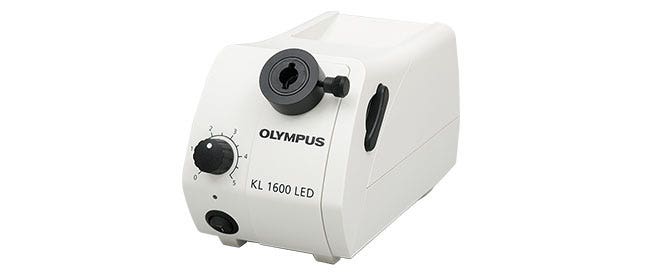
KL 1600 LED
Stereo Microscope Lighting
Featuring a low-noise cooling fan, this stereo microscope fiber optic cold light source provides brightness higher than a 150 W halogen light source yet consumes 80% less energy. It features smooth electronic dimming between 0–100%, while maintaining stable color temperature.
- Brightness higher than 150 W halogen light sources
- Very low-noise cooling fan
- Continuous electronic dimming from zero to 100%
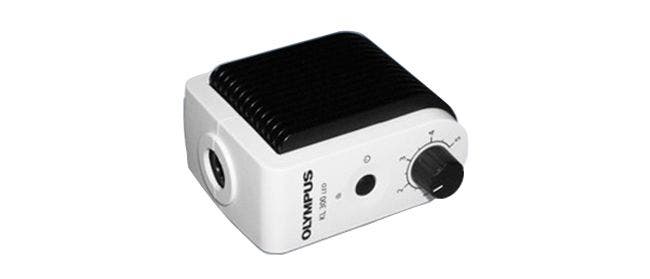
KL 300 LED
Stereo Microscope Lighting
- Brightness equivalent to 30 W halogen light sources
- No cooling fan (free of noise and vibration)
- Continuous electronic dimming from zero to 100%
Why Choose EVIDENT LED Illumination Systems
Reliable imaging starts with illumination you can control with precision.
Evident LED illumination systems deliver stable light while simplifying operation across research, clinical, and industrial microscopy workflows.
- Instant on/off switching: Supports TTL-triggered synchronization with cameras, helping reduce phototoxicity and photobleaching in live-cell imaging.
- Independently controlled wavelength channels: Provide targeted excitation without excess background, improving signal-to-noise in fluorescence applications.
- Energy efficiency: Compared to arc lamps, LED illumination systems offer significantly higher energy efficiency and longer lifespans, lowering operating costs.
- Consistent, reproducible performance: Designed to support uniform field distribution with Köhler illumination and high-intensity applications with LED light engines.
- Budget-friendly and high-performance options: While laser illumination offers ultra-high precision, LED illumination systems provide a cost-effective solution for everyday microscopy.
Frequently Asked Questions About Microscope Illumination Systems
Microscope light sources vary depending on the application, with different types optimized for specific imaging needs. For stereo microscopes, common light sources include LED ring lights, gooseneck illuminators, and fiber optic light guides. These provide bright, adjustable illumination for viewing surface details of larger, three-dimensional specimens without generating excessive heat.
For fluorescence microscopes, light sources must excite fluorescent dyes or proteins, so high-intensity illumination is critical. Common types include mercury vapor lamps, metal halide lamps, and increasingly, LED light engines and lasers. These sources offer the specific wavelengths needed to excite fluorophores while minimizing photobleaching and phototoxicity during imaging. Each type supports different levels of brightness, stability, and spectral control to suit various fluorescence applications.
Different microscope light sources offer unique advantages depending on the application:
- LEDs: Energy-efficient, long-lasting, and low-heat, making them ideal for both stereo and fluorescence microscopy. They offer stable, flicker-free illumination and fast on/off control.
- Halogen lamps: Provide bright, broad-spectrum light with good color rendering, commonly used in brightfield and stereo microscopy.
- Metal halide lamps: Deliver high-intensity, broad-spectrum light suitable for fluorescence imaging. They offer a balance of brightness and lifespan but require warm-up time.
- Mercury vapor lamps: Produce intense light at specific wavelengths, ideal for certain fluorescence applications.
- Lasers: Offer precise, high-intensity light at narrow wavelengths for advanced fluorescence and super-resolution techniques.
Each light source supports different microscopy needs based on brightness, spectral output, lifespan, and control. For more information on choosing the correct light source for your needs, visit our guide to light sources.
Microscope Light Source Resources
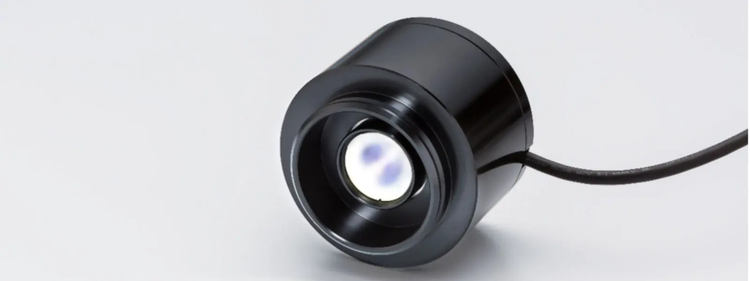
A Guide to LED Light Sources for Microscope Devices
This is your guide to LED light sources for microscope devices. Learn about the types of LEDs and get tips on how to select a light source for your equipment.
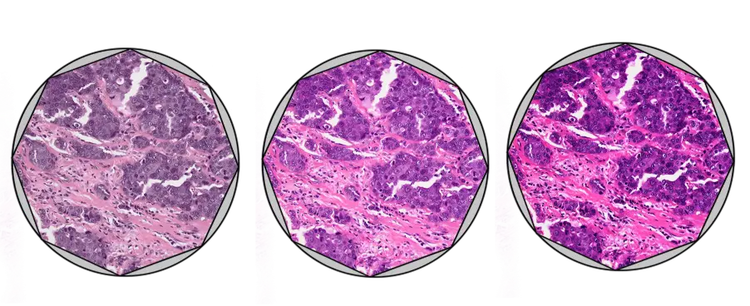
How to Align Köhler Illumination in 6 Simple Steps
Get step-by-step guidance on aligning your microscope using the Köhler illumination technique, so you can achieve even, bright illumination.
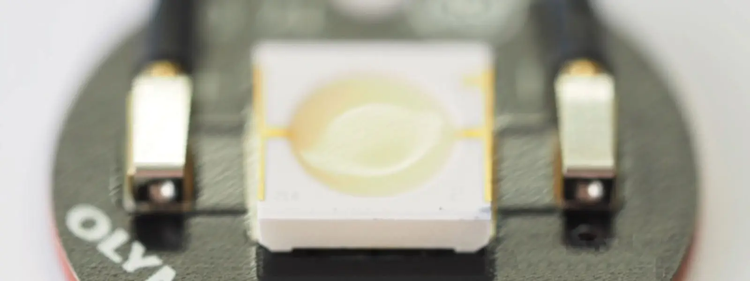
A Bright Idea—Developing LED Components with High Color Rendering for Microscope Devices
True Color LED is a bright light source with a high intensity and long lifespan. Learn how it is used in microscope devices for life science and industry.