Université de Montréal

Over the course of more than 135 years, the Université de Montréal (UdeM) has become one of the world’s leading research universities. Its outstanding teaching, rigorous research, and talented students keep UdeM in the ranks of top universities year after year.
The Université de Montréal innovates through the work conducted at its Centre interdisciplinaire de recherche sur le cerveau et l'apprentissage (Center for Interdisciplinary Research on Brain and Learning, or CIRCA). This Center on brain and learning aims to accelerate interdisciplinary research and its applications through two-way reinforcement between the brain sciences and disciplines that operate in practice settings. CIRCA's research work is approached in an interdisciplinary manner by more than 60 researchers from 17 units and 7 faculties working on campus. Through its programming and its four thematic research axes, CIRCA acts as a catalyst for multidisciplinary research in learning, an area with a great potential to impact the community. CIRCA helps change mentalities and ways of doing things by providing an environment and mechanisms that enable those working in these research sectors to transcend boundaries.

The Work at CIRCA
CIRCA members study the neural basis of neuroplasticity and learning processes and the factors that disrupt and promote learning at different ages. CIRCA also creates two-way links between brain science and data science to develop innovative intervention approaches to improve learning. The Center focuses its activities on themes for which this multidisciplinary approach has yet to be explored by other research centers in Quebec through four major interrelated axes: normal mechanisms of learning, perception, and behavior; learning, perception, and behavior disorders; intervention, diagnostic, and therapeutic tools; and computational neurosciences and neuroinformatics (transversal axis).
CIRCA Researchers
CIRCA is composed of 64 researchers, including the director, Dr. Christian Casanova, and the four axis managers, Dr. Isabelle Archambault, Dr. Arlette Kolta, Dr. Karim Jerbi, and Dr. Richard Robitaille. For a complete list of member researchers as well as their profiles and fields of expertise, please visit the website: https://www.circa.umontreal.ca/membres/ (in French only)

In the Spotlight
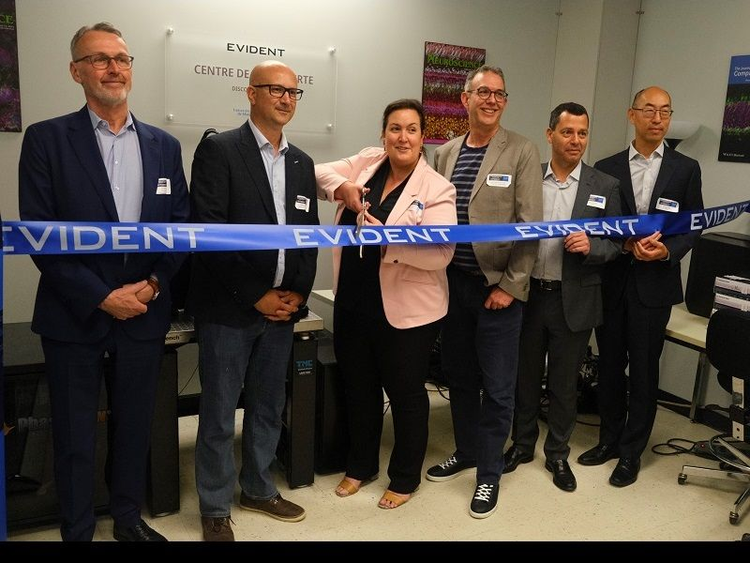

Ribbon cutting (left to right):
- Christian Casanova, Professor Emeritus at UdeM and Vice-President for Research and Partnerships at the École de technologie supérieure
- Matthieu Vanni, Assistant Professor and Director of the Evident Discovery Center at UdeM
- Julie-Andrée Marinier, OD, M.Sc. Interim Director of the School of Optometry, UdeM
- Jean-François Bouchard, Assistant Director of Research, Graduate Studies, and Faculty Affairs at UdeM
- Andre Mindlin, Executive Director of Sales and Marketing, Evident Canada
- Arnold Huang, President of Americas Sales and Marketing for Evident
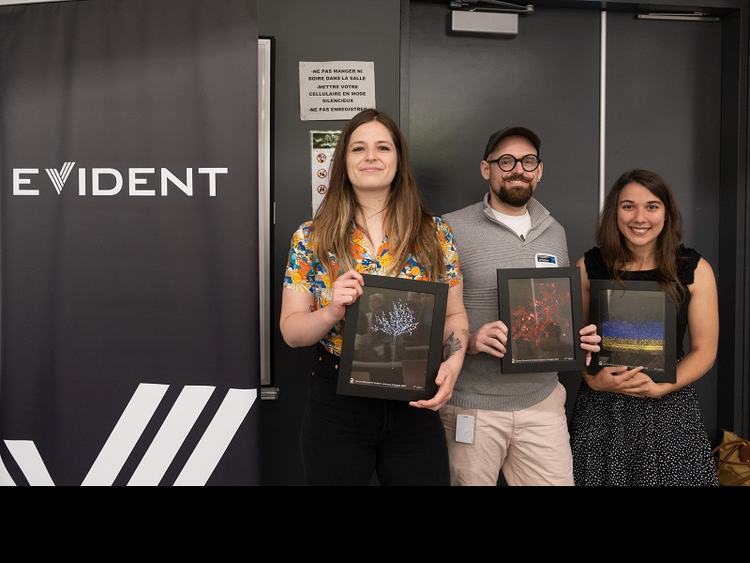
Image contest winners (left to right):
- First place: Chloé Savard
- Second place: Sergio Crespo-Garcia
- Third place: Catarina Sofia Micaelo Fernandes
Image Contest Winners
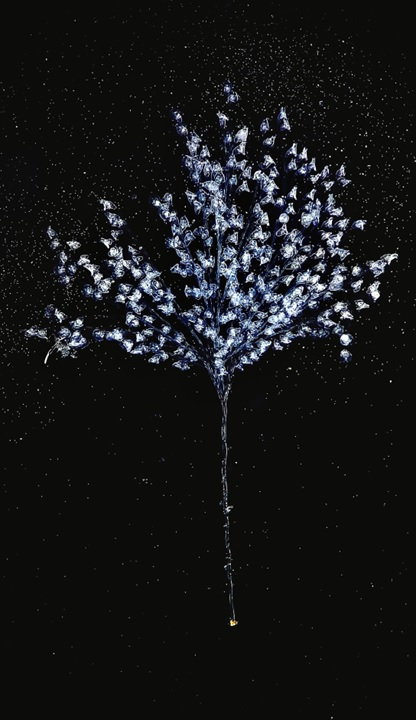
First place: Chloé Savard
This microscopic tree looks like a plant but moves like an animal, but what is it exactly? It’s neither a plant nor an animal, but a colony of single cell organisms called ciliates from the Carchesium polypinum species. This microbe can be found around the globe, mainly in freshwater ponds and lakes but is also used in sewage treatment. Carchesium possess thousands of tiny cilia that create a water vortex drawing food particles toward the colony and each single cell. They usually eat bacteria, phytoplankton and debris that are floating around them. The stalks of these creatures have the ability to contract like springs in a matter of 10-20 mm per second and becomes 20 to 40% shorter as their bell becomes spherical! The bell of these ciliates can reach a speed up to 60-90 mm per second which corresponds to 1200 body length per second and makes them one the fastest living organisms!
Captured using darkfield imaging.

Second place: Sergio Crespo-Garcia
Mononuclear phagocytes populating a site of pathological angiogenesis in the ischemic mouse retina.
Captured on an Olympus FLUOVIEW FV1000 confocal microscope.
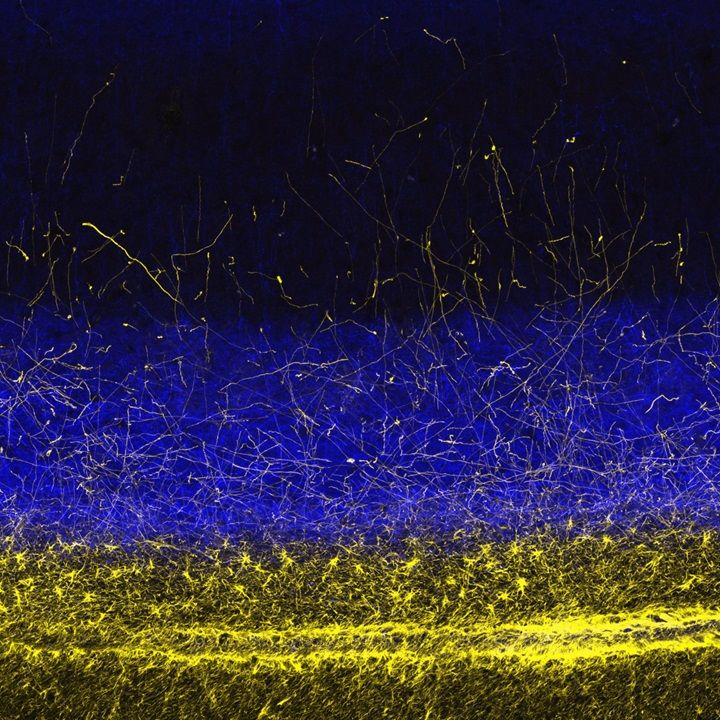
Third place: Catarina Sofia Micaelo Fernandes
Au-dessus des étoiles / Above the stars ; Axones exprimant le CB1R (en bleu) au-dessus des "étoiles" gliales exprimant la GFAP (en jaune) Cortex visuel du singe vervet, transition cortex/substance blanche.
Captured on an Olympus FLUOVIEW FV3000 confocal microscope.
Systems at Université de Montréal
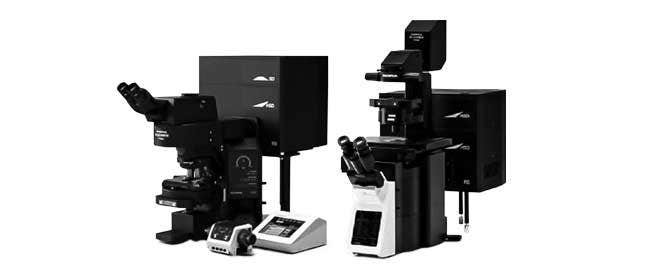
FLUOVIEW™ FV3000RS laser scanning confocal system
Enabling the observation and recording of fast phenomena and live physiological events, this hybrid laser scanning unit uses a galvanometer scanner for precision scanning and a resonant scanner for high-speed imaging with a with a large field of view.
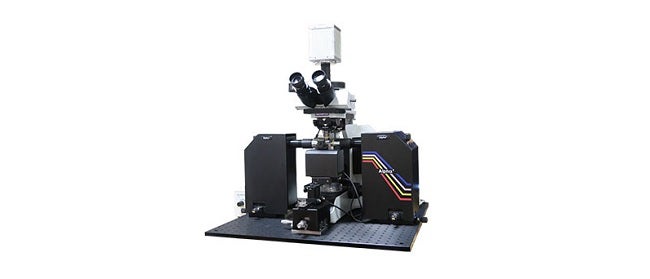
PhaseView® Alpha3 light sheet microscope
Offering researchers a flexible, high-performing light sheet solution, the Alpha3 system enables high-speed, intelligent optical focus sweeping for uniform, artifact-free, multidimensional imaging across the entire field of view.
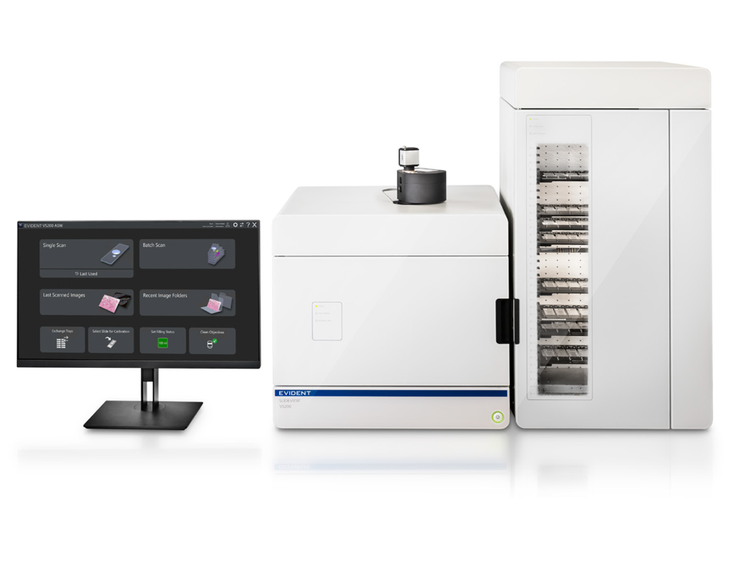
SLIDEVIEW VS200
Combining high-quality multiplex imaging, accurate color reproduction in brightfield, optical clarity in thick samples, and the broadest range of imaging modalities in one slide scanner, the SLIDEVIEW™ VS200 system enables researchers to capture more meaningful data from every sample—without complexity, manual intervention, or the need for multiple instruments. Designed to deliver consistent, repeatable results across users and workflows, the VS200 system helps you unlock more insights from your slides while supporting scalable imaging needs.