Visualizing Pine Needles with Multimodal Imaging: From Brightfield to Fluorescence
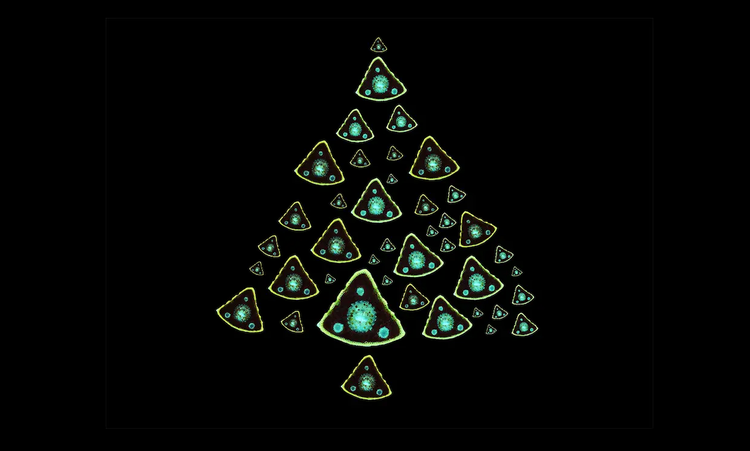
200 µm section of pine needle captured using the SLIDEVIEW VS200 slide scanner with the UPLXAPO 10X (NA 0.40) objective lens.

Remaining green year-round, evergreen trees have long been celebrated across cultures as enduring symbols of life, hope, and resilience. This powerful symbolism continues today, with pine needle trees often chosen as decorations during the holidays for their vibrant, lasting greenery.
Beyond their role in holiday and seasonal décor, pine needles are also fascinating biological structures. Thanks to their anatomical properties and natural autofluorescence, they serve as an ideal sample to showcase the multimodal capabilities of the SLIDEVIEW™ VS200 universal slide scanner.
Using a 200 µm pine needle section, we demonstrate how this scanner, equipped with the new dual lamp adapter, facilitates multimodal imaging by integrating both LED and laser light sources.
What Is Multimodal Imaging?
Multimodal microscopy imaging combines multiple imaging techniques within a single instrument to provide comprehensive and complementary information about biological samples at the microscopic level. By integrating methods such as fluorescence microscopy with polarization, researchers can simultaneously capture structural, chemical, and functional properties of cells and tissues that would be impossible to observe with just one technique.
Multimodal imaging is particularly valuable in fields like neuroscience, cancer research, and developmental biology, where understanding complex biological phenomena requires visualizing multiple markers, tracking cellular interactions in real time, and examining samples across different scales and dimensions.
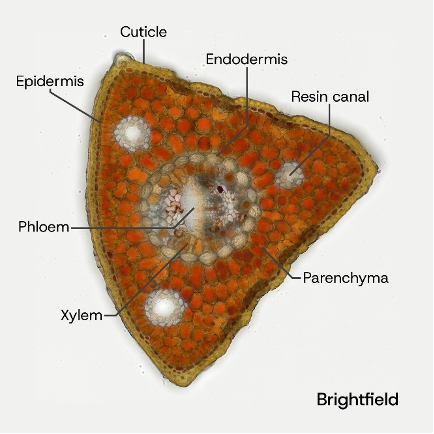
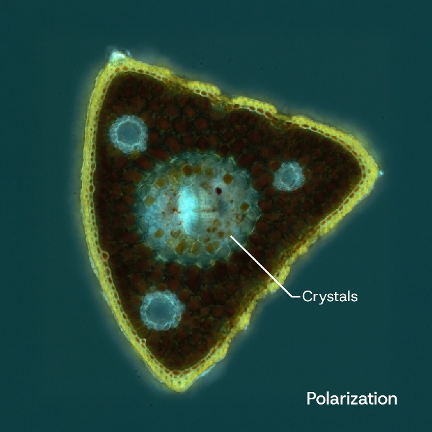
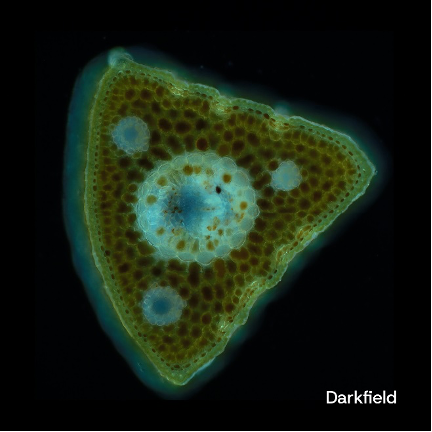
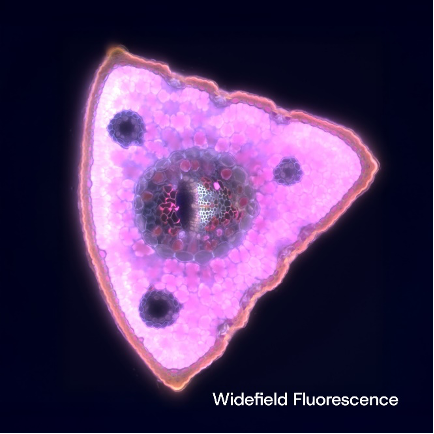
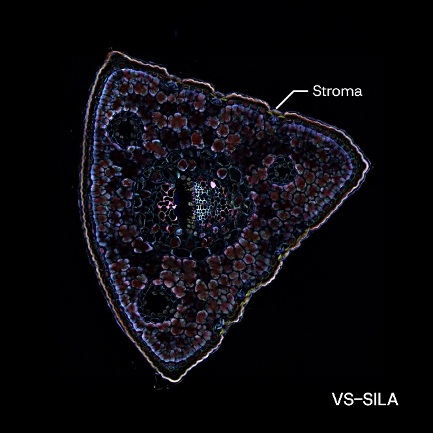
Figure 1. Multimodal extended focus imaging of a 200 µm section of pine needle using the SLIDEVIEW VS200 slide scanner with the UPLXAPO 10X (NA 0.40) objective lens. Images courtesy of Alec DeGrand.
Multimodal Insights from a Pine Needle Cross-Section
Pine needle leaves are equifacial, meaning they have identical anatomical structures on both sides and can perform photosynthesis on both surfaces.1 Using multimodal imaging on the VS200 slide scanner (Figure 1), we captured the following features:
- Brightfield clearly reveals the different anatomical parts.
- Polarizationhighlights crystals in the vascular bundles, especially in the xylem, where water transport occurs.
- Darkfieldshows an empty resin canal on the right. When combined with brightfield and polarization, the canal's morphology appears less circular, with more rounded and loosely organized surrounding cells.
- Fluorescencehighlights the cuticle, but the plant section is thick, so the different fluorescence channels (DAPI, FITC, TRITC, CY5, and CY7) look blurry, and single cells are difficult to recognize with widefield fluorescence. However, using VS-SILA speckle illumination autofluorescence is clearly localized in the top or bottom portions of the cells, and cell membranes are easy to recognize. The stomata and guard cells, which regulate gas exchange and water loss 2, are also visible (Figure 2).
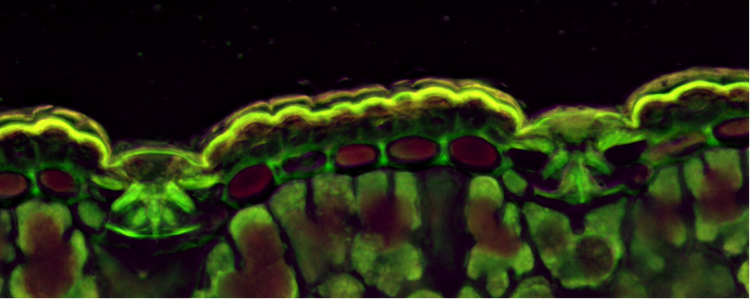
Figure 2. Stomata in a pine needle section. Extended focus imaging (EFI) using the UPLXAPO 40X (NA 0.95) objective. FITC and TRITC channels with the VS-SILA optical sectioning device for the SLIDEVIEW VS200 slide scanner. Guard cells and stomata are clearly visible.
A Deeper Look at Familiar Structures
Pine needles, often overlooked, reveal a world of structural complexity under multimodal imaging. The SLIDEVIEW VS200 slide scanner enables researchers to uncover details that remain hidden with single-mode observations. Each imaging modality offers unique strengths, and combining them leads to richer, more accurate data.
The VS200 scanner offers a wide range of imaging methods in a single system. Users can apply brightfield, reflected brightfield, phase contrast, darkfield, linear polarization, circular polarization*, fluorescence, and VS-SILA—all without switching instruments. Now available with a dual lamp adapter, the system enables combined and synchronized LED and laser illumination for uniform, high-intensity imaging. Whether you're studying fine fluorescence signals or dense tissue structures, the VS200 delivers clarity and versatility for advanced research.
Ready to take your imaging further? Contact us today to schedule a demo and learn how the SLIDEVIEW VS200 slide scanner can support your research.
*Availability may vary by region. Please contact your local Evident representative for more information.
References
1. Wanner, G. 2004. Mikroskopisch-Botanisches Praktikum. Stuttgart: Georg Thieme Verlag.
2. Sitte, P. et al. 1998. Strasburger Lehrbuch der Botanik für Hochschulen. 33rd ed. Gustav Fischer Verlag.
Featured Products
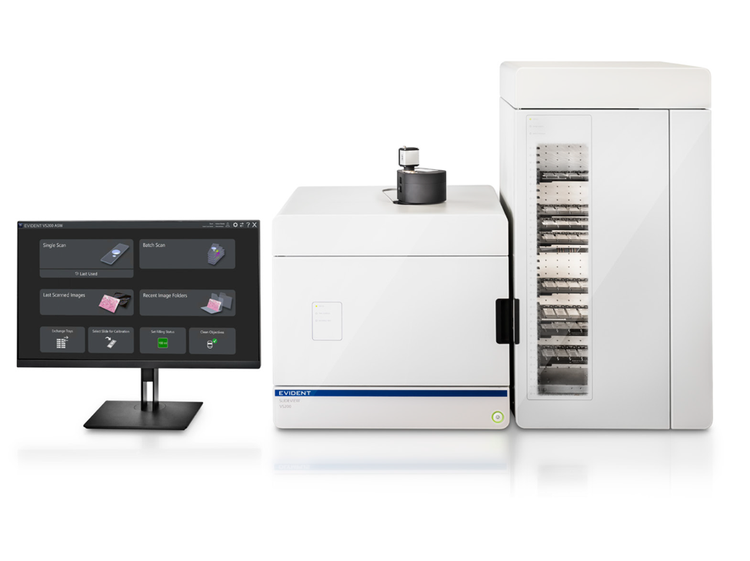
SLIDEVIEW VS200
Combining high-quality multiplex imaging, accurate color reproduction in brightfield, optical clarity in thick samples, and the broadest range of imaging modalities in one slide scanner, the SLIDEVIEW™ VS200 system enables researchers to capture more meaningful data from every sample—without complexity, manual intervention, or the need for multiple instruments. Designed to deliver consistent, repeatable results across users and workflows, the VS200 system helps you unlock more insights from your slides while supporting scalable imaging needs.