SilVIR Detector
The SilVIR detector combines two advanced technologies—a silicon photomultiplier (SiPM) and our patented* fast signal processing design. With this breakthrough detector technology at the core of our FV5000 and FV5000MPE systems, you can achieve much lower noise, higher sensitivity, and improved photon resolving capabilities.
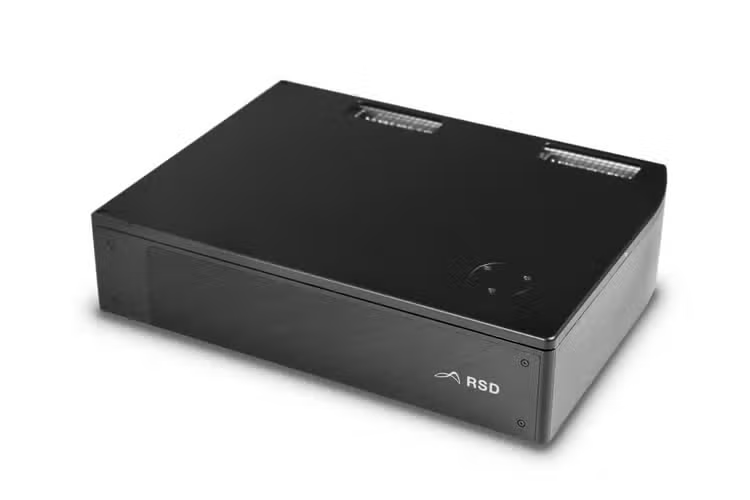
SilVIR detector
Next-Generation Detector Technology
The SilVIR detector combines two advanced technologies—a silicon photomultiplier (SiPM) and our patented* fast signal processing design. With this breakthrough detector technology at the core of our FV5000 and FV5000MPE systems, you can achieve much lower noise, higher sensitivity, and improved photon resolving capabilities.
SilVIR Detector Technology
Silicon Photomultiplier
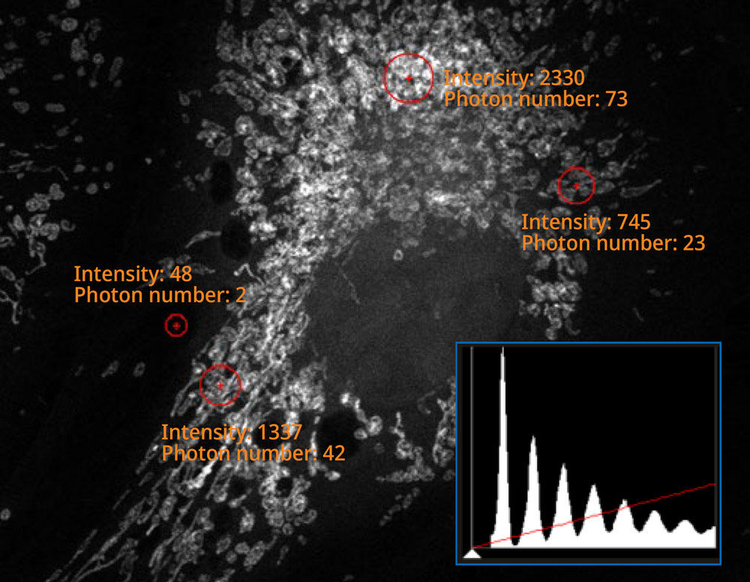
The detector’s silicon photomultiplier consists of multipixel Geiger-mode-operated avalanche photodiodes (APD). It can detect random incident photons simultaneously, enabling a higher photon detection efficiency for a wider range of wavelengths and dynamic range. It also provides quantitative data—the height of the output pulse precisely shows the number of detected photons.
Patented* Fast Signal Processing
Our digital signal processing utilizes an integrated circuit design featuring field-programmable gate array (FPGA) semiconductors within the high-speed analog/digital (A/D) converter.
It also shortens the SiPM decay curve and enables the accurate detection of the number of photons based on the height of each output pulse while simultaneously realizing very low noise below one photon.
*Patent number US11237047
Combined Power and Performance
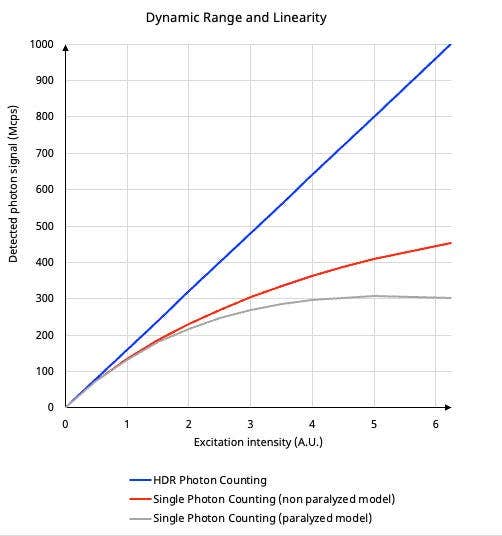
Together, these technologies deliver linear and high dynamic range detection up to 2,000 photons/2 µs.
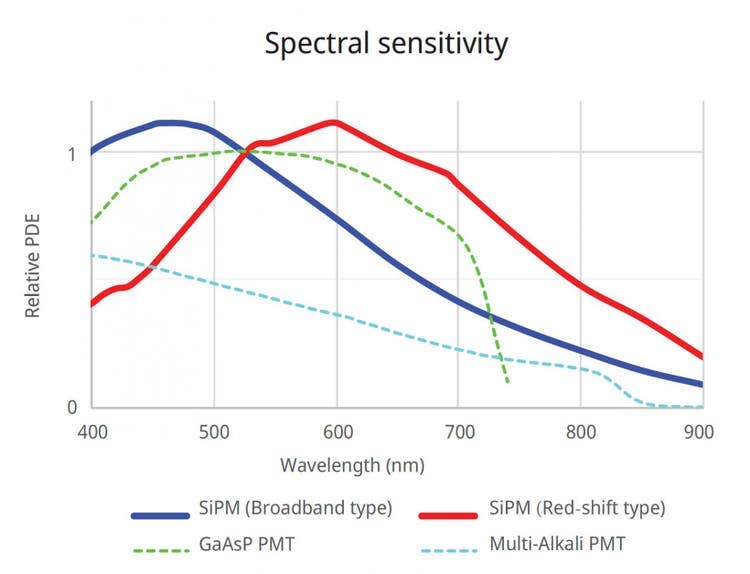
The detector’s photon detection efficiency is higher than the GaAsP PMT detectors traditionally used for high-sensitivity confocal imaging in all wavelengths. This enables the SilVIR detector to provide a superior signal-to-noise (S/N) ratio to bring your weak fluorescence signals to life.
And because SilVIR detectors are based on semiconductor technology, their sensitivity does not degrade and individual differences between different detectors are very small, helping ensure reliable, consistent results across time and users.
High-Quality Images, Even with Weak Fluorescence
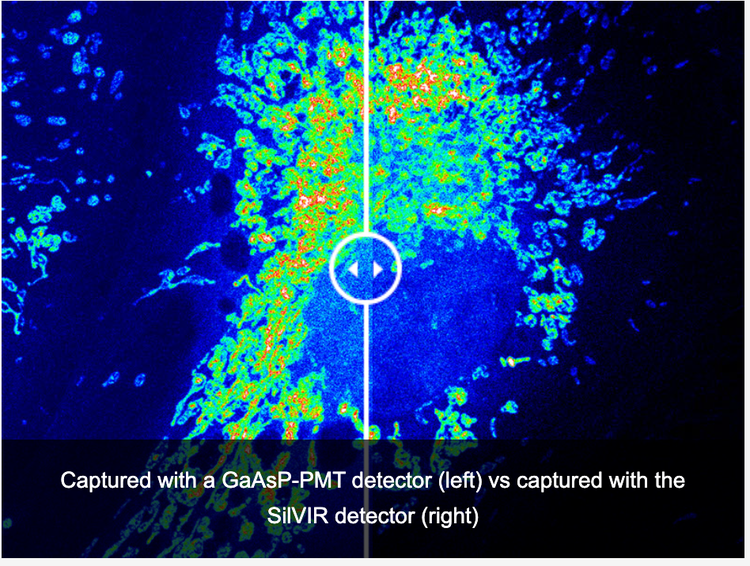
The FV5000 and FV5000MPE systems’ ability to capture weak fluorescence images surpasses that of previous-generation laser scanning systems.
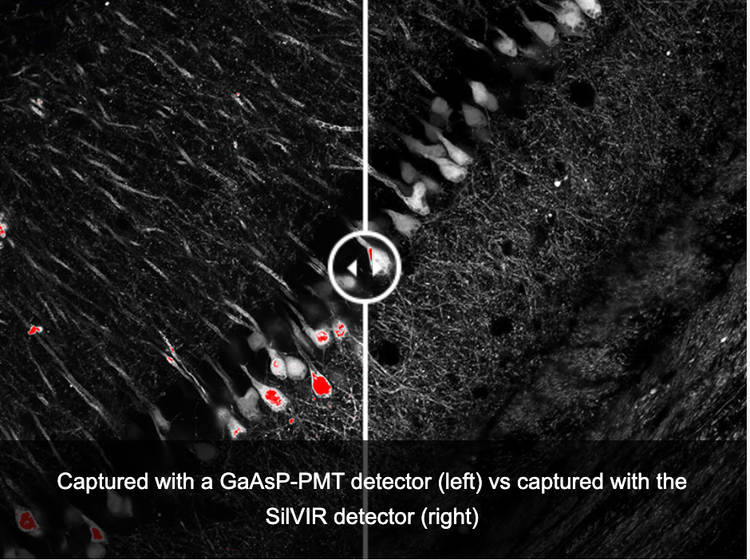
The SilVIR detector has very low noise and higher photon detection efficiency than traditional GaAsP-PMT detectors across the violet to near-infrared wavelength range, delivering better image quality, especially when acquiring dim fluorescence. You can capture vivid fluorescence images with a clear background without adjusting the offset. Higher sensitivity means you need less laser power, reducing photodamage to your samples. And when combined with our resonant scanner you can acquire high-quality, fast-frame-rate images in less time.
Game Changing Quantification
SilVIR detector technology enables you to precisely quantify image intensity for more reliable data. Imaging data is output as the number of photons, providing the absolute value of the fluorescence intensity for each image. The wider dynamic range provides accurate quantification of fluorescence intensity by photon number even at high intensity levels.
Experience the Full Dynamic Range of Fluorescence
Instead of choosing to focus on either dim or bright fluorescence areas, the FV5000 and FV5000MPE microscopes can capture both in one image without saturation or loss of information thanks to the SilVIR detector’s high dynamic range. This allows accurate image analysis and processing with less work.
Intuitive User-Interface and Workflows
The photomultiplier tubes traditionally used in confocal imaging require voltage adjustments depending on the sample’s brightness level as well as an offset adjustment to reduce signal noise. This requires expert knowledge and experience to make proper adjustments to acquire high-quality confocal images.
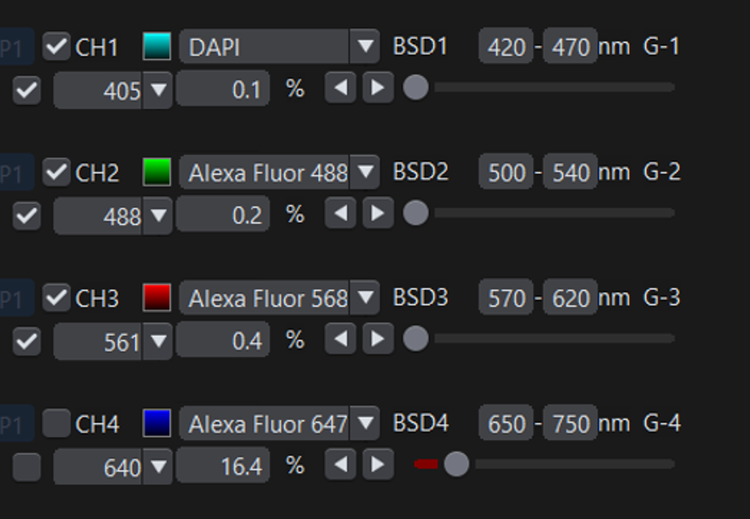
The SilVIR detector’s voltage is optimized for sensitivity and low noise at the factory, so you don’t need to make any voltage and offset adjustments—all you need to adjust is the laser power to achieve a certain photon number. Since the signal-to-noise (S/N) ratio is proportional to the photon number, you can maintain consistent image quality by keeping the photon number constant.
Detector Settings
Applications
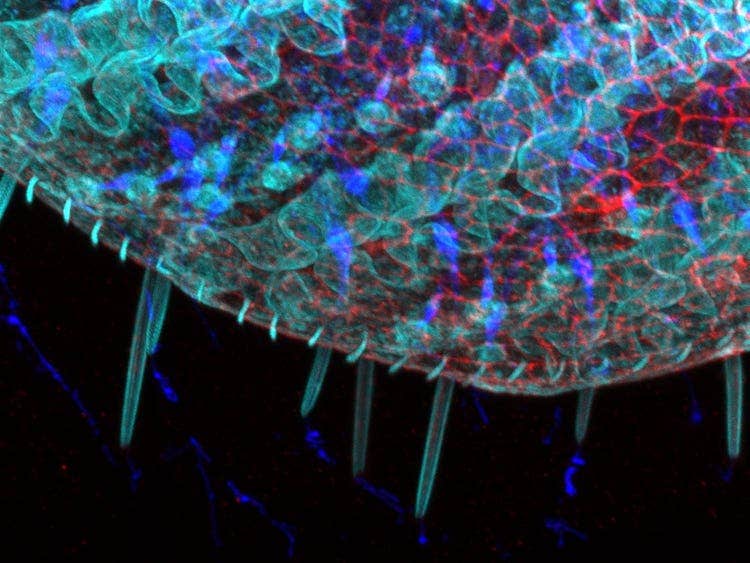
Gustatory hair and Peudotrachea in Drosophila (42hours pupation)
Stained with Phalloidin (AlexaFluor 405, F-actin, Cyan), Anti-phosphotyrosine antibody (AlexaFluor 555, cell surface, red) anti-HRP antibody (AlexaFluor 647, axon, blue).
Sample Courtesy of: Sun Zhengkuan and Shigeo Hayashi, Laboratory for Morphogenetic Signaling, RIKEN Center for Biosystems Dynamics Research, Japan.
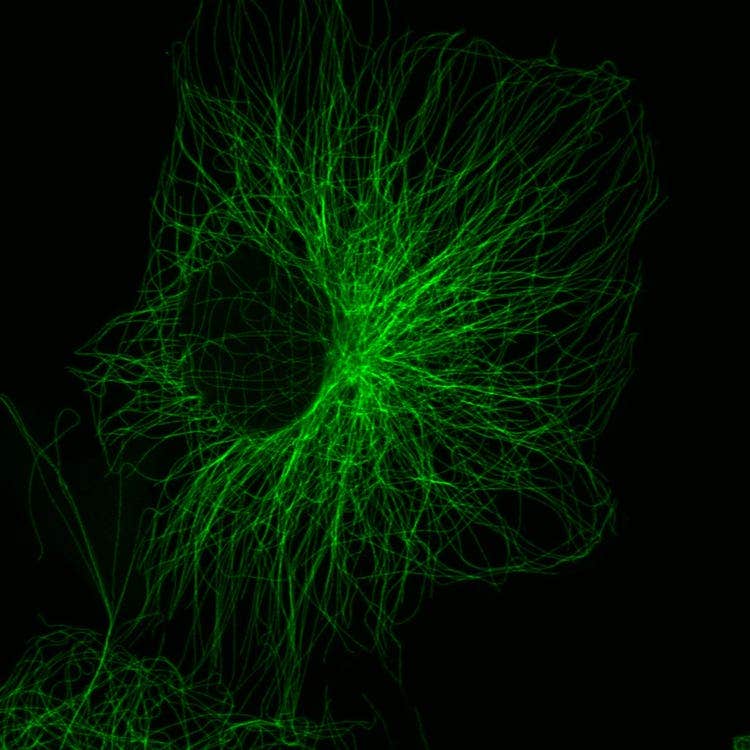
Cos-7 cells: anti-Tubulin (Alexa Fluor 488; green).
Sample Courtesy of:Sample courtesy of Dr. Jana Döhner, Dr. Urs Ziegler, University of Zürich.
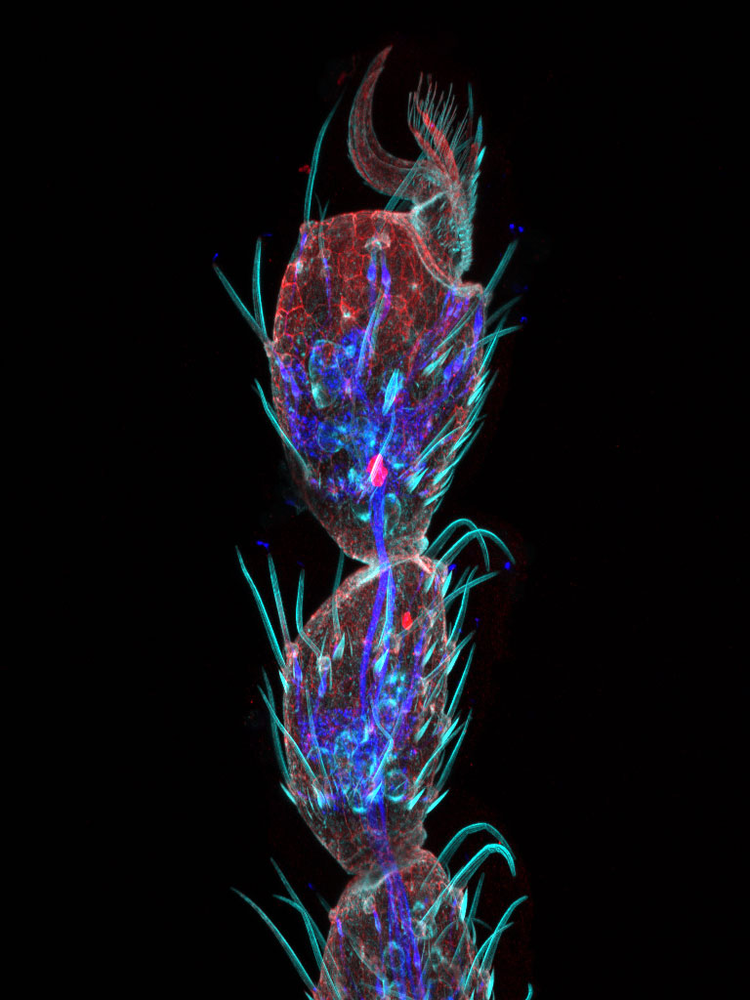
Tip of a Drosophila leg (42-hour pupation), stained with phalloidin (AlexaFluor 405, F-actin, Cyan), anti-phosphotyrosine antibody (AlexaFluor 555, cell surface, red), and anti-HRP antibody (AlexaFluor 647, axon, blue).
Sample Courtesy of: Zhengkuan Sun, Shigeo Hayashi, Laboratory for Morphogenetic Signaling, RIKEN Center for Biosystems Dynamics Research, Japan.
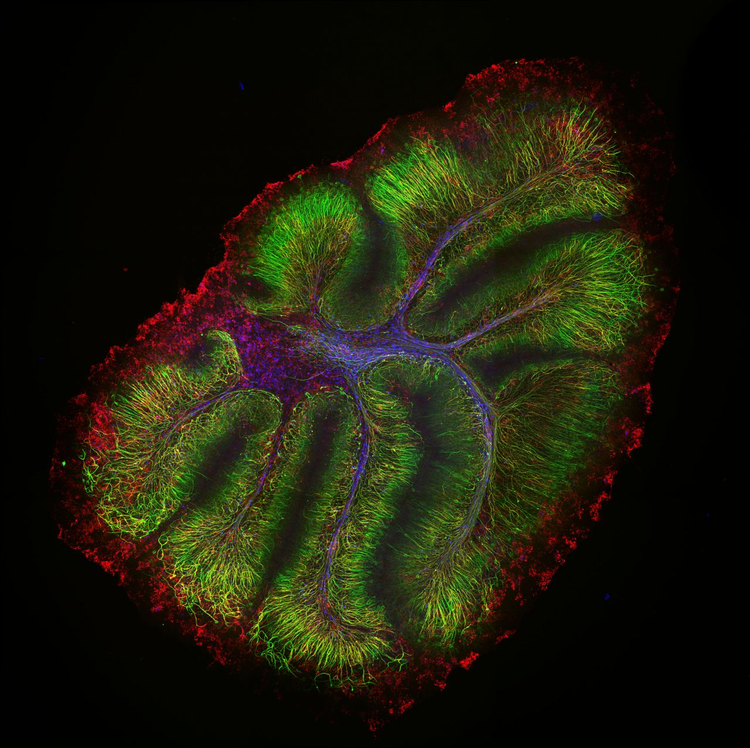
Neurofilament-heavy chain (NFH) in green, myelin basic protein (MBP) in red, glutathione S-transferase pi 1 (GSTpi) in blue. Mouse cerebellum captured with a UPLXAPO10X objective.
Sample courtesy of Katherine Given, Ph.D. Principal Investigator, Neurobiology University of Colorado Anschutz Medical Campus, Aurora, Colorado
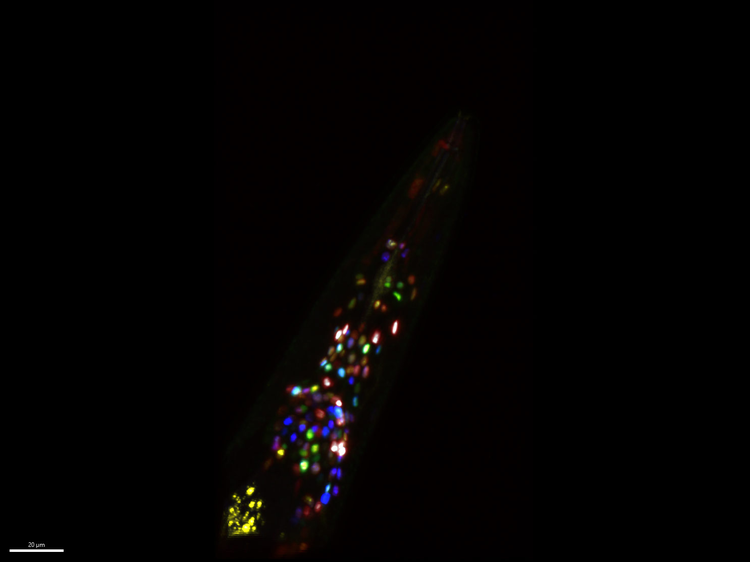
Multicolor image of C. elegans hybrid strain of NeuroPAL strain and GCaMP strain. NeuroPAL strain was generated by Eviatar Yemini and Oliver Hobert.
Courtesy of Kotaro Kimura; Graduate School of Science, Nagoya City University and Asuka Takeishi; Neural circuit of multisensory integration, RIKEN Hakubi Research Team.
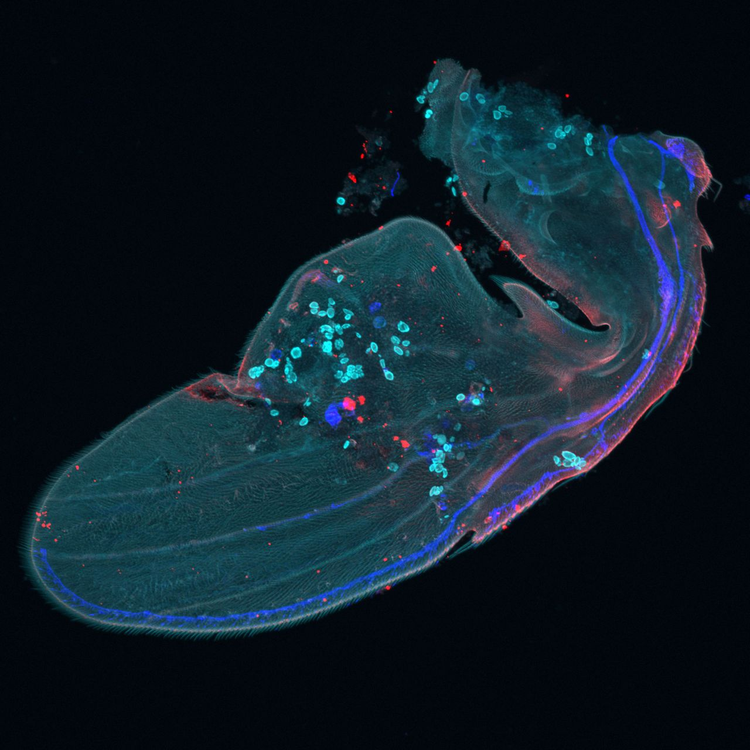
Overview image of a Drosophila wing (42-hour pupation). Stained with phalloidin (AlexaFluor 405, F-actin, Cyan), anti-phosphotyrosine antibody (AlexaFluor 555, cell surface, red), and anti-HRP antibody (AlexaFluor 647, axon, blue).
Sample courtesy of: Sun Zhengkuan, Shigeo Hayashi, Laboratory for Morphogenetic Signaling, RIKEN Center for Biosystems Dynamics Research, Japan.
FV5000 Confocal Laser Scanning Microscope
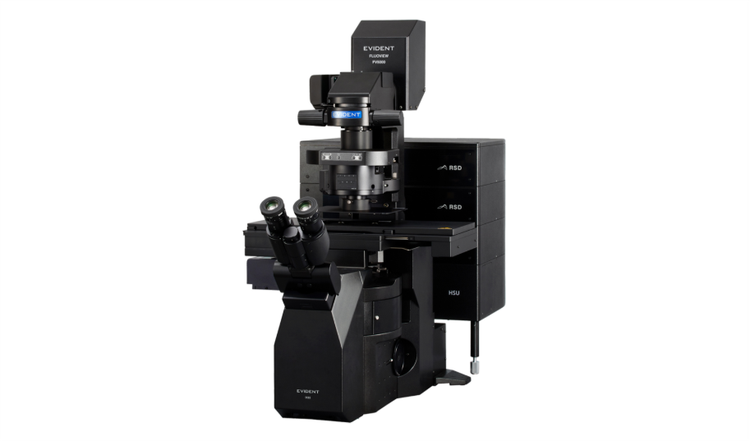
FV5000
Confocal Laser Scanning Microscope
- Extraordinary clarity, speed, and reliability driven by groundbreaking innovations
- SilVIR™ detectors deliver photon-level quantitation, exceptional sensitivity, and ultra-high signal-to-noise
- Unmatched dynamic range captures the full signal spectrum and prevents saturation
- High-speed 2K resonant scanning and high-density 8K galvo scanning in one platform
- FLUOVIEW Smart™ software simplifies operation with intuitive controls and AI-powered automation
- TruResolution™ auto correction collar optimizes focus for over 20 objectives
- Modular design supports up to 10 laser lines and future multiphoton upgrades
- Laser Power Monitor (LPM) ensures stable illumination and reproducible results over time
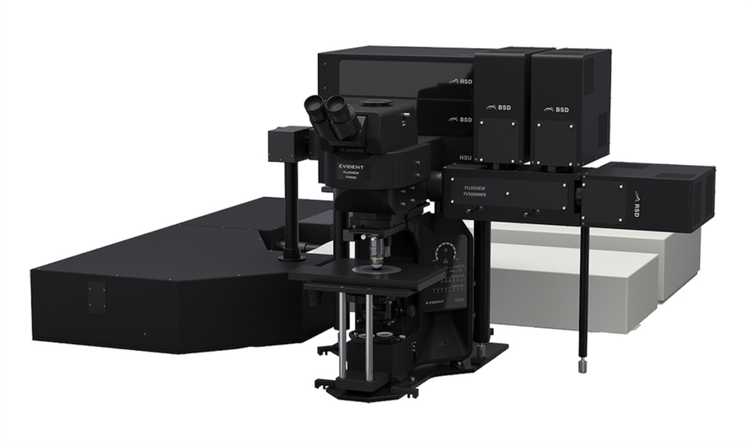
FV5000MPE
Multiphoton Laser Scanning Microscope
- Compact fiber-pigtailed lasers enable deep, quantitative imaging in scattering tissue
- One-, two-, or three-line simultaneous MPE laser excitation for millimeters deep imaging
- SilVIR™, TruAI, and TruSight™ technologies deliver outstanding signal-to-noise and clarity
- MPE-optimized objectives, TruResolution™ auto correction collar, and automated IR laser alignment maintain sharp focus
- Available as an FV5000 system upgrade or a complete MPE system
- Fully tunable laser configurations available for more advanced multiphoton applications