应用笔记
Evaluating the Shape of the Landing Zone Pattern and Contaminants on a Hard Disk / All-in-one system of optical, laser, and probe microscope capabilities provides seamless measurement from the millimeter to nanometer level.
Application
The magnetic head slider of a hard disk drive (HDD) makes light contact with the disk when it stops spinning. When the disk is spinning, the airflow of the disk causes the slider to float about 10 nm above the disk’s surface. Contaminants or scratches on the surface of the disk can disrupt the airflow causing the magnetic head to bump the surface and become damaged.
To increase the recording density on a magnetic disk, a smooth disk surface is needed. However, the smoother the surface, the more the head slider sticks to the disk’s surface when it stops spinning. This tendency means that more torque is required when spinning restarts, and this can cause damage to the disk surface. To solve this problem, a ring-like landing zone where a portion of the disk surface is roughened or patterned is included to keep the slider from sticking to the disk’s surface. Contaminants and landing zone patterns may both have nanometer-level irregularities that are so small that it is difficult to observe the shape or measure the irregularity’s height using brightfield observation.
The Evident solution
Evident' OLS4500(Formerly Olympus OLS4500) nano-search microscope provides the high-definition differential interference microscopy of a laser microscope as well as brightfield observation so users can clearly visualize minor irregularities on a hard disk’s surface and easily locate the target to be measured. In addition, the high-resolution laser microscope enables 3D measurement to measure the profile of irregularities with a height of several tens of nanometers. Seamlessly transfer the target area for probe microscopy without losing track of the measurement subject. The probe microscope is capable of capturing reliable nanometer-level height data for a subject with micron-sized width that would be difficult to measure even with laser microscopy. The profile evaluation of the same area using both the laser and probe microscopes integrated into this unit enables comparison of the data and the ability to select the best observation method for each subject.
1. Observing a landing zone dot pattern and contaminants using optical and laser microscopes
Laser microscopic intensity image
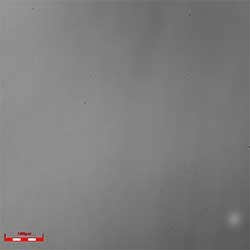
Objective lens 20X
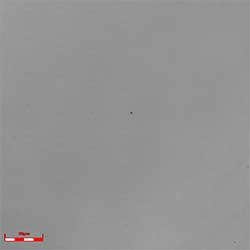
Objective lens 100X
Laser microscope differential interference image
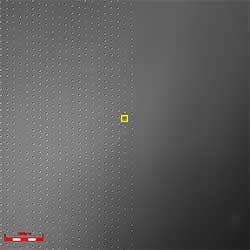
Objective lens 20X
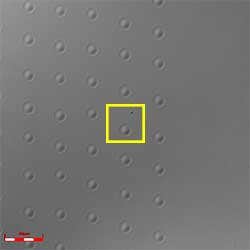
Objective lens 100X
Differential interference image
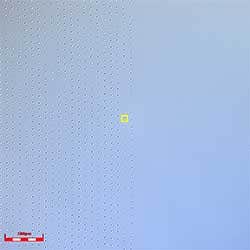
Objective lens 20X
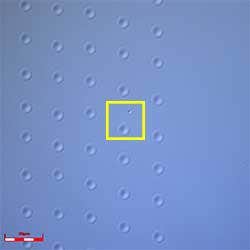
Objective lens 100X
2. Comparing data from laser microscopes and probe microscopes
Laser microscope image
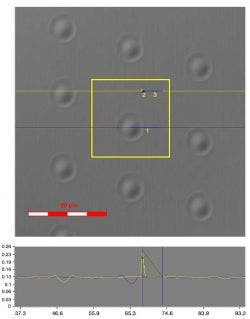
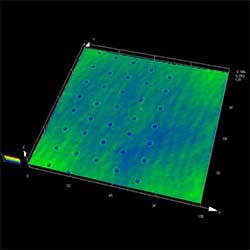
Depth of the dot pattern: 0.032 um
Width of the contaminant: 0.382 um
Height of the contaminant: 0.115 um
Probe microscope data
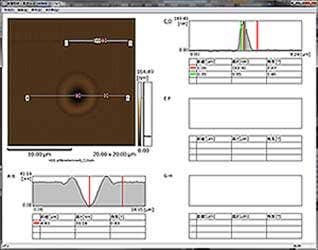
Depth of the dot pattern: 0.033 μm
Width of the contaminant: 0.390 μm
Height of the contaminant: 0.142 μm
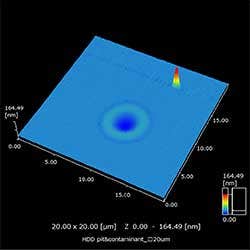
The data obtained with the probe microscope shows that the shape measurement of a contaminant of this size with a laser microscope cannot correctly capture the contaminant’s height because the size of the contaminant is close to the spot diameter of the laser (0.4 μm).
相关产品
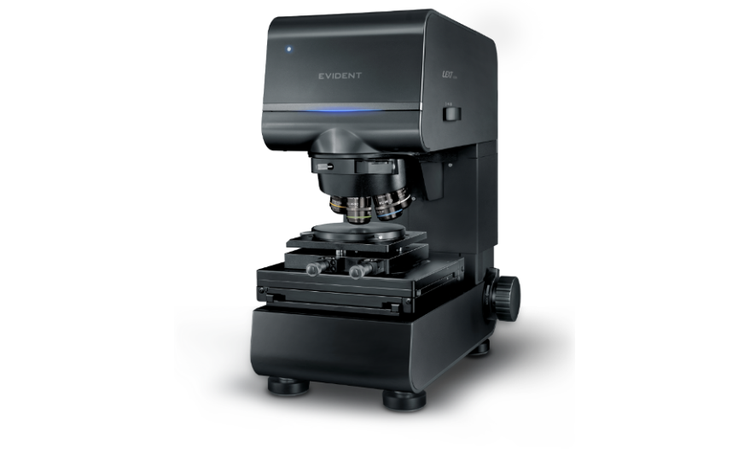
LEXT OLS5500
全新一代 精准测量 激光共聚焦显微镜
- 从纳米级至微米级的可追溯表面测量
- 一个获奖平台融合了激光扫描显微镜(LSM)、白光干涉仪(WLI)和焦点变化显微镜(FVM)技术
- 一款能够同时为 LSM 和 WLI 测量提供准确性和重复性* 保证的显微成像平台
- WLI 模式的测量通量比我们的传统 LSM 提高达 40 倍。
- 采用自主设计的光学系统,为表面测量提供卓越的测量精度
- 直观界面结合智能自动化,满足不同经验级别用户的操作需求
- 集成 PRECiV™ 软件的 AI 增强型高通量工作流程
* 根据 Evident 截至 2025 年 10 月的内部研究结果。设备必须按照制造商的规格进行校准并且不存在任何缺陷时,方可保证测量的准确性和可重复性。 校准必须由 Evident 的技术人员或 Evident 授权的专家执行。
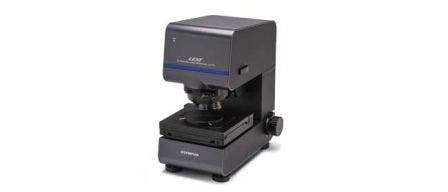
LEXT OLS5100
具有出色精度和光学性能的LEXT™OLS5100激光扫描显微镜配备了让系统更加易于使用的智能工具。其能够快速高效完成亚微米级形貌和表面粗糙度的精确测量任务,既简化了工作流程又能让您获得可信赖的高质量数据。