应用笔记
Measuring the Layer Profiles of Thin-Film Solid-State Lithium-Ion Batteries Manufactured Using the Inkjet Technique
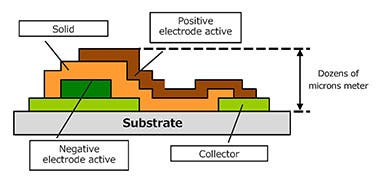
Thin-film solid-state battery
Application
Solid-state lithium-ion batteries are viewed as the next generation of batteries. There are several types of structures for the solid-state lithium-ion battery. While not widely available yet, the thin-film type is close to commercialization and is predicted to be primarily used in mobile equipment and home appliances. Solid-state lithium-ion batteries are expected to replace the lithium-ion batteries currently used due to the many advantages of solid-state batteries, which include:
- Reduced risk of overheating and/or fire
- Higher energy density, which increases charging capacity per weight or volume
- Slow progression of battery degradation
- Ability to operate in a wider range of ambient temperatures
However, there are some obstacles that must be overcome before these batteries can be widely used.
The first issue lays in manufacturing, as the current film deposition methods (such as sputtering and vapor deposition) are too slow to be cost-efficient in mass production. A potential solution is film deposition using inkjet devices, which can control film thickness with high precision.
The second obstacle is the inspection method. Film measurement using a contact-type roughness gage carries the risk of damaging the deposition surface. In addition, the measurement is made difficult by the black electrode materials, which cause the light of the interferometer to be absorbed.
The Evident Solution
The LEXT OLS5000 3D laser scanning microscope can measure the thickness of the deposited film and the surface roughness of formed electrodes and the electrolyte layer of a thin-film solid-state lithium-ion battery.
Product Features
- The OLS5000 microscope can detect a minute amount of reflected light, so data can be easily acquired—even for test objects less likely to reflect light, such as electrode materials.
- Thanks to the noncontact measurement, there is no risk of damaging test objects.
- For roughness measurement, the surface of a test object is scanned using laser light to acquire the planar roughness data. Planar roughness data has more information and more accurate data than line-only roughness data.
- Horizontal stitching of data and measurement across a wider area are available, helping ensure accurate stitched data.
- The stitching function enables measurement of a step between a substrate material and the back part of a negative electrode part.
- When a profile line has minute irregularities, the step can be measured by specifying the area around the point to be measured and using the average height as the height of the point.
Images
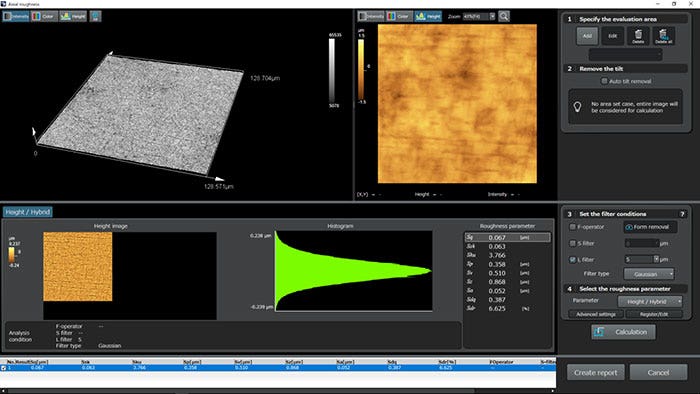
Roughness measurement of a positive electrode
The 3D shape data, laser image, and color image are simultaneously displayed, making your analysis more extensive than ever.
(Dummy sample in which lithium cobalt oxide is applied to metal foil using ink-jet coating)
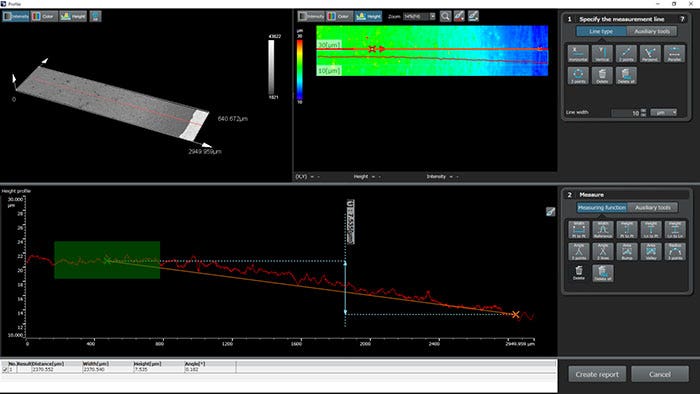
Film thickness measurement of a negative electrode
(Dummy sample in which silicon is applied to metal foil using ink-jet coating)
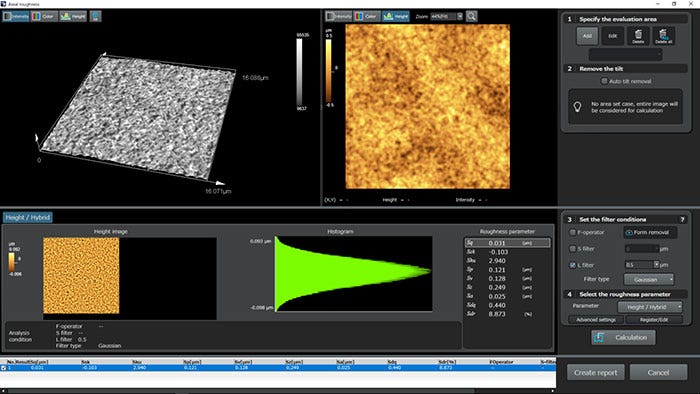
Roughness measurement of an electrolyte
(Dummy sample in which LATP-system glass ceramic is applied to metal foil using ink-jet coating)
相关产品
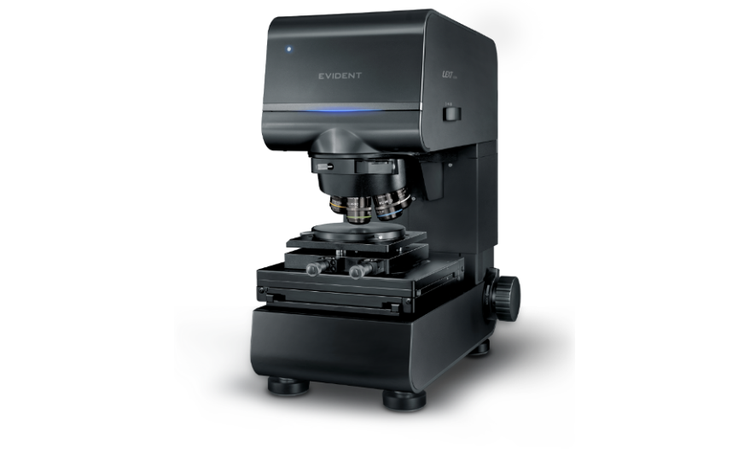
LEXT OLS5500
全新一代 精准测量 激光共聚焦显微镜
- 从纳米级至微米级的可追溯表面测量
- 一个获奖平台融合了激光扫描显微镜(LSM)、白光干涉仪(WLI)和焦点变化显微镜(FVM)技术
- 一款能够同时为 LSM 和 WLI 测量提供准确性和重复性* 保证的显微成像平台
- WLI 模式的测量通量比我们的传统 LSM 提高达 40 倍。
- 采用自主设计的光学系统,为表面测量提供卓越的测量精度
- 直观界面结合智能自动化,满足不同经验级别用户的操作需求
- 集成 PRECiV™ 软件的 AI 增强型高通量工作流程
* 根据 Evident 截至 2025 年 10 月的内部研究结果。设备必须按照制造商的规格进行校准并且不存在任何缺陷时,方可保证测量的准确性和可重复性。 校准必须由 Evident 的技术人员或 Evident 授权的专家执行。
LEXT OLS5100
具有出色精度和光学性能的LEXT™OLS5100激光扫描显微镜配备了让系统更加易于使用的智能工具。其能够快速高效完成亚微米级形貌和表面粗糙度的精确测量任务,既简化了工作流程又能让您获得可信赖的高质量数据。