应用笔记
Robot Insect Wings
Executive Summary
The Harvard School of Engineering and Applied Sciences required a measurement tool for quantifying the relationship between a natural insect wing, a micro-machined silicon mold and a fabricated wing.
The School of Engineering and Applied Sciences (SEAS) serves as the connector and integrator of Harvard's teaching and research efforts in engineering, applied sciences, and technology while fostering relationships with industry and government labs or serving as an "incubator" for new ventures.
Within SEAS sits the laboratory of award winning Professor Robert Wood whose research focuses on all aspects of mobile micro robot design, fabrication, control, and analysis. His lab's expertise in micro fabrication and micro system design combined with insights from nature has enabled the creation of high-performance micro robots for aerial and terrestrial environments. Such systems can be used for search and rescue, hazardous environment exploration, environmental exploration, monitoring and reconnaissance.
The Evident OLS4000(Formerly Olympus OLS4000) Laser Confocal System at Professor Wood's lab is used to provide accurate morphological measurements in the creation of micromolds and fabricated insect wings.
Re-creating Nature
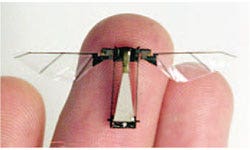
Attention to detail during fabrication, especially profile measurements, was of utmost importance. The LEXT OLS4000 Laser Scanning Confocal Microscope from Evident OLS4000(Formerly Olympus OLS4000) was chosen over a SEM and stylus profilometer as the preferred optical metrology tool for this project. The reason for this was the SEM is not able to measure height and a stylus profilometer lacks the ability to measure critical wall-like steep profiles as the stylus tip (typically having a square pyramid shape) will collide with the side wall and never reach the bottom. A feature of the OLS4000 is the ability to quickly and accurately measure deep cavities and 85 degree sloped walls.
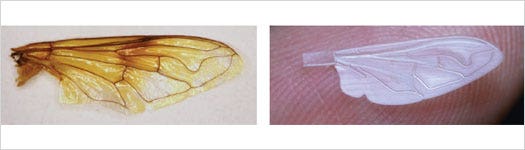
Real Wing Fabricated Wing
Quantifying the Process Method
After formal design of a hoverfly wing it is necessary to create a mold that will serve as the basis for manufacture. Painstaking efforts are taken to duplicate the intricate topographical features from both the top and bottom of the wing into a silicon mold.
Silicon is chosen for mold material due to its favorable compatibility with laser ablation etching properties. Laser ablation is used numerous times to etch/replicate the exact details. With 10 μ thin membranes, 50-125 μ vein heights and 100 μ corrugation heights one can imagine this is not an easy task.¹ The OLS4000 was used to integrate these three different micro-scale features as a quick check during the ablation process. After each ablation, the OLS4000 was used to provide feedback on etch depths, with an acceptable variation of ±0.3 micron/step. A scan with the OLS4000 took less than 1 minute-a very fast process with results deciding whether further ablation was necessary or not. Resulting measurements of the surface profiles of the natural wings, the molds, and the newly fabricated wings were able to demonstrate the high accuracy of this new replication molding process method.
Measuring Square Shaped Channels
As mentioned earlier the topology of fabricated wings also needs to match their natural counterparts. Aside from structure, wing profile also may play a role in various flight performance characteristics. An insect's wing profile affects the magnitude of aerodynamic lift and drag. Most importantly, the wing profile determines the wing flexibility and resultant deformation during flapping flight.
The LEXT OLS4000 utilizes dual confocal pinholes and detectors that increase the system's sensitivity such that sidewalls of up to 85 degrees can be imaged and measured. Because Dr. Tanaka's mold designs required deep-etch U-shaped channels with high aspect ratios, the OLS4000 was the only laser scanning confocal system that was able to accurately measure these critical surface features.
In addition, the stitching capability of the OLS4000 was key in making measurements and following structural features across a wider field of view. Stitching is a software technique that allows a number of high resolution images to be combined into one. This provided one cohesive profile measurement to be taken on what was now the entire wing section.

A. Fabricated wing, smooth side, 2-D
B. Fabricated wing, smooth side, 3-D
C. Fabricated wing, vein side, 3-D
D. Fabricated wing, vein side, 2-D
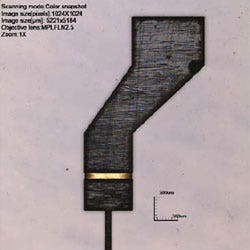
Cabon Hinge Overview. OLS4000 Brightfield CCD non-confocal mode, Objective lens MPLFLN 2.5X
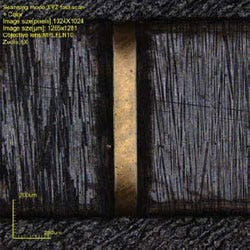
Carbon Hinge. OLS 4000 Laser confocal mode with color overlay.
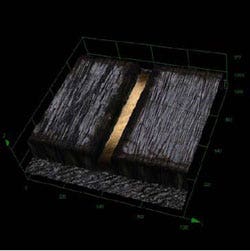
Carbon Hinge. OLS 4000 Laser confocal mode, 3D.
Verifying Carbon Hinge Quality

Evident LEXT OLS4000(Formerly Olympus LEXT OLS4000) Laser Scanning Confocal Microscope
相关产品
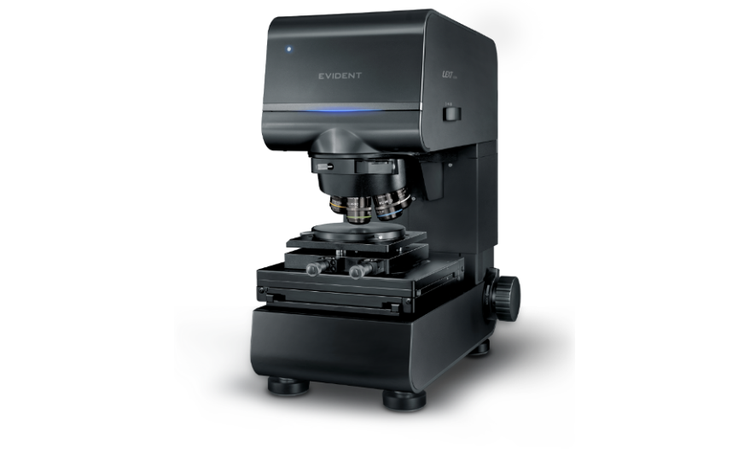
LEXT OLS5500
全新一代 精准测量 激光共聚焦显微镜
- 从纳米级至微米级的可追溯表面测量
- 一个获奖平台融合了激光扫描显微镜(LSM)、白光干涉仪(WLI)和焦点变化显微镜(FVM)技术
- 一款能够同时为 LSM 和 WLI 测量提供准确性和重复性* 保证的显微成像平台
- WLI 模式的测量通量比我们的传统 LSM 提高达 40 倍。
- 采用自主设计的光学系统,为表面测量提供卓越的测量精度
- 直观界面结合智能自动化,满足不同经验级别用户的操作需求
- 集成 PRECiV™ 软件的 AI 增强型高通量工作流程
* 根据 Evident 截至 2025 年 10 月的内部研究结果。设备必须按照制造商的规格进行校准并且不存在任何缺陷时,方可保证测量的准确性和可重复性。 校准必须由 Evident 的技术人员或 Evident 授权的专家执行。
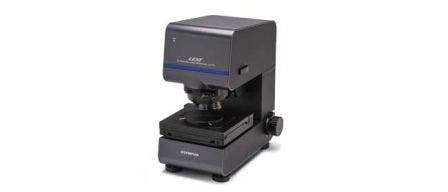
LEXT OLS5100
具有出色精度和光学性能的LEXT™OLS5100激光扫描显微镜配备了让系统更加易于使用的智能工具。其能够快速高效完成亚微米级形貌和表面粗糙度的精确测量任务,既简化了工作流程又能让您获得可信赖的高质量数据。