Innovations in Microscopy: FLUOVIEW™ FV5000 Redefines the Boundaries of Confocal and Multiphoton Imaging
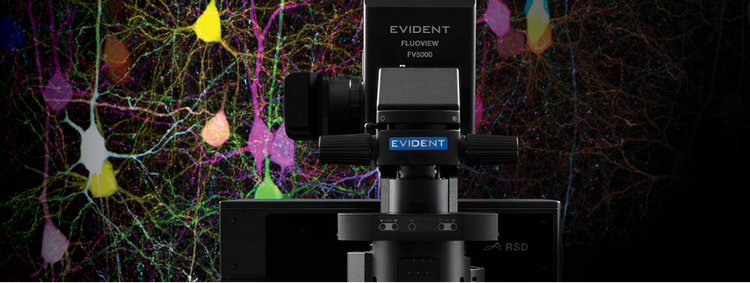
Mouse brain slice expressing 7-color Tetbow cleared with SeeDB2 (in utero electroporation). Sample courtesy of: Drs. Satoshi Fujimoto and Takeshi Imai, Graduate School of Medical Sciences, Kyushu University.


Life science research is entering a transformative era. Across imaging labs and core research facilities, scientists are facing growing demands for high-resolution, quantitative data to answer increasingly complex biological questions. Precision imaging is everything to the individuals leading the fields of neuroscience, cell biology, drug discovery, cancer research, and developmental biology.
Historically, researchers have often had to make difficult compromises in their work: balancing image quality with speed, or trading experimental depth for sample preservation. Capturing delicate live-cell processes required caution to avoid phototoxicity, while deep-tissue imaging was often limited by optical scattering or complex equipment setups. Even basic reproducibility has been a challenge, with slight variations in instrument calibration leading to inconsistent results between users, experiments, or labs.
With the introduction of the FLUOVIEW™ FV5000 confocal and multiphoton laser scanning microscope, these barriers can become things of the past. “The FV5000 redefines the boundaries of resolution, speed, and experimental versatility,” says Buelent Peker, Senior Product Marketing Manager at Evident and a recognized expert in laser scanning microscopy. “What was once incredibly challenging can now become routine thanks to exciting new advancements in scanning technology, detectors, and software.”
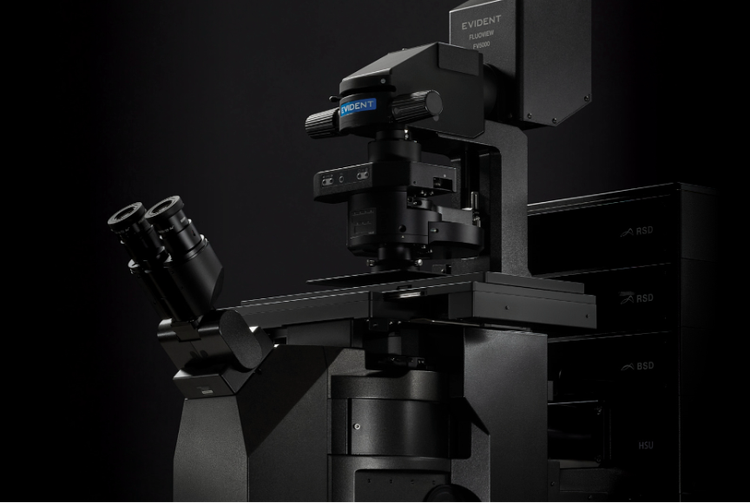
New Advancements in Life Science Confocal Microscopes
The FV5000 is built on profound new developments in life science confocal microscopy. When combined, these innovations create a fundamentally different imaging experience for users of all levels—one where speed, sensitivity, and quantitative accuracy work together, not against each other.
1. Quantitative Analysis with Photon Counting
One of the most transformative developments in modern confocal microscopy is photon counting technology. Traditionally, confocal microscopes relied on comparing relative light intensities to infer differences between samples. While this method provides qualitative information, it is highly sensitive to external factors such as detector voltage, alignment, laser power stability, and even temperature changes in the lab. Slight variations between experiments can cause inconsistent measurements. This makes quantitative comparisons unreliable, especially when trying to replicate results across time points, projects, or collaborative studies.
“With intensity level comparison, there are always some difficulties,” says Peker. “You need to control your instrument very tightly, and your detectors have to give you a count output with a specific sensitivity—the amplification of the signal reaching your detector needs to always be the same, the laser power reaching your sample needs to always be the same. Additionally, you have to make sure to always use the same channel on the system, as sensitivity can vary from detector to detector.”
SilVIR™ Detector Technology
The new benchmark in advanced microscopy, the FV5000’s next-generation SilVIR™ detector technology delivers photon-level quantitation that fundamentally changes this paradigm by detecting and counting individual photons, creating a true, absolute measurement of fluorescence intensity rather than a relative estimate. This transforms confocal microscopy into an absolute quantitative tool, bridging the gap between qualitative imaging and reproducible data analysis.
Reproducibility Across Labs
One of the main advantages of quantitative analysis is reproducibility across labs. For large-scale collaborations or multi-site research studies, reliable reproducibility is paramount—photon counting removes previous variables and enables researchers at different facilities to collect directly comparable data.
To further ensure consistency, the FV5000’s Laser Power Monitor (LPM) automatically measures and calibrates laser output in real time. This guarantees that identical imaging conditions—such as excitation power and detector response—are maintained across sessions and systems. Together, photon counting and LPM standardization eliminate key sources of variation, enabling true quantitative comparability.
This is especially critical in disciplines like neuroscience or drug discovery, where experimental replication is essential to validate results and ensure data integrity across research sites.
Consistency Within Experiments
The tracking of developmental processes or disease progression requires consistent imaging over weeks or even months. Photon counting ensures consistent and reliable measurements, allowing scientists to confidently compare time points without worrying about day-to-day calibration issues.
Complementing this, the Laser Power Monitor (LPM) continuously measures and compensates for laser power fluctuations during acquisition. This maintains identical excitation conditions from day to day, even across long-term experiments. Together, photon counting and LPM stability safeguard quantitative consistency—enabling researchers to track subtle biological changes with confidence.
The Elimination of Guesswork
Previously, scientists had to spend valuable time tweaking detector settings to avoid saturation or noise. This introduces both human error and workflow complexity—especially challenging for less experienced users. With the FV5000’s SilVIR technology, these manual adjustments are eliminated, making imaging simpler and more reliable for users of all experience levels.
“The photon-level quantitation made possible by the FV5000 takes the guesswork out of precision imaging and ensures that results can be trusted across different experiments and laboratories.”
2. Sensitivity and High Dynamic Range Detection
Biological samples often contain extremely diverse signal intensities. For example, a neuron soma might fluoresce brightly while thin axonal processes produce faint signals. Historically, researchers had to manually adjust gain or laser power to capture both, often requiring multiple images at different settings.
This approach is time-consuming and prevents direct quantitative comparison between regions or samples. The FV5000’s high dynamic range (HDR)—the widest in the industry—solves this challenge by simultaneously capturing both dim and bright signals within a single image. This provides exceptional sensitivity, allowing researchers to explore the full complexity of their samples.
“Ideally, you want to have a very sensitive detector and a high dynamic range, both of which you find with the FV5000,” Peker explains. “With traditional systems, if you wanted to effectively see intensities and structures, you would need to adjust your voltage to highlight the very dim parts—but if you increase your voltage then you have a different amplification, and your dynamic range is getting smaller. On the other hand, if you have very bright areas, then you need to decrease your levels. Then you end up with all this increasing and decreasing for different parts of the same sample—not ideal for acquisition consistency or intensity comparison.”
Elimination of Saturated Images
Another drawback of not being able to display dim and bright signals simultaneously is the generation of saturated images. Saturation occurs when bright regions overwhelm the detector, clipping data and destroying quantitative integrity. The FV5000’s HDR eliminates this risk, preserving information across the entire intensity spectrum.
“At the end of the day, saturation kills everything that needs to be analyzed—it needs to be avoided by any means. HDR is a big help.” — Buelent Peker
3. Wide-Band Imaging and Scanning Techniques
Confocal microscopy is no longer limited to visible light ranges—the FV5000 can span 400–900 nm with near infrared (NIR) lasers, enabling the use of NIR dyes that offer unique benefits for life science research.
Deeper Tissue Penetration
NIR light scatters less in biological tissues, allowing researchers to image deeper into 3D structures like organoids, embryos, or thick tissue slices. “With NIR dyes, you can go deeper into 3D tissue and thick samples—the penetration depth is simply better, with less scattering due to more redshifted dyes,” Peker says.
Reduced Phototoxicity
The FV5000’s longer wavelengths are gentler on living cells, extending the viability of long-term live-cell imagingexperiments. This is especially valuable for developmental biology and drug testing, where cells need to remain healthy for days or even weeks. According to Peker, “With NIR dyes, you can conduct live-cell imaging much longer in an incubated environment—your cells will not die as quickly due to less phototoxicity.”
4. Dual Galvo and Resonant Scanning
While precise, traditional galvo scanning has speed limitations, making it difficult to capture fast biological events or efficiently scan large tissue volumes. Resonant scanning addresses this challenge, dramatically increasing frame rates.
The FV5000 combines both scanning strategies, delivering dual-mode flexibility. Galvo mode can be used for experiments requiring maximum signal-to-noise ratio or complex stimulation patterns, such as optogenetics. Resonant mode, ideal for high-speed imaging of dynamic processes, can then be used for applications such as vesicle trafficking, calcium spikes, or whole brain scans at higher throughput.
“The FV5000’s scanning flexibility ensures that researchers can optimize their imaging for any application,” Peker says. “With both galvo and resonant scanning available on the same system, you can easily switch between modes as needed without compromising performance or image quality.”
5. High FPS Imaging
The FV5000 also offers high frames-per-second (FPS) imaging, essential for specific scientific tasks. High FPS imaging is ideal for tracking fast-moving cellular structures, like vesicles or cytoskeletal elements, and for capturing rapid physiological events. High FPS imaging can also be used to reduce acquisition times for large XYZ mosaic scans, making hours-long workflows six to ten times faster.
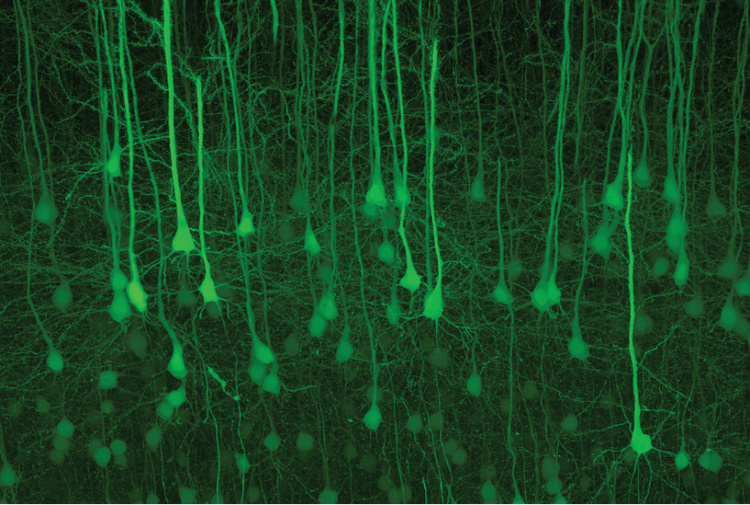
Mouse brain slice cleared with SeeDB2. EYFP cortical layer 5 pyramidal neurons in Thy1-YFP-H. Sample courtesy of: Drs. Satoshi Fujimoto and Takeshi Imai, Graduate School of Medical Sciences, Kyushu University.
6. Fiber Laser Technology
Multiphoton excitation (MPE) is essential for imaging deep into thick, scattering tissues, including brain slices, organoids, and living embryos. Traditional MPE systems often relied on bulky femtosecond infrared lasers that required large optical tables, specialized air conditioning to manage heat, and skilled technical staff. These systems were prohibitively expensive and difficult to integrate, which meant MPE was usually limited to facilities with large budgets and staff.
Incorporating innovative breakthroughs in fiber laser technology, the FLUOVIEW™ FV5000MPE is helping transform the multiphoton landscape, giving more labs the opportunity to study thick 3D samples and living organisms.
Compact and Accessible
The FV5000MPE’s multiphoton fiber lasers are significantly smaller and easier to integrate into existing systems than femtosecond IR lasers. They are also far less sensitive to environmental changes like vibration or temperature fluctuations.
Fixed Wavelengths
The FV5000MPE offers fixed-wavelength fiber lasers at 920 nm and 1064 nm, allowing researchers to select the optimal wavelength based on their experimental needs. For example, 920 nm is well-suited for exciting GFP and is widely used for imaging biological samples. On the other hand, 1064 nm is ideal for deeper tissue imaging, as it enables reduced scattering and better penetration into thick specimens.
Since these lasers operate at fixed wavelengths, they are easy to use, highly stable, and help reduce system costs while still meeting the general requirements of life science research.
Democratizing Deep Imaging
An affordable, easily deployed solution for routine multiphoton imaging, the FV5000MPE makes multiphoton more accessible to smaller labs and core facilities, expanding its reach beyond elite research centers. The FV5000MPE’s fiber lasers not only simplify multiphoton but also improve reliability, helping researchers image living organisms for extended periods without the complications of traditional systems.
“With the FV5000MPE, multiphoton technology is more accessible, cheaper, and easier to fit into labs,” says Peker. “Recent developments have given us the ability to create an MPE systems that is compact, easy to use, and easy to upgrade.”
“Fiber-coupled lasers are opening the door to deep-tissue imaging for labs that never had the resources before. This is a major step toward democratizing MPE technology.” — Buelent Peker
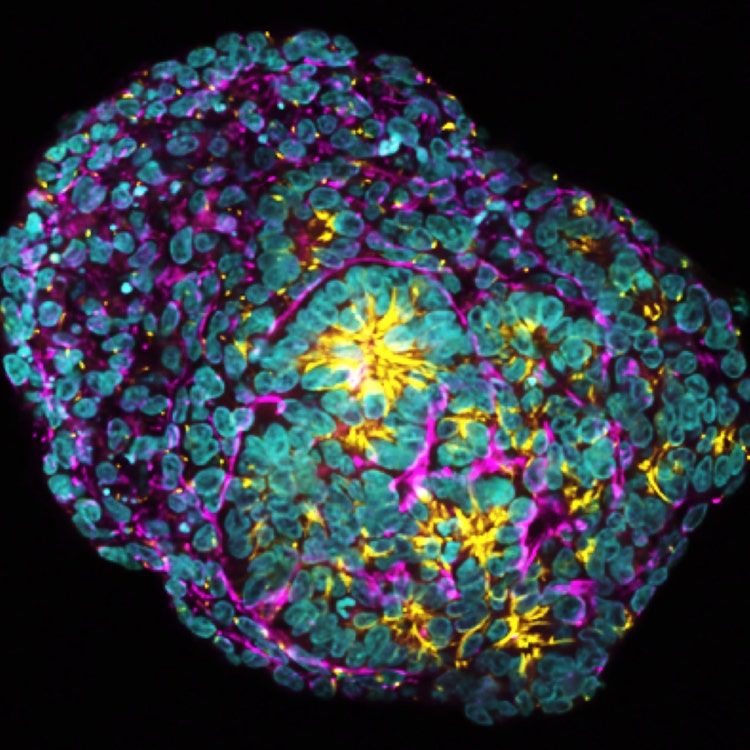
Human kidney organoid. Captured with single wavelength fiber-pigtailed IR lasers at 920 nm and 1064 nm for simultaneous 3CH multiphoton imaging with a LUPLAPO25XO objective lens. Sample courtesy of: Dr Robert Turnbull and Prof. Katja Röper, Department of Physiology, Development and Neuroscience, University of Cambridge.
A Technological Turning Point
The new FV5000 represents a technological turning point in confocal microscopy. With photon counting and actively controlled and monitored illumination power, researchers can now generate truly quantitative data that is reproducible across experiments and labs. High dynamic range detection eliminates image saturation and enables the simultaneous capture of faint and bright structures. And the combination of galvo and resonant scanning is redefining time-to-result, allowing dynamic biological events to be captured in real time.
Additionally, the FV5000MPE is helping democratize multiphoton excitation, making deep-tissue imaging accessible to a broader range of labs.
Beyond these system advancements, the FV5000 uses smart automation and AI-driven software to simplify complex workflows and reduce setup times, making both confocal and multiphoton systems more approachable for new users.
The FLUOVIEW FV5000 is an all-in-one laser scanning microscope system that empowers researchers to work faster, smarter, and more creatively, generating publication-ready images and robust quantitative data.
“The FV5000 makes it possible for more scientists to push the boundaries of discovery—advanced imaging is no longer limited to specialized labs.” — Buelent Peker
For life science researchers, the future has never looked more exciting.
Featured Products
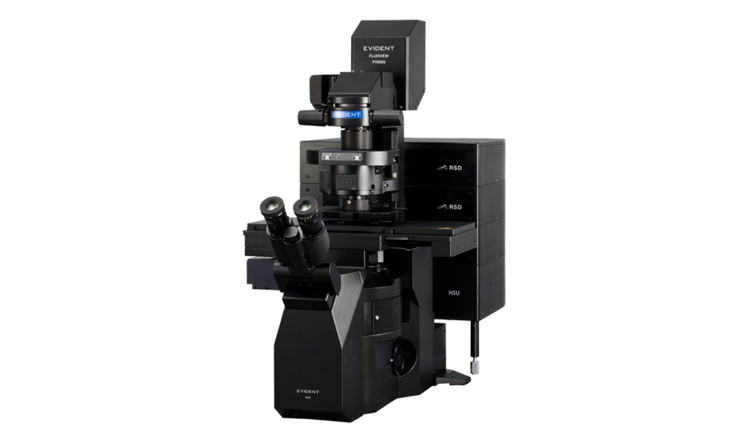
FV5000
Confocal Laser Scanning Microscope
- Extraordinary clarity, speed, and reliability driven by groundbreaking innovations
- SilVIR™ detectors deliver photon-level quantitation, exceptional sensitivity, and ultra-high signal-to-noise
- Unmatched dynamic range captures the full signal spectrum and prevents saturation
- High-speed 2K resonant scanning and high-density 8K galvo scanning in one platform
- FLUOVIEW Smart™ software simplifies operation with intuitive controls and AI-powered automation
- TruResolution™ auto correction collar optimizes focus for over 20 objectives
- Modular design supports up to 10 laser lines and future multiphoton upgrades
- Laser Power Monitor (LPM) ensures stable illumination and reproducible results over time
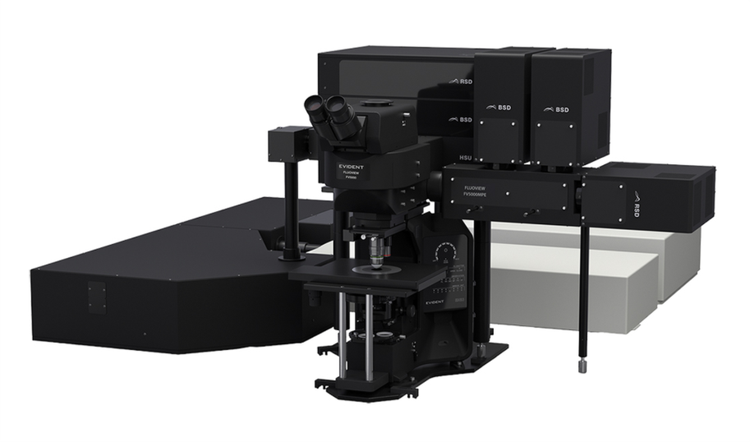
FV5000MPE
Multiphoton Laser Scanning Microscope
- Compact fiber-pigtailed lasers enable deep, quantitative imaging in scattering tissue
- One-, two-, or three-line simultaneous MPE laser excitation for millimeters deep imaging
- SilVIR™, TruAI, and TruSight™ technologies deliver outstanding signal-to-noise and clarity
- MPE-optimized objectives, TruResolution™ auto correction collar, and automated IR laser alignment maintain sharp focus
- Available as an FV5000 system upgrade or a complete MPE system
- Fully tunable laser configurations available for more advanced multiphoton applications
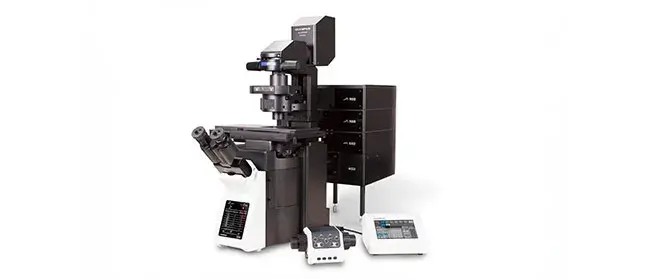
FLUOVIEW™ FV4000 Confocal Laser Scanning Microscope
Confocal Laser Scanning Microscope
- Game-changing dynamic range for imaging from the macro scale to subcellular structures
- Multiplex up to six channels simultaneously with TruSpectral technology
- Redesigned high-speed, high-resolution scanners for fixed and live cell imaging
- Improved depth and photosensitivity with pioneering NIR capabilities and renowned optics
- Peace of mind with the reliable, repeatable SilVIR detector
- Industry leading * ten laser lines with a broader spectral range from 405 nm to 785 nm
*As of October 2023.