Extraordinary Clarity, Speed, and Reliability
Confocal laser scanning microscopy delivers crisp optical sectioning, clean 3D stacks, and high signal-to-noise by focusing a laser beam to a diffraction-limited spot at the focal plane while rejecting out-of-focus light. From live cells to surface topography, our laser scanning confocal microscopes and multiphoton systems help you focus fluorescence, expand your field of view, and reveal more detail with less light.
Confocal laser scanning microscopy is a versatile method applied across life science, materials science, and industrial inspection to obtain high-resolution, high-contrast images of a sample. Laser scanning microscopes can scan samples point by point, resulting in optical sectioning that can be used to construct precise 3D images.
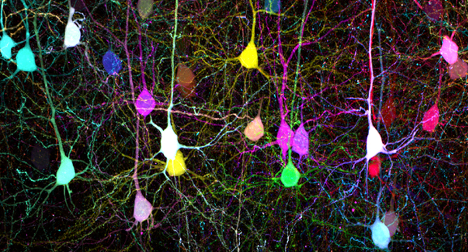
Mouse brain slice expressing 7-color Tetbow cleared with SeeDB2 (in utero electroporation). Sample courtesy of: Drs. Satoshi Fujimoto and Takeshi Imai, Graduate School of Medical Sciences, Kyushu University.
Life Science Confocal Microscopes
Evident’s laser scanning microscopes are designed with a range of imaging modalities to meet the most difficult challenges in life science.
Powered by our next-generation SilVIR™ detector technology, the FV5000 delivers exceptional sensitivity, speed, and reproducibility in a platform designed for simplicity. 2K resonant and 8K galvo scanning, intuitive FLUOVIEW Smart™ automation, and TruResolution™ automated correction collar adjustment bring clarity and confidence to every experiment, and new innovations make advanced multiphoton imaging more accessible and affordable than ever before.
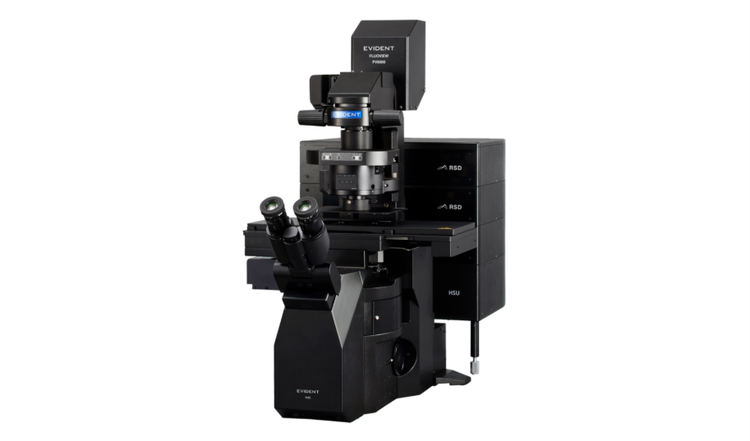
FV5000
Confocal Laser Scanning Microscope
- Extraordinary clarity, speed, and reliability driven by groundbreaking innovations
- SilVIR™ detectors deliver photon-level quantitation, exceptional sensitivity, and ultra-high signal-to-noise
- Unmatched dynamic range captures the full signal spectrum and prevents saturation
- High-speed 2K resonant scanning and high-density 8K galvo scanning in one platform
- FLUOVIEW Smart™ software simplifies operation with intuitive controls and AI-powered automation
- TruResolution™ auto correction collar optimizes focus for over 20 objectives
- Modular design supports up to 10 laser lines and future multiphoton upgrades
- Laser Power Monitor (LPM) ensures stable illumination and reproducible results over time
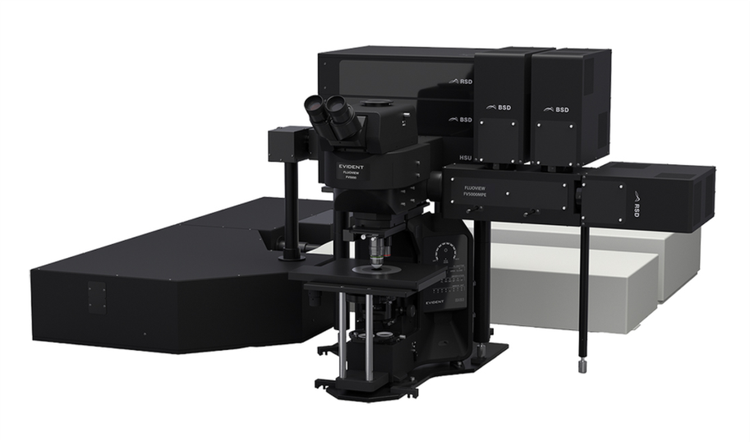
FV5000MPE
Multiphoton Laser Scanning Microscope
- Compact fiber-pigtailed lasers enable deep, quantitative imaging in scattering tissue
- One-, two-, or three-line simultaneous MPE laser excitation for millimeters deep imaging
- SilVIR™, TruAI, and TruSight™ technologies deliver outstanding signal-to-noise and clarity
- MPE-optimized objectives, TruResolution™ auto correction collar, and automated IR laser alignment maintain sharp focus
- Available as an FV5000 system upgrade or a complete MPE system
- Fully tunable laser configurations available for more advanced multiphoton applications
FV5000 + MPE: Combined Platform
A unified system that integrates confocal and multiphoton in one platform, the FV5000 + MPE lets teams switch modalities without changing workflows. A single software environment and optical path—often with shared stages and objectives—keeps operation consistent. Move from fast confocal to deep multiphoton on the same sample with a seamless handoff—this single, upgradeable platform simplifies procurement and service while protecting budget and uptime.
Learn about our latest microscopy innovations—see how we’re redefining confocal and multiphoton imaging.
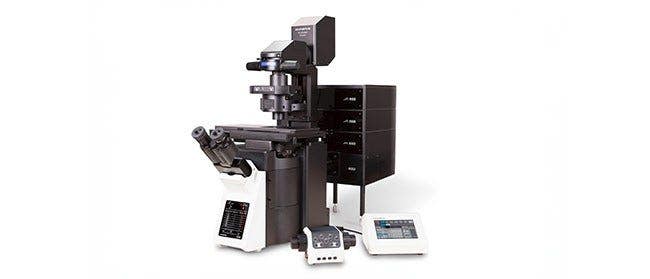
FV4000
Confocal Laser Scanning Microscope
- Game-changing dynamic range for imaging from the macro scale to subcellular structures
- Multiplex up to six channels simultaneously with TruSpectral technology
- Redesigned high-speed, high-resolution scanners for fixed and live cell imaging
- Improved depth and photosensitivity with pioneering NIR capabilities and renowned optics
- Peace of mind with the reliable, repeatable SilVIR detector
- Industry leading * ten laser lines with a broader spectral range from 405 nm to 785 nm
*As of October 2023.
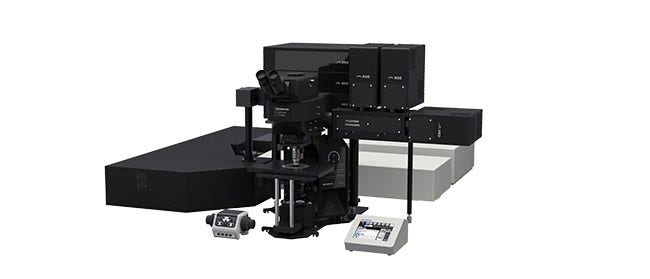
FV4000MPE
Multiphoton Laser Scanning Microscope
- Acquire accurate, quantitative image data from the macro scale to subcellular structures
- Obtain more information from a single multicolor imageMonitor neuron and other essential dynamics with high-speed imaging
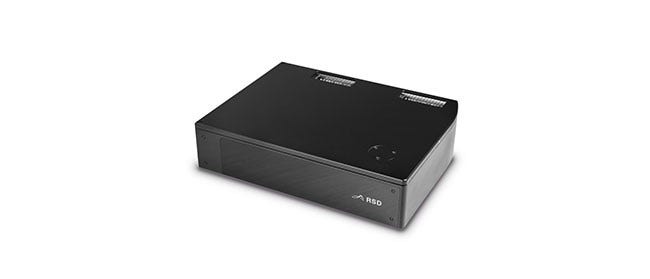
SilVIR Detector
FLUOVIEW Laser Scanning Microscope Solutions
- Combines a silicon photomultiplier and patented * fast signal processing for lower noise, higher sensitivity, and improved photon resolving capabilities
- High detection efficiency provides superior signal-to-noise to bring weak fluorescence to life
- Capture vivid fluorescence images with no offset adjustments
- Precisely quantify image intensity for more reliable data
*Patent number US11237047
3D Optical Profilometers and Industrial Confocal Microscopes
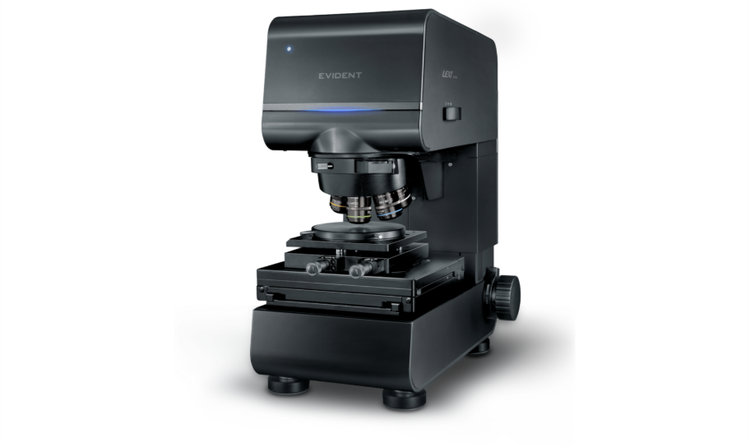
LEXT OLS5500
Hybrid 3D Optical Profilometer
- Traceable surface measurements from the nanometer to micrometer scale
- Laser scanning microscopy (LSM), white light interferometry (WLI), and focus variation microscopy (FVM) in one award-winning platform
- First 3D optical profilometer to offer guaranteed accuracy and repeatability* for both LSM and WLI measurements
- WLI mode delivers up to 40x faster measurement throughput than conventional LSM
- Exceptional precision across surfaces with in-house engineered optics
- Intuitive interface and smart automation streamline operation for users of all levels
- AI-enhanced and high-throughput workflows with PRECiV™ software integration
*Based on Evident’s internal research as of October 2025. The guaranteed accuracy and repeatability apply only if the device has been calibrated according to the manufacturer’s specifications and is in defect free condition. Calibration must be performed by an Evident technician or an Evident-authorized specialist.
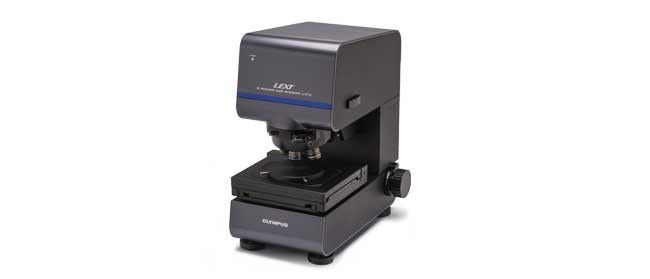
LEXT OLS5100
Confocal Laser Scanning Microscope for Materials Analysis
- Accurate measurements of 3D surface shapes at the submicron level
- High-performance optics reduce aberration throughout the entire field of view
- High-resolution image stitching and fast scanning speeds to quickly acquire images
- User-friendly interface and intuitive software enabling operation by all user types
Life Science Modalities and Specialized Features
Point-Scanning Confocal
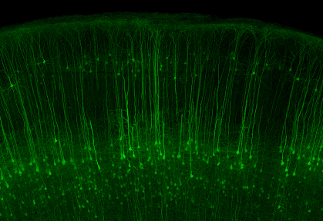
Mouse brain slice cleared with SeeDB2. EYFP cortical layer 5 pyramidal neurons in Thy1-YFP-H. Sample courtesy of: Drs. Satoshi Fujimoto and Takeshi Imai, Graduate School of Medical Sciences, Kyushu University.
Point scanning focuses a laser to a diffraction-limited spot and uses a pinhole at the focal plane to reject out-of-focus light, delivering high-contrast optical sections and quantitative 3D stacks. Choose 8K galvo for precise high-resolution mapping or 2K resonant for high-speed dynamics—both run on the same optics for comparable data. SilVIR detection helps achieve high signal-to-noise with fewer averages, and FLUOVIEW Smart™ software streamlines setup and workflow so users get to defendable data faster.
Multiphoton / Two-Photon Imaging
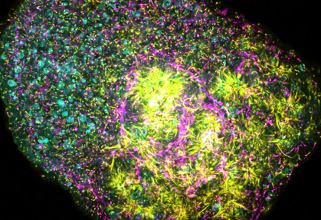
Human kidney organoid. AlexaFluor 488, 568,647 and DAPI used to target tubulin, integrin beta-1, laminin-111/211 and nuclei. Sample courtesy of: Dr. Robert Turnbull and Prof. Katja Röper, Department of Physiology, Development and Neuroscience, University of Cambridge.
Longer-wavelength excitation confines energy at focus, enabling deeper imaging in scattering tissue with lower photodamage—ideal for in vivo neurobiology, organoids, and cleared samples. The FV5000MPE module adds multiphoton (incl. SHG/THG) while keeping a single software workflow alongside confocal. IR alignment and stability features support repeatable acquisition across sessions and users.
Spectral / Tunable Detection (TruSpectral™)
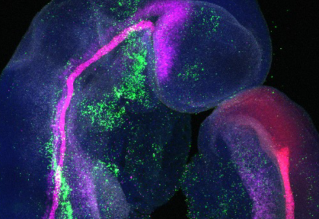
High-resolution five-channel confocal image of an embryo captured using DAPI and Alexa Fluor 488, 568, 647, and 750—revealing detailed structures across multiple fluorescence spectra. Sample courtesy of: Mohamed Gatie, PhD, Developmental Biology Program, Memorial Sloan Kettering Cancer Center.
TruSpectral™ detectors separate emissions by wavelength of light, improving contrast and enabling true multiplex fluorescence—even when spectra overlap. Capture up to six confocal channels simultaneously (≈400–900 nm) and use spectral unmixing to manage autofluorescence without sacrificing sensitivity. Paired with SilVIR detector technology, this delivers clean, quantitative confocal imaging for complex panels.
High-Speed Live Imaging (TruAI)
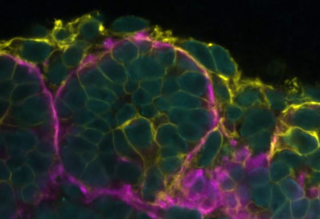
Human iPSC-derived kidney organoids with membrane-GFP. Sample courtesy of: Dr. Robert Turnbull and Prof. Katja Röper, Department of Physiology, Development and Neuroscience, University of Cambridge.
Resonant scanning increases frame rate for rapid cellular events while keeping exposure low for live cells. TruAI denoising restores clarity, maintaining temporal resolution and reducing the need for heavy averaging. Combine with smart tools (e.g., Smart Laser Power Adjustment) to balance gentleness and image quality for long time-lapse and volumetric studies.
Super-Resolution Imaging (FV-OSR)
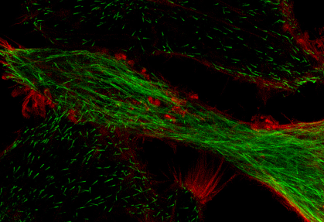
Cultured HeLa cells expressing Lifeact-mScarlet-I and EB3-3xmNeonGreen. Sample courtesy of: Haruka Mii, Prof. Kazuhiro Aoki,Graduate School of Biostudies, Kyoto University.
FV-OSR software enhances high-frequency information to push lateral detail beyond the diffraction limit—up to ~120 nm XY under defined conditions—without dedicated SR hardware. With high NA objectives and SilVIR sensitivity, you can acquire simultaneous multi-channel super-resolution images in everyday workflows. A practical path to subcellular answers when resolution, not speed or depth, is the bottleneck.
Spinning-Disk Confocal Imaging
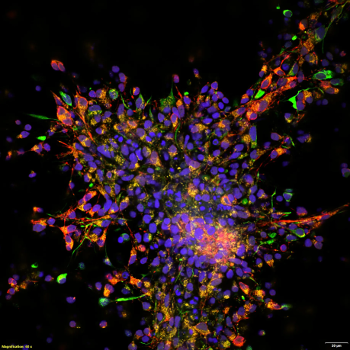
Neurons. DAPI (blue), ATP5 (yellow), vimentin (red), MAP2 (green).
A rotating disk with parallel pinholes scans many points at once, boosting speed and reducing light dose—well suited to delicate live samples and screens. Expect crisp sectioning with gentle illumination for fast events across a wider field of view. Availability may vary by platform; your specialist can advise fit and configuration. Contact us for more information.
Life Science Applications
Confocal and multiphoton microscopes are indispensable tools in life science research, enabling scientists to visualize and analyze biological structures and processes in unprecedented detail. These complementary imaging modalities provide a comprehensive understanding of complex biological systems—from subcellular mechanisms to whole-tissue dynamics.
Laser Scanning Confocal Microscopy: Precision and Clarity at the Cellular Level
Confocal microscopy uses focused laser light and pinhole detection to eliminate out-of-focus fluorescence, producing crisp, high-resolution optical sections of biological specimens. This allows researchers to reconstruct detailed 3D images of cells, tissues, and organoids with excellent contrast. Confocal systems are ideal for:
- High resolution fixed and live-cell 3D imaging: Subcellular resolution for studying organelles, cytoskeletal structures, or protein localization with fast acquisition and stable focus
- Quantitative fluorescence imaging: Precise measurement of fluorescence intensity for comparative studies
- Time-lapse studies: Capture of dynamic cellular events such as migration, division, or intracellular signaling
- Neuroscience and developmental biology: Fine processes at the focal plane with high contrast
- Multiplex fluorescence: Spectral detection separates overlapping dyes; robust excitation and emission control
Confocal microscopes are essential for research in cell biology, neuroscience, developmental biology, and molecular medicine.
Multiphoton Microscopy: Deeper Imaging for Live and Thick Samples
Multiphoton excitation (MPE) microscopy extends imaging capabilities beyond the limits of conventional confocal systems. Using longer-wavelength, near-infrared (NIR) light, MPE excites fluorophores at the focal point, allowing researchers to image millimeters deep into living tissue with minimal phototoxicity and photobleaching. Multiphoton is primarily used for:
- In vivo and intravital imaging: Observing neural activity in intact brain tissue or tracking cell movement within living samples
- Thick, scattering samples: Organoids, embryos, tissue explants
- Long-term live imaging: Reduced photodamage enables extended observation of developmental or physiological processes
- Deep imaging: Multiphoton/two-photon for thick or cleared tissues with improved penetration and viability
Because multiphoton systems achieve deeper tissue penetration and reduced background fluorescence, they are essential for imaging in more physiologically relevant environments.
Using Both Modalities for Comprehensive Biological Insight
By combining confocal and multiphoton microscopy, researchers can capture the full range of biological phenomena—from fine intracellular details to large-scale tissue dynamics. Integrated software and shared optical paths allow researchers to seamlessly switch between modalities depending on their imaging depth and sensitivity requirements. This dual capability supports a wide variety of life science applications, including Neuroscience, cancer research, developmental biology, and immunology. By using both modalities, researchers can gain deeper, more comprehensive insights into the complexity of life at every scale.
See how FV5000 confocal and multiphoton imaging can reveal more in live cells and thick tissues.
Materials and Industrial Metrology Applications
See what surfaces are really doing. Confocal imaging for materials science and industrial metrology applications uses laser scanning and precise focus light control to capture 3D topography and geometry—non-contact, repeatable, and fast.
Applications include surface roughness and coating thickness measurement, semiconductor/ microelectronics inspection, analysis of automotive and aerospace components, inspection of battery electrodes and additive manufacturing surfaces, polymer and composite inspection, and imaging of opaque/reflective samples.
Laser Scanning Confocal Microscopy: High-Resolution Surface Imaging and Measurement
Confocal microscopy offers exceptional surface imaging and metrology capabilities by using focused laser light and a pinhole aperture to eliminate out-of-focus reflections. This produces crisp, three-dimensional surface profiles with nanometer-level precision—ideal for evaluating microstructures and topographies. Applications in industrial metrology include:
- 3D surface profiling: accurate measurement of height, roughness, and surface texture for metals, polymers, ceramics, and composites
- Thin film and coating analysis: evaluation of thickness uniformity, layer adhesion, and defects without cross-sectioning
- Failure analysis: detection of microcracks, delamination, and wear on mechanical or electronic components
- Non-contact measurement: confocal imaging avoids physical contact with delicate or high-value samples, preserving sample integrity
Confocal microscopy excels in precision inspection of smooth or reflective surfaces, where detailed optical sectioning and fine focus control provide highly reproducible data for quality assurance, R&D, and production environments.
Related Categories
Confocal Microscope FAQs
Confocal and multiphoton systems use tightly focused light from a stable light source to scan across the sample. A pinhole rejects stray light, producing thin optical sections that assemble into accurate 3D data.
Point-scanning confocal (galvo/resonant) equals flexible, quantitative confocal imaging. Two-photon/multiphoton means a longer wavelength of light for deeper imaging with reduced photodamage. Spectral/tunable detection separates overlapping fluorophores by wavelength to improve contrast and multiplexing.
Laser scanning confocal microscopes are used across life science and industrial research—from live cells and thick tissues to surfaces and microfeatures—to deliver high-contrast optical sections, quantitative 3D stacks, and reproducible measurements. By focusing a laser beam to a diffraction-limited spot and rejecting out-of-focus light at the focal plane, confocal systems provide the signal-to-noise and clarity needed for molecular, cellular, and structural studies.
Learn more in our Microscopy Resource Center.
Point-scanning confocal systems raster a focused laser spot across the field of view; emitted light is relayed through a pinhole conjugate to the focal plane so only in-focus photons are detected. This spatial filtering improves contrast versus widefield, enables optical sectioning, and supports accurate 3D reconstructions.
With the FLUOVIEW FV5000 microscope, you can choose 8K galvo scanning for high-density mapping or 2K resonant scanning for high-speed dynamics—on the same optical path for comparable data—while SilVIR detectors help achieve high SNR with fewer averages.
Learn more in our Microscopy Resource Center.
Multiphoton (two-photon) microscopy uses tightly focused near-infrared excitation (typically ~700–1300 nm) to confine excitation to the focal point. Because longer wavelengths of light scatter and absorb less, multiphoton enables deeper, gentler imaging in thick or scattering specimens without a confocal pinhole—capturing more useful signal, including scattered photons.
The FLUOVIEW FV5000MPE microscope adds multiphoton (including SHG/THG support) within a single software workflow alongside confocal.
Magnification is set by objective and zoom. The FV5000 microscope supports a broad range of objectives—from low magnification for whole-tissue context to high magnification (e.g., 60X–100X) for subcellular structures—plus system zoom to frame regions of interest without changing optics.
Your Evident specialist can recommend objective/zoom combinations for your sample and field of view needs.
Systems are modular. You can start with a configuration that fits your application and budget (e.g., selected lasers, detectors, and objectives) and upgrade as needs evolve—up to adding the FV5000MPE multiphoton module for deeper imaging.
Contact your local Evident representative to discuss configurations, request a demo, or get a quote.
Confocal Resources
Introduction to Confocal Microscopy
Read our primer on confocal microscopy, covering its history; principles; and configurations, advantages, and limitations.
Concepts in Confocal Microscopy
Explore our resource hub on confocal microscopy, featuring techniques, applications, tutorials, and reference guides.
Confocal Microscope Scanning Systems
Learn more about scanning systems for confocal microscopy and their advantages for different life science applications.
Basic Principles of Laser Scanning Microscopes
Browse through our metrology resource center on industrial laser scanning microscopes, covering the basic principles for materials science and inspection.