Overcoming the Challenges of Organoid Imaging Using a Silicone Gel Immersion Objective
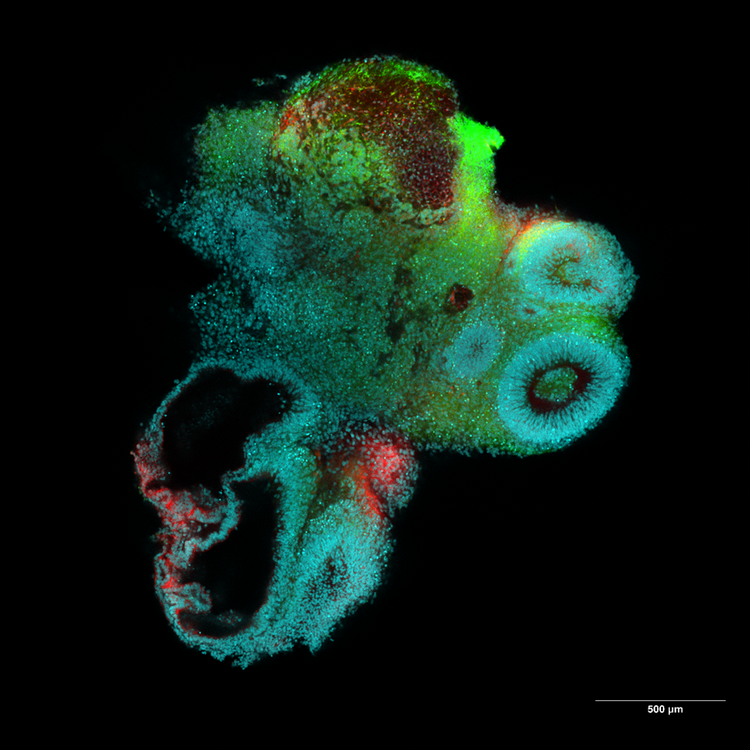
Cerebral organoid: cyan: nuclear, green: TUJ1, red: PAX6

Taro Hayashi
Life Science Application Scientist
8 April 2026
Organoids, which mimic human organs, are increasingly vital in drug screening and disease modeling. However, their significant thickness and size present unique challenges for microscopy.
Typically, researchers use a workflow that alternates between low-magnification for navigation and high-magnification for detail, or they employ image stitching to capture the entire specimen. While standard air (dry) objectives are convenient, they often fall short in resolution and working distance when imaging deep into the organoid.
To achieve high-resolution 3D imaging, confocal microscopes paired with liquid immersion objectives (water, oil, or silicone oil) are the gold standard. Yet, these approaches introduce operational challenges: oil contact can break during stage movement, and residual oil on the dish can degrade images when switching back to air objectives.
In this post, we evaluate a breakthrough solution: a first-of-its-kind silicone gel immersion objective lens (LUPLAPO25XS) paired with the FLUOVIEW™ FV5000 confocal laser scanning microscope for brain organoid imaging. We explore the three main advantages of this optical technology compared to using conventional silicone oil immersion objectives.
Protocol for the Organoid Imaging Experiment
To evaluate the benefits of silicone gel immersion, we used the organoid produced using the following protocol:
Cerebral Organoid Generation
Human induced pluripotent stem cells (hiPSCs; line 201B7) were maintained under undifferentiated conditions using eTeSR medium (STEMCELL Technologies). Cerebral organoids were generated using the STEMdiff Cerebral Organoid Kit (STEMCELL Technologies). The differentiation process, including embryoid body formation, neuroectoderm induction, and subsequent organoid maturation, was carried out according to the instructions provided with the STEMdiff Cerebral Organoid Kit.
Immunostaining and Tissue Clearing
Organoids were fixed and subjected to immunostaining using DAPI for nuclear labeling, anti-TUJ1 (Alexa Fluor 488) for neuronal markers, and anti-PAX6 (Alexa Fluor 594) for neural progenitor markers. Following staining, samples were cleared using the Sca l eS4 tissue-clearing reagent prior to imaging.
3 Advantages of Using Silicone Gel Immersion for Brain Organoid Imaging
The experiment demonstrated how the LUPLAPO25XS silicone gel immersion objective paired with the FV5000 confocal microscope overcame common operational challenges in brain organoid imaging. Here are the three key advantages:
1. Z-Axis Stability: Freedom from Contact Loss
Conventional silicone oil immersion requires a continuous liquid bridge between the lens and the dish. During deep Z-stack imaging or significant Z-focus adjustments, this bridge can easily break.
- The silicone oil challenge: Once the silicone oil contact is lost, returning to the original Z-coordinate often results in a blurred image because the oil does not automatically reform a perfect meniscus. Researchers must manually intervene to reapply the oil or adjust the lens, interrupting the experiment (Figure 1).
- The silicone gel advantage: Thanks to the elastic properties of the silicone gel, the contact is resilient. Even if the lens is moved far away from the dish, returning to the target Z-coordinate instantly restores a high-resolution image. This enables more flexible focus adjustments and highly reproducible imaging sessions (Figure 2).
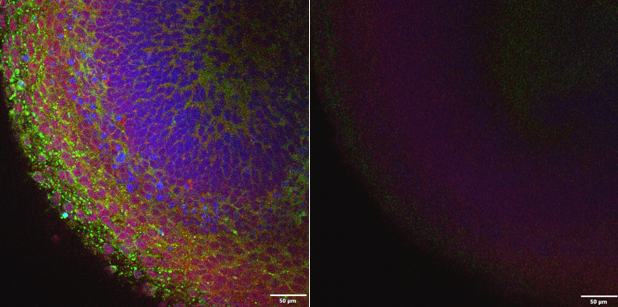
Figure 1. Contact loss with a silicone oil immersion objective causes image brightness/quality loss. Blue: nuclear. Green: TUJ1. Red: PAX6.
Left: Regular observation with the UPLSAPO30XSIR silicone oil objective; the images are very clear.
Right: After the escape function moves the objective away and repositions it, image brightness and quality decrease due to missing oil between the objective and sample.
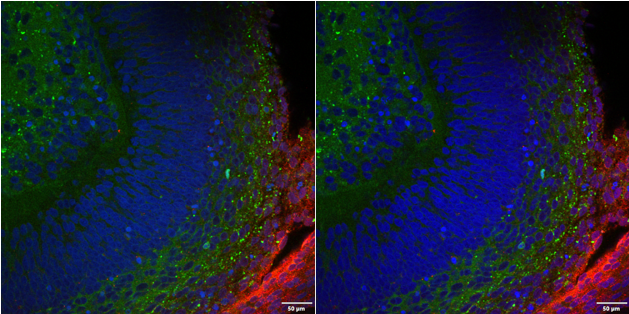
Figure 2. Silicone gel maintains contact even after moving the objective. Blue: nuclear, Green: TUJ1, Red: PAX6.
Left: Regular observation with the LUPLAPO25XS silicone gel immersion objective; the images are very clear.
Right: After the escape function moves the objective away and repositions it, the same image quality is reproduced.
2. Seamless Lens Switching: A Zero-Cleaning Workflow
In a typical observation workflow, researchers often switch back to a low-magnification air objective after high-resolution inspection.
- The silicone oil challenge: Silicone oil leaves a messy residue on the bottom of the imaging dish. If you switch to an air objective without thoroughly cleaning the dish, the residual oil can cause severe spherical aberration, making the image unusable. This cleaning process is time-consuming and risks jarring the sample (Figure 3).
- The silicone gel advantage: Silicone gel is non-migratory and does not leave a liquid residue on the dish. Our verification showed that you can switch from the gel objective to an air objective and immediately continue observing with zero image degradation. This enables a seamless workflow that combines the convenience of dry objectives with the optical performance of immersion imaging (Figure 4).
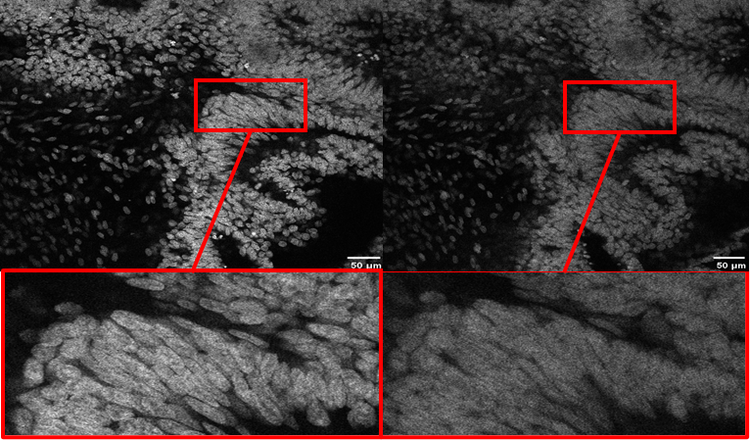
Figure 3. Dry objective image comparison before and after using a silicone oil immersion objective. Gray: nuclear.
Left: 20X dry objective image (UPLXAPO20X) before using a silicone oil immersion objective.
Right: 20X dry objective image after using an oil immersion lens. The image quality decreases because oil remains on the sample.
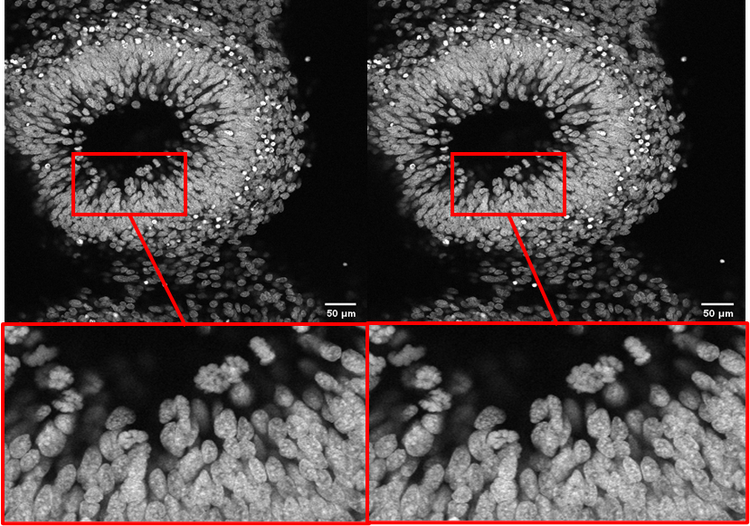
Figure 4. Dry objective image comparison before and after using the silicone gel immersion objective. Gray: nuclear.
Left: 20X dry objective image (UPLXAPO20X) before using the silicone gel objective.
Right: 20X dry objective image after using the silicone gel objective. The image quality remains equivalent because no immersion residue is left between the dry objective and sample.
3. Automated Multi-Well Success: Stability in Image Stitching
High-throughput research often requires image stitching and 3D imaging across multiple organoids in a multi-well plate.
- The silicone oil challenge: Moving the stage between wells often causes the silicone oil to separate or deplete, leading to failure in automated imaging runs. In our tests, the silicone oil objective lens failed to maintain contact beyond the first well (Figure 5).
- The silicone gel advantage: The silicone gel immersion objective successfully captured all targeted organoids across multiple wells without a single instance of contact loss (Figure 6).
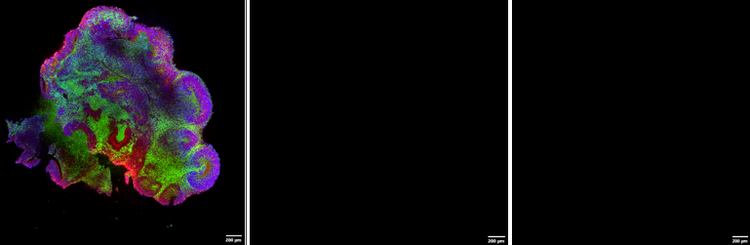
Figure 5. Multi-position imaging with an oil immersion lens (6×6 stitched image). Blue: nuclear. Green: TUJ1. Red: PAX6. Three different organoids were observed with an oil immersion objective. Imaging failed at the second organoid due to loss of oil contact. Organoids were placed one per well in a chamber slide.
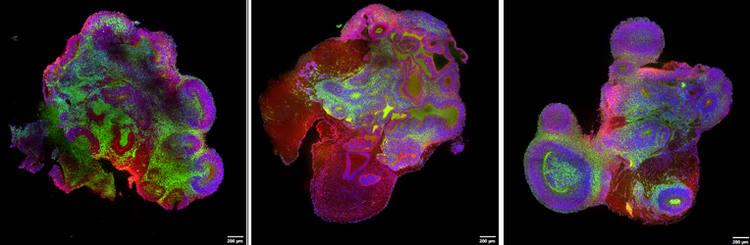
Figure 6. Multi-position imaging with a silicone gel immersion objective (6×6 stitched image). Blue: nuclear. Green: TUJ1. Red: PAX6. Three different organoids were observed using the silicone gel objective, which successfully imaged all organoids with high image quality. Organoids were placed one per well in a chamber slide.
The New Standard for Organoid Research
Our verification confirms that the LUPLAPO25XS silicone gel immersion objective offers the best of both worlds: the ease of use of an air objective and the optical performance of an immersion objective.
When combined with the FV5000 confocal laser scanning microscope, this optical technology helps address multiple challenges in organoid imaging—oil contact loss, cleaning steps between observations, and interruptions in automated imaging runs.
The result: researchers can focus more on their experiments and less on their objective lens.
Discover how silicone gel immersion technology can help streamline organoid imaging while maintaining high image quality and reproducibility. Reach out to the Evident team today to learn more and set up a demonstration.
Featured Products
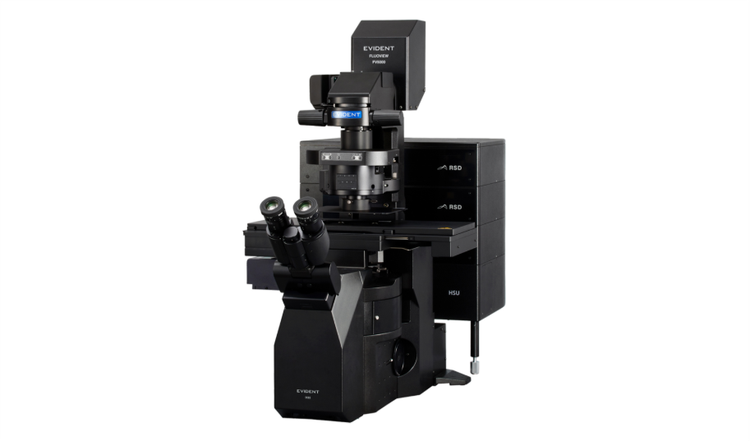
FV5000
Confocal Laser Scanning Microscope
- Extraordinary clarity, speed, and reliability driven by groundbreaking innovations
- SilVIR™ detectors deliver photon-level quantitation, exceptional sensitivity, and ultra-high signal-to-noise
- Unmatched dynamic range captures the full signal spectrum and prevents saturation
- High-speed 2K resonant scanning and high-density 8K galvo scanning in one platform
- FLUOVIEW Smart™ software simplifies operation with intuitive controls and AI-powered automation
- TruResolution™ auto correction collar optimizes focus for over 20 objectives
- Modular design supports up to 10 laser lines and future multiphoton upgrades
- Laser Power Monitor (LPM) ensures stable illumination and reproducible results over time
Taro Hayashi
Life Science Application Scientist
Taro Hayashi is a life science application scientist in the R&D department at Evident, where he focuses on developing advanced microscopy applications. He earned his master’s degree in life science from Tokyo Metropolitan University in 2010, then joined Evident later that year. During his academic studies, he specialized in beetle taxonomy and comparative morphology, exploring the diversity and structure of living organisms. At Evident, he has contributed to the development of the LV200 bioluminescence imaging system and IXplore™ IX83/IX85 microscope platform, helping support researchers in achieving innovative imaging results.