Breaking Barriers in Macro-to-Micro Confocal Imaging
Achieving Wide Field of View, High-Resolution, and Deep-Tissue Observation with a Single Objective Lens
In modern life science research, including neurobiology, oncology, and developmental biology, there is a critical need to analyze intracellular structures and functions in correlation with the architecture and functionality of the tissue in which the cells originally existed.
Confocal laser scanning microscopy (CLSM) and spinning disk confocal microscopy (SDCM) are core modalities for high-resolution fluorescence imaging. However, achieving comprehensive macro-to-micro correlation in thick samples requires overcoming optical and workflow constraints, notably limited working distance, aberrations from refracted index (RI) mismatch, and cumbersome objective lens switching.
This white paper addresses these limitations and details a solution that integrates a wide field of view, long working distance, and high numerical aperture (NA) in a single objective lens—paired with automated, depth-aware spherical aberration correction—to streamline macro-to-micro imaging.
Challenges in Macro-to-Micro Imaging with Confocal Microscopy
Conventional confocal imaging using objective lenses with a high magnification (e.g., 60X), high NA, and oil immersion medium enables acquisition of detailed cellular-level information.
However, correlating these data with the global structure of thick tissue has been difficult. A typical workflow requires first capturing the overall tissue using a low-magnification dry objective, followed by switching to a high-magnification oil immersion objective to image localized regions. This process introduces operational complexity and misalignment risk due to repeated switching between dry and oil objectives.
To overcome this limitation, a single objective lens capable of macro-to-micro imaging—simultaneously providing a wide field of view, long working distance, and high NA—has been needed. Previously, objectives meeting these criteria were generally confined to 75 mm parfocal length, limiting application to specialized upright systems and preventing use on inverted microscopes. As a result, these lenses were restricted to dedicated platforms rather than broadly deployable systems.
Furthermore, the refractive indices of tissue-clearing reagents (Table 1) span approximately 1.38–1.56; which is relatively high. Refractive index mismatches introduce spherical aberration, degrading resolution and contrast and creating a major barrier to deep-tissue observation and quantitative 3D analysis.
Table 1. Representative refractive indices of tissue-clearing reagents.
Innovating the LUPLAPO25XO Oil Immersion Objective Lens
Evident has applied its ultra-thin lens polishing technology built into the high-performance X Line™ objectives series1 to develop the world’s first oil immersion apochromatic objective with a compact 45 mm parfocal length that achieves an NA of 1.00 and working distance of 1.0 mm (Table 2).
The LUPLAPO25XO objective lens (25X) combines a wide field of view, long working distance, and high NA into a single, universally deployable objective—providing broader, deeper, and more detailed imaging without changing optics (Figure 1, Table 2). The lens incorporates a correction collar that supports specimen refractive indices from 1.45 to 1.56, ensuring compatibility with a range of tissue-clearing reagents and effectively suppressing spherical aberration (Figure 2).
When paired with the FLUOVIEW™ FV5000 confocal and FV5000MPE multiphoton laser scanning microscopes, the TruResolution™ system provides automated correction collar adjustment. This system enables easy and reproducible spherical aberration correction for users at any skill level. During Z‑stack acquisition, the system continuously optimizes the collar position according to depth, maintaining correction throughout the entire 3D volume.2
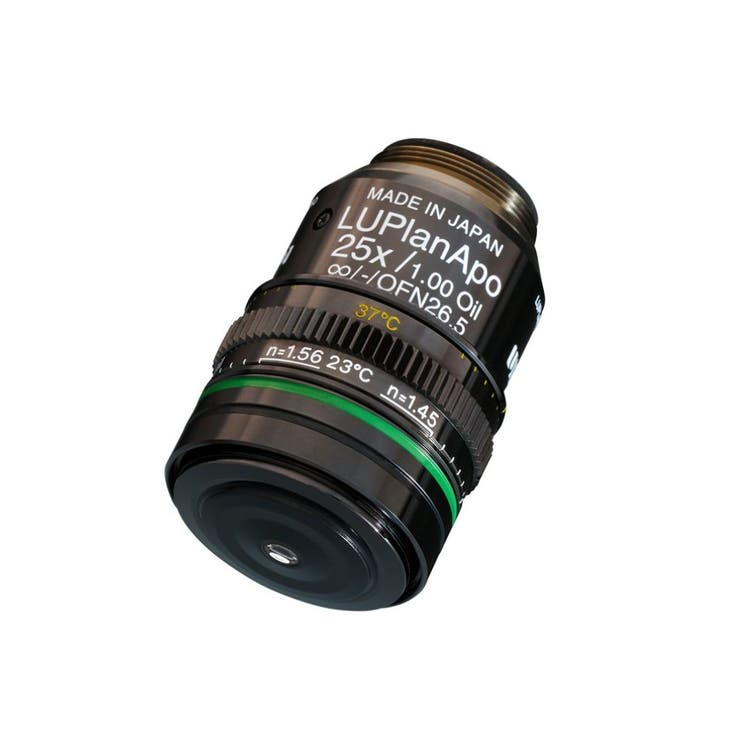
Figure 1. LUPLAPO25XO objective lens.
Refractive index of sample: 1.45 ~ 1.56
Table 2. LUPLAPO25XO specifications.
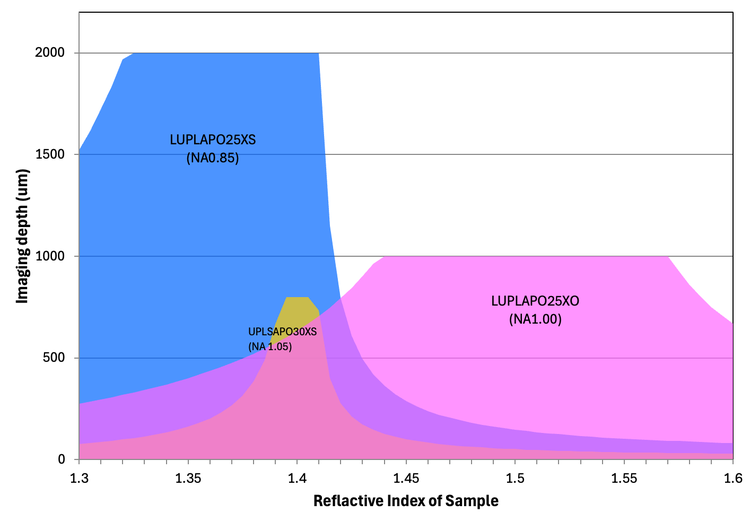
Figure 2. Refractive index compatibility range and maximum imaging depth for objective lenses used for deep imaging. This graph illustrates the range of specimen refractive indices that can be observed with aberration suppression through correction collar adjustment, as well as the maximum imaging depth achievable.
For the LUPLAPO25XO objective lens, adjusting the correction collar enables spherical aberration correction for specimens with refractive indices between 1.45 and 1.56, allowing precise imaging up to 1 mm depth in samples treated with representative tissue-clearing reagents. Even for specimens with lower refractive indices, such as live cells (RI ≈ 1.36–1.38) or tissues cleared with SCALEVIEW-A2 (RI ≈ 1.38), correction is possible to a certain extent, enabling relatively high-quality imaging down to approximately 500 µm depth.
Imaging Applications in Advanced Life Science Research
The LUPLAPO25XO objective lens is ideally suited for deep observation of tissue-cleared specimens and for simultaneous visualization of fine cellular structures and overall tissue architecture. Its performance is maximized when used with the FLUOVIEW FV5000 for confocal three-dimensional imaging.
1. Wide Field of View, High-Resolution 3D Imaging
Using the LUPLAPO25XO objective lens, it is possible to capture a wide area of approximately 0.5 mm × 0.5 mm at a resolution of about 230 nm in a single scan. The image shown in Figure 3 represents a maximum intensity projection (MIP) of a Z-stack acquired from the surface to a depth of 250 µm in a mouse brain slice cleared with the SeeDB2 tissue-clearing reagent (n = 1.52).
Traditionally, capturing an area of this size at equivalent resolution required imaging nine separate regions (3 × 3) using a 60X oil immersion objective, followed by stitching the images together. Moreover, the working distance of a 60X oil immersion lens is only about 0.1 mm, making imaging at 250 µm depth impossible. In contrast, the LUPLAPO25XO objective lens combines a wide field of view and long working distance, enabling efficient deep observation and acquisition of highly detailed 3D images in significantly less time.
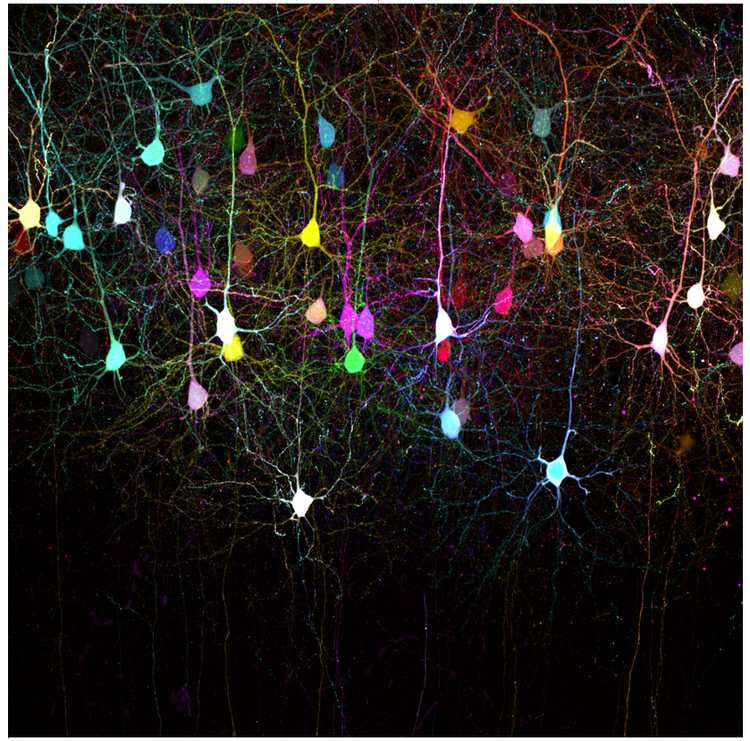
Figure 3. Mouse brain slice expressing 7-color Tetbow, cleared with SeeDB2 (in utero electroporation) and imaged on FLUOVIEW FV5000.
Sample courtesy of: Drs. Satoshi Fujimoto and Takeshi Imai, Graduate School of Medical Sciences, Kyushu University.
2. Capturing Subcellular High-Resolution Images Using Ultra-High Pixel Density Imaging
When capturing the maximum field of view at 8192 × 8192 pixels, the system achieves a pixel pitch of 69 nm, enabling extremely high spatial sampling. By applying TruSight™ deconvolution processing to these datasets, structures that previously required super-resolution microscopy for visualization can now be rendered with exceptional clarity (Figure 4). This advancement enables researchers to observe tissue architecture and fine cellular structures within a single image, providing a unified view that bridges macro-scale organization and micro-scale detail.
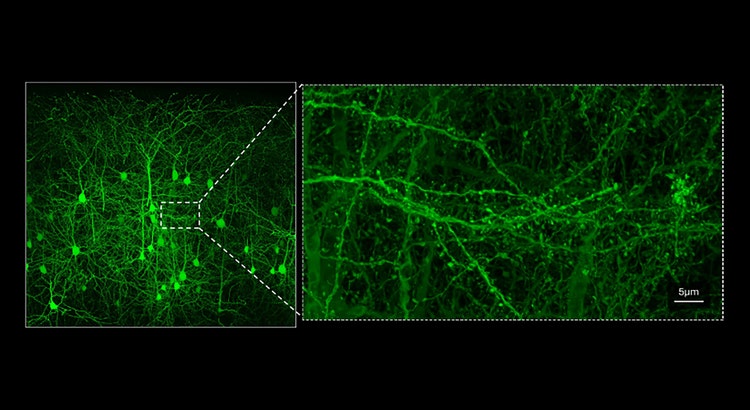
Figure 4. Mouse brain slice cleared with SeeDB2 and imaged on the FLUOVIEW FV5000. YPet is expressed in layer 2/3 pyramidal neurons (in utero electroporation).
Left image: A maximum intensity projection of a Z-stack acquired at 8192 × 8192 pixels processed with TruSight deconvolution.
Right image: Enlarged view of the area outlined by the dashed line in the left image.
Sample courtesy of: Drs. Satoshi Fujimoto and Takeshi Imai, Graduate School of Medical Sciences, Kyushu University.
3. Acquiring Wide-Area, High-Resolution Images
By continuously capturing adjacent fields of view and stitching them together, it is possible to obtain high-resolution images over an even larger area. Using this approach, researchers can capture the entire structure of a mouse embryo in fine detail (Figure 5).
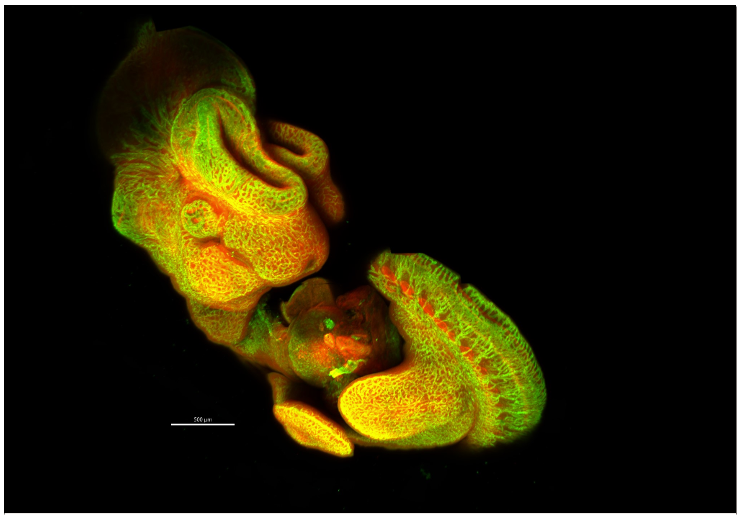
Figure 5. Whole mouse embryo cleared with Ethyl cinnamate, labeled with Alexa Fluor 405, 488, and 568.
Captured in confocal mode (170 tiles in XY, 700 microns depth) with a 25X oil immersion lens (1 mm WD) on the FLUOVIEW FV5000.
Sample courtesy of: Dr. Emma Siragher, Hanna Group, Department of Physiology, Development and Neuroscience, University of Cambridge.
Conclusion
When the LUPLAPO25XO objective lens—combining a wide field of view, long working distance, and high NA—is used with the FLUOVIEW FV5000, it enables acquisition of a 0.5 mm × 0.5 mm area at approximately 230 nm resolution in a single scan. Moreover, the system performs automated spherical aberration correction according to specimen refractive indices (RI 1.45–1.56), enabling three-dimensional imaging up to 1 mm depth.
Additionally, when capturing the maximum field of view at 8192 × 8192 pixels, the pixel pitch reaches 69 nm. Combined with TruSight deconvolution processing, structures that previously required super-resolution microscopy for visualization can now be clearly resolved.
Furthermore, by continuously acquiring adjacent fields and stitching them together, wide-area, high-resolution imaging becomes possible. These combined capabilities deliver an imaging system that enables integrated analysis of both macro-scale tissue architecture and micro-scale cellular details within a single dataset, meeting the demands of fields such as developmental biology and neuroscience.
Authors
Naofumi Kobayashi, Optical Engineering Imaging Optics, Micro-Imaging Solutions R&D, Evident
Hiromi Utsunomiya, Life Science High-End Imaging, Product Management, Evident
References
1. Israel, K. 2020. “Barrier‑Breaking and Now Edison Award‑Winning Objectives.” Insights, Evident, June 12, 2020.
2. Utsunomiya, H. 2026. “TruResolution Automated Spherical Aberration Correction for High-Resolution Deep Tissue Imaging .” Evident. Accessed on January 28, 2026.
Products Related to This Application
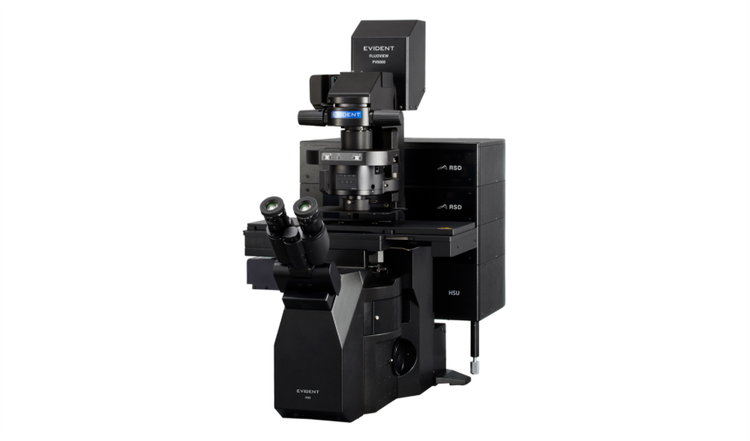
FV5000
Confocal Laser Scanning Microscope
- Extraordinary clarity, speed, and reliability driven by groundbreaking innovations
- SilVIR™ detectors deliver photon-level quantitation, exceptional sensitivity, and ultra-high signal-to-noise
- Unmatched dynamic range captures the full signal spectrum and prevents saturation
- High-speed 2K resonant scanning and high-density 8K galvo scanning in one platform
- FLUOVIEW Smart™ software simplifies operation with intuitive controls and AI-powered automation
- TruResolution™ auto correction collar optimizes focus for over 20 objectives
- Modular design supports up to 10 laser lines and future multiphoton upgrades
- Laser Power Monitor (LPM) ensures stable illumination and reproducible results over time
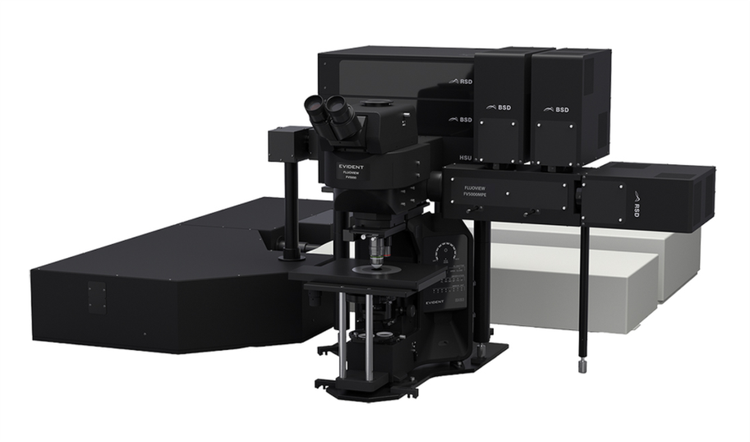
FV5000MPE
Multiphoton Laser Scanning Microscope
- Compact fiber-pigtailed lasers enable deep, quantitative imaging in scattering tissue
- One-, two-, or three-line simultaneous MPE laser excitation for millimeters deep imaging
- SilVIR™, TruAI, and TruSight™ technologies deliver outstanding signal-to-noise and clarity
- MPE-optimized objectives, TruResolution™ auto correction collar, and automated IR laser alignment maintain sharp focus
- Available as an FV5000 system upgrade or a complete MPE system
- Fully tunable laser configurations available for more advanced multiphoton applications
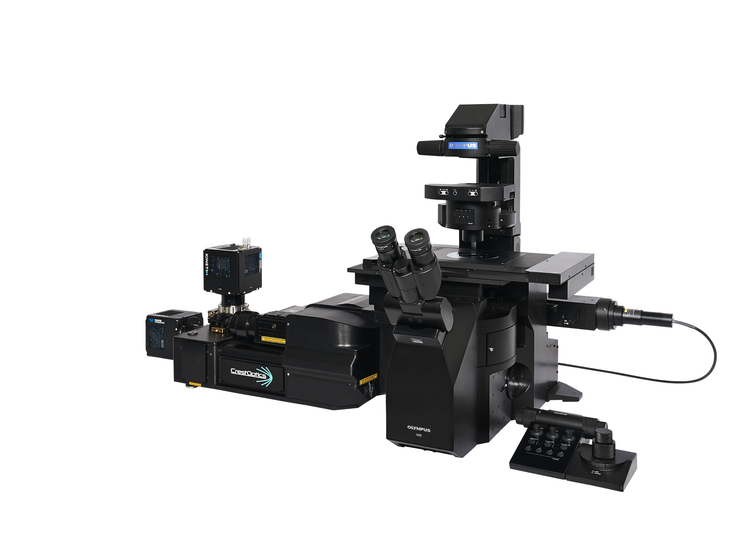
IXplore IX85 SpinXL
See more and discover faster with an unparalleled 26.5 mm field of view (FOV).
- Capture more fast cellular dynamics in a single frame at imaging speeds up to 498 fps
- Precise, gentle live-cell imaging maintains sample viability
- Supports a wide range of applications and users with speed, precision, and flexibility
- Streamlines tasks throughout the lab with intelligent automation and easy workflows
- Evolves with your research via a wide wavelength range, tailored disk options, and expandable imaging modalities
- Powered by CrestOptics spinning disk technology and enhanced with the IXplore™ IX85 platform
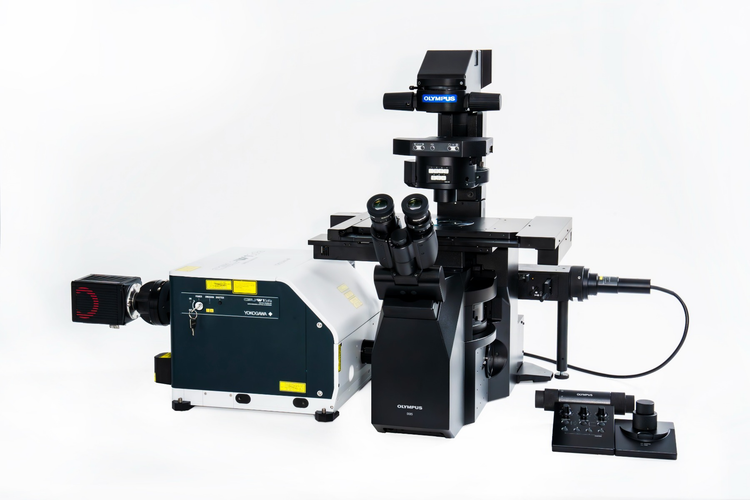
IXplore IX85 Spin
The IXplore™ IX85 Spin system features a spinning disk confocal unit that enables fast 3D image acquisition, a large field of view, and prolonged cell viability in time-lapse experiments. Researchers can use it to perform rapid 3D confocal imaging with high resolution and contrast at greater depths for imaging into thicker samples. The spinning disk also helps to cut down on photobleaching and phototoxicity of samples upon excitation.
TruFocus™ Z-drift compensation system maintains focus for each frame
Precise 3D imaging with improved light collection using X Line™ objectives
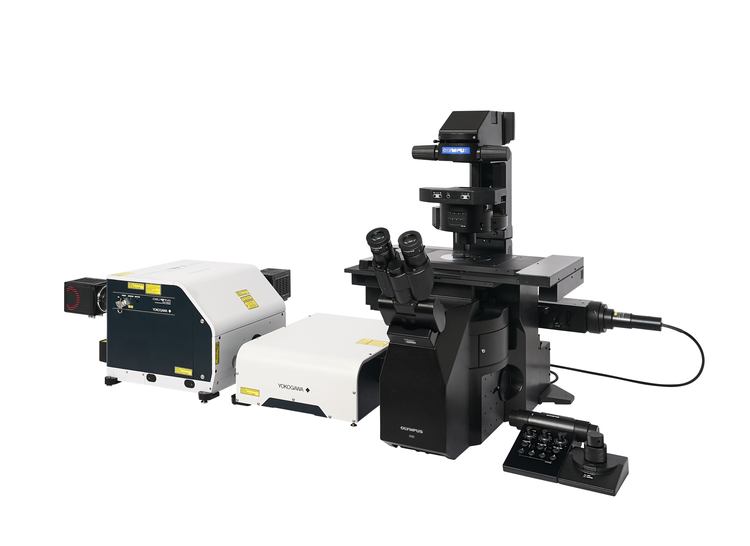
IXplore IX85 SpinSR
Capture ultra-small cellular dynamics in stunning super-resolution detail.
- Discover more with high-speed imaging in resolution down to 120 nm
- Designed for prolonged cell viability in long-term time-lapse experiments
- Powered by Yokogawa spinning disk technology
- Enhanced with the IXplore™ IX85 platform and Evident’s TruSight™ SR super-resolution algorithm