Live-cell imaging turns dynamic biological activity into visible, measurable insight as cells grow, move, divide, and respond in real time.
Evident provides advanced live-cell imaging systems for a wide range of applications, from routine observation to high-resolution fluorescence imaging, fast 3D acquisition, and automated high-content analysis. Whether you need a benchtop fluorescence system for everyday research or modular inverted microscopes designed for speed, resolution, or throughput, our range of live-cell imaging solutions can help you build a workflow matched to your experimental goals.
Explore our live-cell imaging systems to discover solutions for routine cell culture monitoring, long-term time-lapse imaging, advanced confocal imaging, and high-content screening.
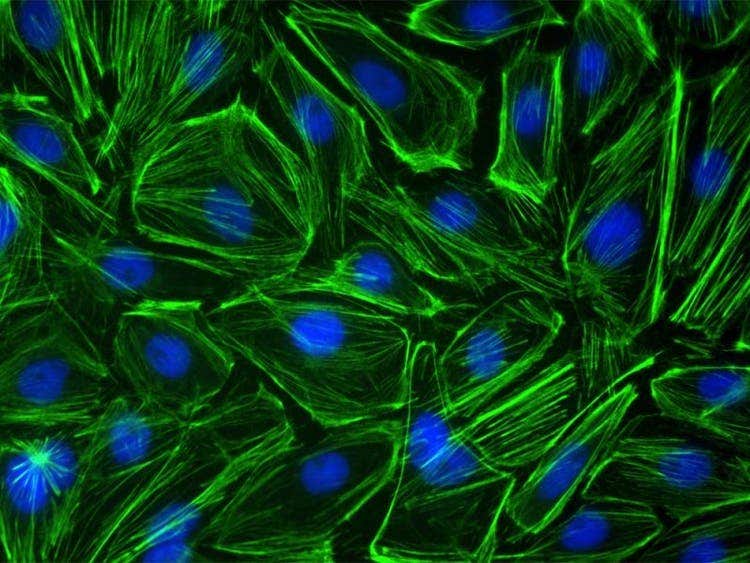
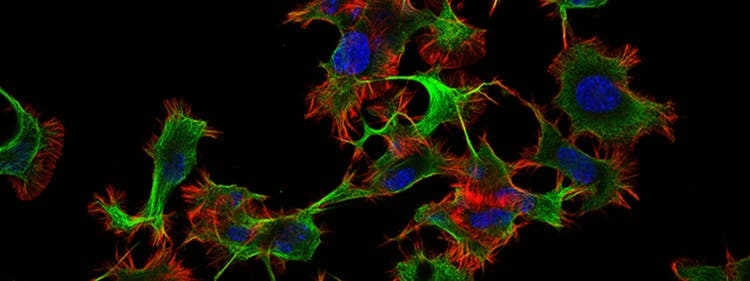
Ptk2 cells. Stain: DAPI, Mitotracker Red, Acti-Stain 488.
Captured on the APEXVIEW APX100 benchtop fluorescence microscope.
Evident Live-Cell Imaging Systems
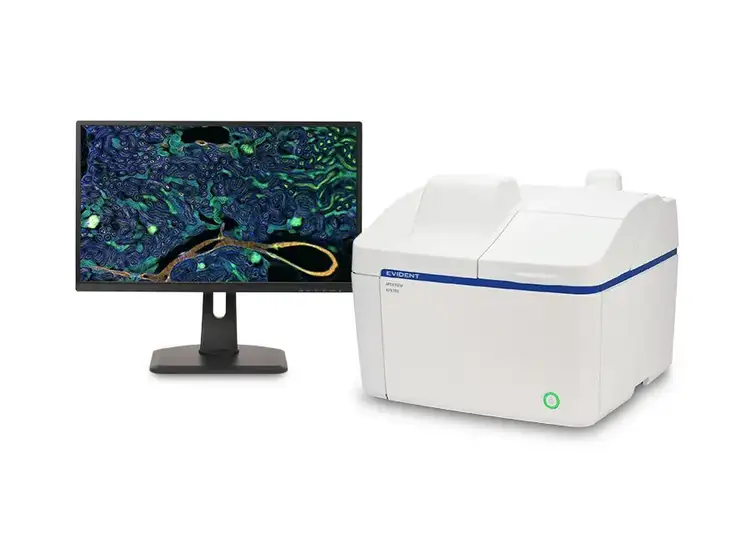
APX100
Benchtop Fluorescence Microscope
The APEXVIEW APX100 benchtop fluorescence microscope makes it fast and simple to acquire expert-quality images. Built with renowned Evident optics, an intuitive user interface, a powerful AI, and a suite of smart features, the APX100 system combines ease of use with high-quality image data to fit your live-cell research needs.
- Easy-to-use, all-in-one microscope system
- Publication-quality images in a few clicks
- Fast, efficient data management
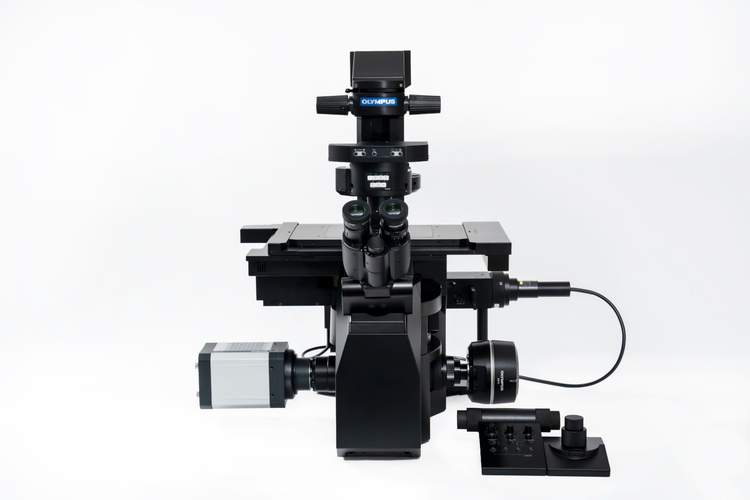
IXplore IX85
Motorized Inverted Microscope Platform
The IXplore™ IX85 platform delivers exceptional flexibility, enabling you to design and build a high-performance imaging system tailored to your specific research needs. The fully modular system is engineered for widefield fluorescence imaging, live-cell time-lapses, and high-content screening. With its modular architecture, industry-leading 26.5 mm field number (FN), and broad compatibility with advanced imaging modalities, it provides a powerful foundation that evolves with your applications.
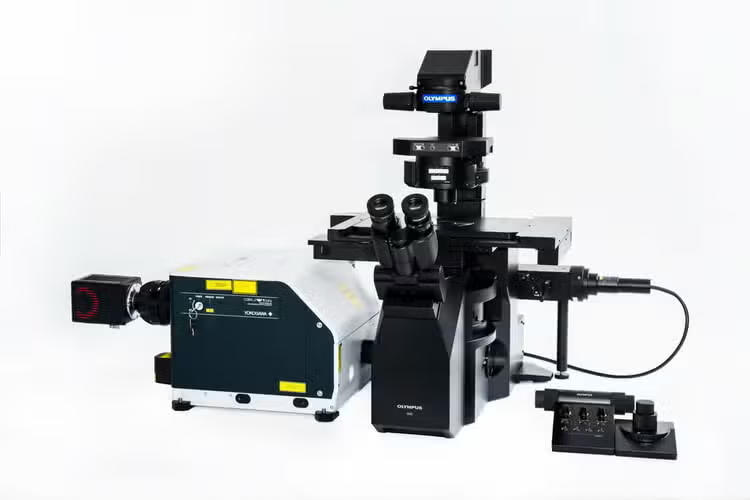
IXplore IX85 Spin Series
Spinning Disk Confocal Microscopes
Capture fast, dynamic biological processes with the speed required for real-time insight. The IXplore™ IX85 Spin series of spinning disk confocal microscopes is designed to deliver fast, precise fluorescence imaging across a wide range of live-cell and time-lapse studies. Integrating proven Yokogawa and CrestOptics spinning disk technologies with the adaptable IXplore IX85 platform, these solutions combine optical performance, automation readiness, and configuration flexibility within a scalable research ecosystem. From core facilities to advanced cell biology and drug discovery labs, the Spin series is designed to evolve alongside your research.
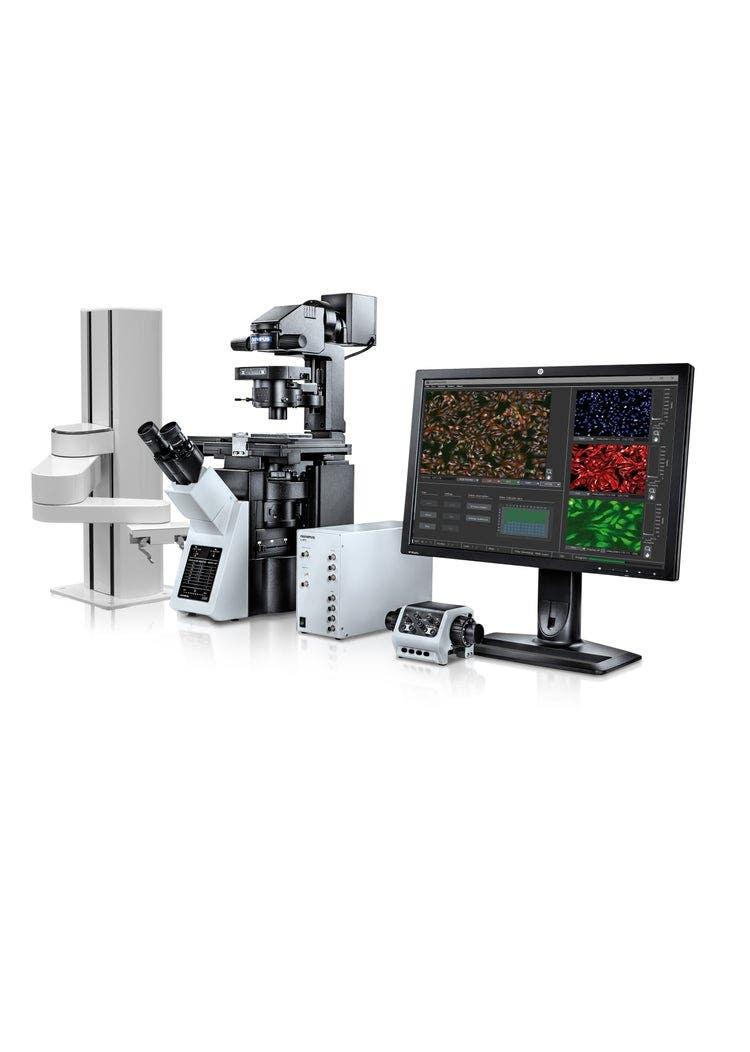
scanR
High-Content Screening Station
Achieve fully automated image acquisition and data analysis of biological samples using the scanR high-content screening station. Design individualized assays for cell cycle, protein localiazation, intracellular transport and more. Modular hardware is compatible with a range of additional systems, including spinning disk confocal, robot loading, incubation, TIRF, and FRAP systems.
- Fast and precise image acquisition and analysis
- Image cytometry based approach enables easy and detailed visualization of results
- Expand your capabilities with modules such as self-learning AI, kinetic parameter measuring, high-speed 3D deconvolution, and more
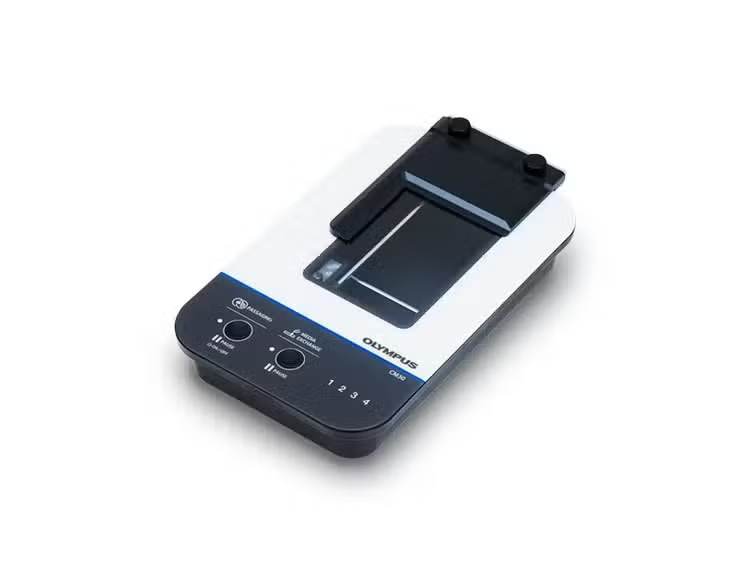
CM30
Incubation Monitoring System
Remotely monitor, analyze, and share your cell cultures’ health, cell count, and confluency using the reliable quantitative data provided by the automated CM30 incubation monitoring system. The system enables label-free observation, reduces the risk of damage to your cultures, and standardizes your culture workflow.
- Automatically collects quantitative data on the health and confluency of your cultures
- Monitor, analyze, and share your cultures' progress remotely from a PC or tablet
- Equipped with oblique epi-illumination for label-free observation
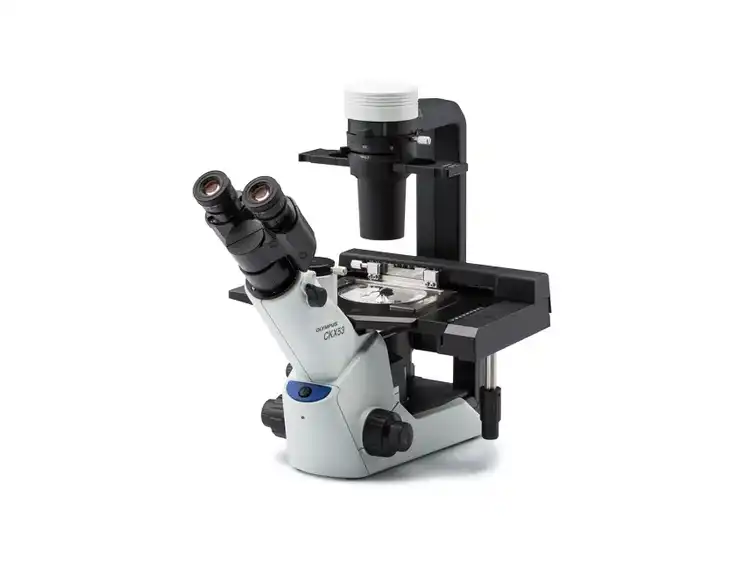
CKX53
Compact Cell Culture Microscope
The CKX53 microscope eases the cell and tissue culture workflow, simplifying steps such as live-cell observation, cell sampling and handling, image capture, and fluorescence observation. Its integrated phase contrast system, compact, ergonomic design, and stable performance enable simple, efficient cell observation in brightfield and fluorescence. The universal sample holder and expandable stage accommodate a wide variety of cell culture container types and sizes.
- Precentered phase contrast that can be used from 4X to 40X without changing the phase plate
- Inversion contrast (IVC) technique provides clear three-dimensional views
- Fluorescence with a 3-position slider
- View multilayer tissue flasks up to 190 mm (7.5 in.) tall thanks to the easily detachable condenser
Live-Cell Imaging Software
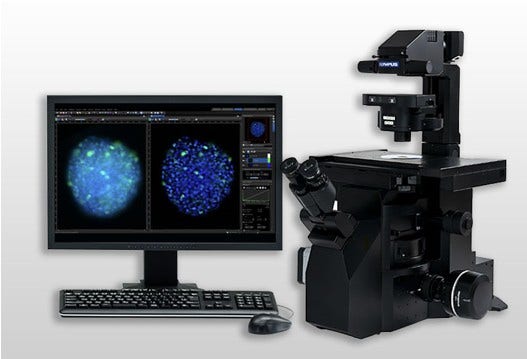
cellSens
Microscope Imaging Software
Providing intuitive operations and a seamless workflow, cellSens software’s user interface is customizable so you control the layout. Offered in a range of packages, cellSens software provides a variety of features optimized for your specific imaging needs. Its Graphic Experiment Manager and Well Navigator features facilitate 5D image acquisition. Achieve improved resolution through TruSight™ deconvolution and share your images using Conference Mode.
- Improve experiment efficiency with TruAI™ deep-learning segmentation analysis, providing label-free nuclei detection and cell counting
- Modular imaging software platform
- Intuitive application-driven user interface
- Broad feature set, ranging from simple snapshot to advanced multidimensional real-time experiments
Live-Cell Imaging Resources
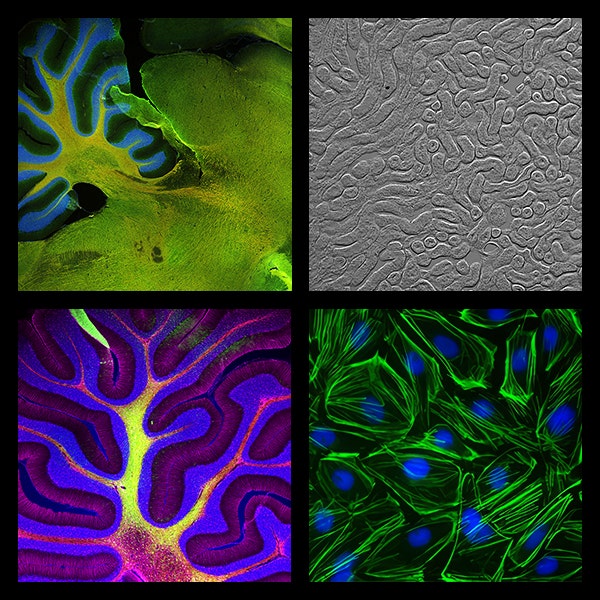
Ebook: Simplifying Live-Cell Imaging
Discover how to address common live-cell imaging challenges, from imaging transparent samples to reducing repetitive adjustments during observation.
6 Tips for Fluorescence Live-Cell Imaging
Explore six practical fluorescence live-cell imaging tips to improve image quality, reduce phototoxicity, support cell viability, and capture reliable time-lapse data.
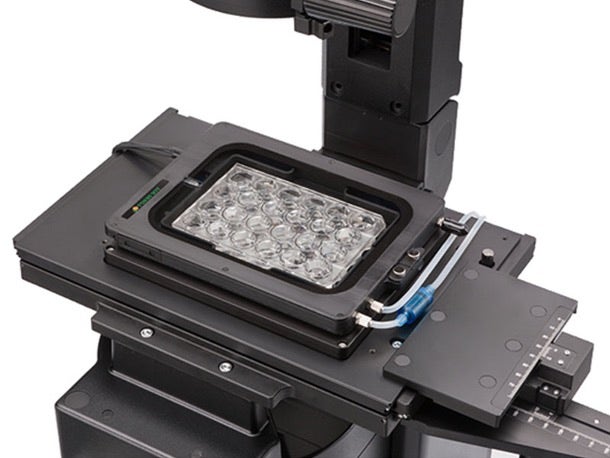
Achieve Longer Live-Cell Imaging with Less Time in the Lab
Learn ways to extend live-cell imaging experiments, reduce hands-on time in the lab, and capture reliable data from long-term cell culture workflows.
Live-Cell Imaging FAQs
What is live-cell imaging?
Live-cell imaging is a microscopy technique that allows researchers to observe and record living cells in real time over extended periods. It is used to study dynamic cellular processes such as cell division, migration, intracellular signaling, and interactions with their environment. Live-cell imaging systems must maintain stable conditions, such as temperature, humidity, and CO₂ levels, to keep cells alive and healthy throughout the experiment.
Advanced imaging technologies and live-cell imaging software are also used to minimize phototoxicity and photobleaching while capturing high-resolution, time-lapse images. This technique is essential for understanding the behavior and function of cells in their natural state, supporting discoveries in fields like cell biology, neuroscience, and cancer research.
What is the difference between live-cell imaging and fixed-cell imaging?
Live-cell imaging and fixed-cell imaging are both essential techniques in cell biology, but they serve different purposes and offer distinct advantages.
- Live-cell imaging allows researchers to observe living cells in real time, making it possible to study dynamic biological processes as they happen, such as cell migration, division, intracellular trafficking, and signal transduction. Because the cells remain alive, this technique requires careful environmental control (e.g., temperature, CO₂ levels, humidity) to maintain cell health, as well as imaging systems that minimize phototoxicity and photobleaching.
- Fixed-cell imaging, on the other hand, involves chemically preserving cells at a specific point in time using fixatives. This process halts all cellular activity, enabling researchers to use more intensive staining methods and higher resolution imaging without concern for cell viability. Fixed-cell imaging is ideal for detailed structural analysis, such as examining organelles, protein localization, or cellular architecture, but it cannot capture dynamic processes or changes over time.
What are the advantages of live-cell imaging?
How does live-cell imaging work?
What types of microscopes are used for live-cell imaging?
Live-cell imaging can be performed with various microscope types, depending on the sample, imaging depth, resolution requirements, and experimental duration. Options include fluorescence microscopes, inverted microscopes, and spinning disk confocal systems. Inverted microscope configurations are often preferred because they support cell culture vessels such as dishes, flasks, and multi-well plates.
For routine observation and imaging, the APEXVIEW™ APX100 benchtop fluorescence microscope supports efficient live-cell workflows. For more advanced applications, the IXplore™ IX85 inverted microscope platform is a fully modular solution for live-cell imaging and dynamic processes. With an industry-leading field number (FN) of 26.5 mm plus end-to-end imaging features, the IXplore IX85 helps researchers capture more at once while dramatically reducing acquisition times.
How do you keep cells alive during live-cell imaging?
To help keep cells alive during live-cell imaging, the microscope system must maintain stable environmental conditions that support normal cell health. This typically includes controlling temperature, CO₂ concentration, humidity, and, when needed, oxygen levels. The imaging setup should also accommodate appropriate culture vessels and help reduce evaporation during longer experiments.
Stable focus, low phototoxicity, and gentle illumination are also important. Environmental control accessories, incubation systems, and optimized imaging software help maintain consistent conditions while images are captured over minutes, hours, or days.
What is phototoxicity, and how can it be minimized?
Phototoxicity is cell damage caused by light exposure during imaging, especially during fluorescence microscopy. Excessive excitation light can stress cells, alter their behavior, or reduce cell viability, which can impact experimental results.
Phototoxicity can be minimized by using lower illumination intensity, shorter exposure times, more sensitive cameras or detectors, and imaging methods that reduce unnecessary light exposure. Researchers can also optimize fluorophore selection, increase the interval between time points, limit the number of channels, and use software tools that support efficient image acquisition. When appropriate, label-free imaging methods can further reduce light-related stress on living cells.
Which live-cell imaging system is right for my application?
The right live-cell imaging system depends on your sample type, required resolution, imaging speed, throughput, and experimental duration. For routine fluorescence imaging in core labs, a benchtop fluorescence microscope supports easy operation for users of all levels. For long-term time-lapse studies, an inverted live-cell imaging microscope with environmental control and focus stability is often recommended.
For fast intracellular dynamics or thicker samples, a spinning disk confocal microscope system can help balance optical sectioning, speed, and cell viability. If your applications require higher resolution, a super-resolution spinning disk system can provide the finer details of ultra-small cellular dynamics. For automated assays, multi-well plates, and quantitative analysis, a high-content screening station supports high-throughput live-cell workflows.
Can you image live cells without fluorescent labels?
Label-free imaging is often useful for long-term studies because it reduces phototoxicity and avoids potential changes caused by labeling. Fluorescence imaging may be preferred when researchers need to visualize specific proteins, organelles, signaling events, or molecular interactions.
What is time-lapse imaging, and how long can you image live cells?
Time-lapse imaging captures a sequence of images at defined intervals to show how living cells change over time. It is commonly used to study cell division, migration, differentiation, intracellular transport, wound healing, organoid growth, and responses to treatments.
The length of a live-cell time-lapse experiment depends on the cell type, imaging conditions, sampling interval, illumination dose, and environmental stability. Some experiments last minutes or hours, while others can continue for days when temperature, CO₂, humidity, focus, and illumination are carefully controlled. For long-term imaging, the goal is to collect enough data to answer biological questions while minimizing stress to the cells.
Can live-cell imaging be automated or used for high-content screening?
For high-content screening, automated live-cell imaging systems can acquire and analyze large image datasets from multi-well plates. The scanR high-content screening station supports automated image acquisition and analysis for biological samples, making it suitable for assay development, live-cell analysis, and quantitative screening workflows.