Metallurgical Microscopes
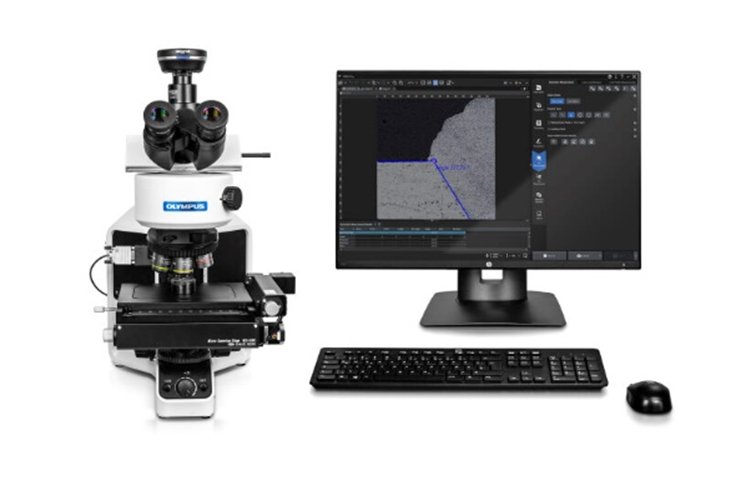
Metallurgical microscopes are specialized optical instruments designed for examining the microstructure of metals and other solid materials. They are essential tools in materials science, quality control, and industrial research, enabling users to analyze surface features, grain structures, coatings, and defects with high precision.
At Evident, our range of metallurgical microscopes and modular accessories meet a wide variety of industrial imaging applications, from routine inspection to sophisticated analysis. Find solutions tailored to specific applications, such as our BX53M upright microscope for general to specialized observation, BX53-P upright microscope for polarized light analysis, GX53 inverted microscope for large or irregular sample inspection, and DSX2000 digital microscope series for seamless, all-in-one imaging. Advancing our rich history of Olympus excellence, all Evident metallurgical microscopes feature world-class optics for enhanced observation, insight, and analysis.
Integrate our metallurgical microscopes with PRECiV™ software to access guided workflow and AI analysis tools, supporting consistent, reliable results in demanding production environments.
Metallurgic Microscopes
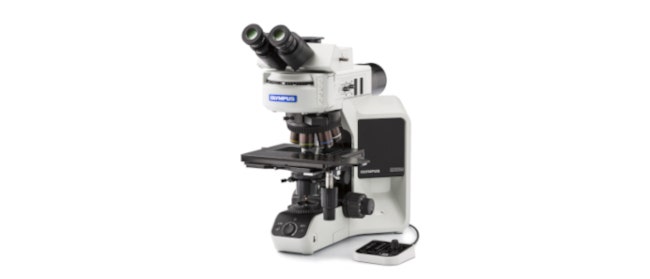
BX53M
Industrial Upright Microscope
Designed with modularity in mind, the BX3M series provides versatility for a wide variety of materials science and industrial inspection applications.
- Modular design with configurations for general or specialized observation
- Intuitive, ergonomic controls simplify complex tasks and improve reproducibility
- Automated light intensity manager for consistent illumination
- Advanced optics and contrast options for accurate, reliable inspections
- IR objective options to view semiconductor patterns through silicon
- PRECiV integration for a seamless workflow from imaging to reporting
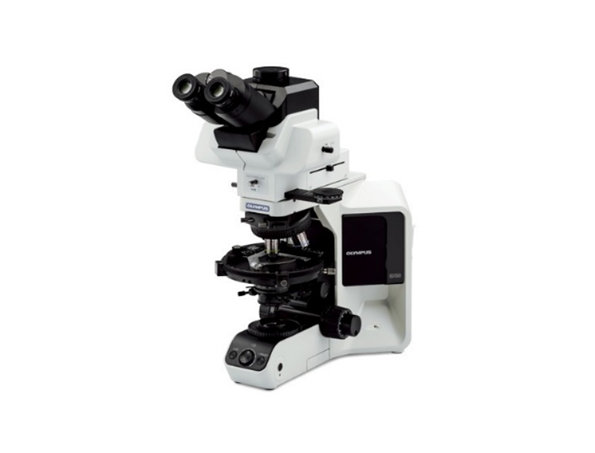
BX53-P
Polarizing Upright Microscope
The BX53-P microscope provides exceptional performance in polarized light applications through its advanced UIS2 infinity-corrected optics and distinctive optical design.
- Specialized design for observation of birefringent and anisotropic materials
- Wide range of compensators for diverse observation and measurement needs
- Polarized light lenses reduce internal strain for excellent image contrast
- Bertrand lens option supports orthoscopic and conoscopic observations
- PRECiV integration for a seamless workflow from imaging to reporting
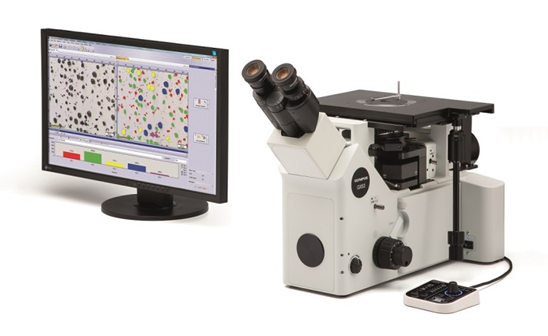
GX53
Inverted Metallurgical Microscope
The GX53 microscope delivers high clarity and reliable performance for metallurgical inspection, enabling efficient analysis of metals and industrial materials.
- Design suited for polished metals, welds, and large or heavy samples
- High‑resolution images under brightfield, darkfield, DIC, or MIX observation
- Modular accessories meet a variety of metallurgical inspection needs
- Long working distance objective options support faster inspections
- PRECiV integration for compliant metallurgical analysis workflows
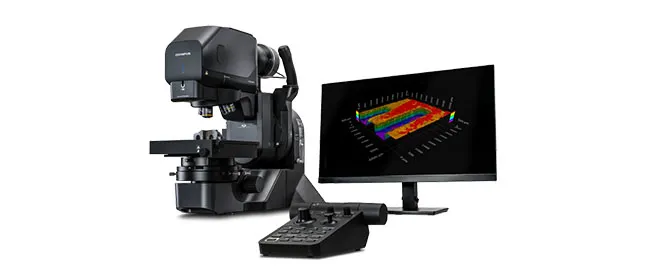
DSX2000
Digital Microscope Series
The award-winning DSX2000 series empowers users of all levels to achieve fast, precise results and capture exceptional images beyond 4K resolution.
- Full motorization simplifies tasks for researchers and QC professionals
- Fast macro-to-micro inspections with a wide magnification range of 21–7,300X
- Seven observation methods at the click of a button for versatile sample analysis
- 20 objective lens options adapt imaging to different samples and applications
- Macro camera accessory for fast, flexible imaging of large samples
- PRECiV integration unlocks efficiency with Live AI and other smart tools
- Guaranteed* accuracy and repeatability with professional on-site calibration
*The guaranteed accuracy and repeatability apply only if the device has been calibrated according to the manufacturer's specifications and is in defect-free condition. Calibration must be performed by an Evident technician or an Evident-authorized specialist.
Image Analysis for Metallography
Our industrial image analysis software has guided workflows to streamline materials science analyses. These step-by-step instructions enable reproducible and reliable results. A range of optional Material Solutions can be added with dedicated workflows for material qualification and evaluation. These solutions enable you to conduct an analysis according to common international standards (ISO, ASTM, JIS, and DIN). Find solutions for a range of materials, including metals, ceramics, coatings, welds, aluminum alloys, and cast iron. All Material Solutions can be implemented in PRECiV imaging and measurement software and Stream Enterprise data management software.
Evident’s suite of optional AI tools adds to this workflow efficiency. With TruAI deep-learning technology, you can apply a trained neural network to quickly enhance, segment, and detect features in many of our Material Solutions. This enables a more robust and reproducible analysis, offering detection and measurement of challenging defects and particles that conventional analysis methods may miss. For everyday use, Live AI is a powerful tool for quick feature detection and image quality improvement to enhance your materials science analyses.
Industrial Inspection Software
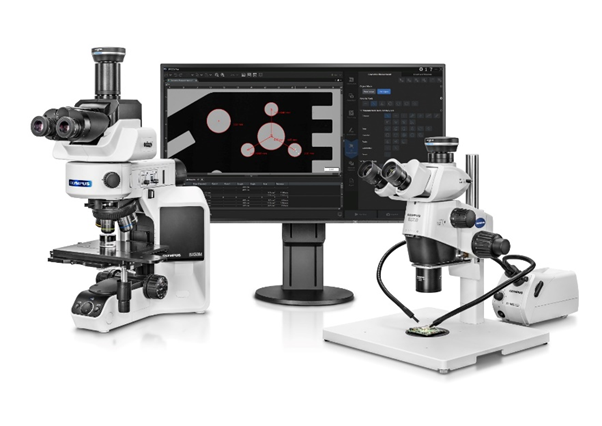
PRECiV
Simple-to-use PRECiV™ software puts you in control of your microscope so that you can perform repetitive 2D/3D measurements and analysis during production, quality control, and inspection operations.
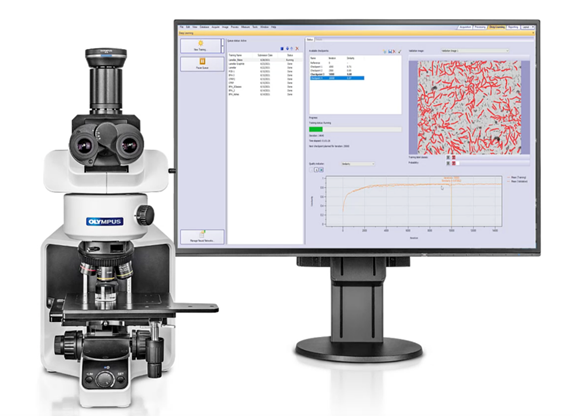
Stream Enterprise
Stream Enterprise software with integrated data management offers intelligent step-by-step workflows to acquire sharp images that are ready for quantitative measurements and professional reporting based on the latest standards.
Metallurgical Microscope Applications
Metallurgical microscopes are essential tools across a range of industries, supporting critical applications from quality control and failure analysis to advanced research and specialized material studies.
Material Inspection and Quality Control
Metallurgical microscopes play a vital role in material inspection and quality control by enabling detailed analysis of metals and alloys. They are used to examine grain size, detect inclusions, identify porosity, and uncover surface or internal defects. These microscopes can be used to verify the results of heat treatment processes, ensuring structural integrity and consistency. In addition, they are commonly used to inspect welds, evaluate coating uniformity, and assess surface finishes for manufacturing and compliance standards. Their precision and versatility make them essential tools in industrial and laboratory settings.
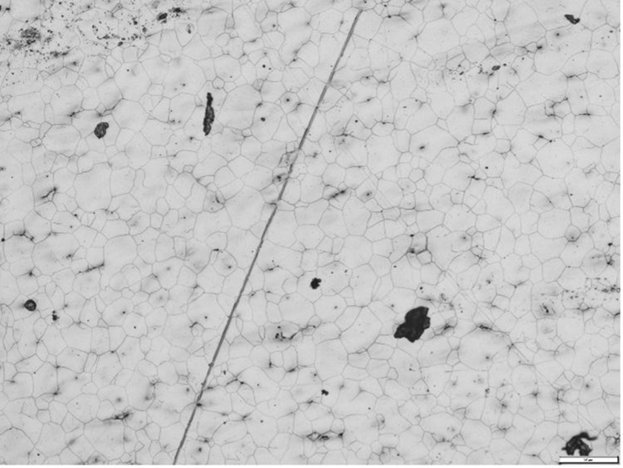
Metallographic section with grain boundaries, polishing marks, and dust.

Brightfield image of a brake pad that is worn after use.
Failure Analysis
Metallurgical microscopes are essential tools in failure analysis, providing the high-resolution imaging needed to investigate fractures, cracks, corrosion, and fatigue patterns. They support root cause analysis by revealing microstructural changes and defects that contribute to material or component failure in industrial and engineering environments. These microscopes are also used in forensic investigations to examine tool marks, metal fragments, and other trace evidence. By enabling detailed surface and subsurface examination, metallurgical microscopes help identify failure mechanisms and support corrective action and product improvement.
Research and Development
In research and development, metallurgical microscopes are used to study the effects of manufacturing processes on metal microstructures, helping engineers and scientists optimize performance and durability. They support the development and refinement of new alloys, coatings, and composite materials by enabling detailed structural analysis at the microscopic level. These microscopes are also valuable in thin film analysis for semiconductors and microelectronics, where precision is critical. Additionally, they are used to measure coating thickness and assess uniformity, ensuring materials meet design and functional specifications across advanced R&D applications.

Steel microstructure. Grain boundaries highlighted using live contrast enhancement.
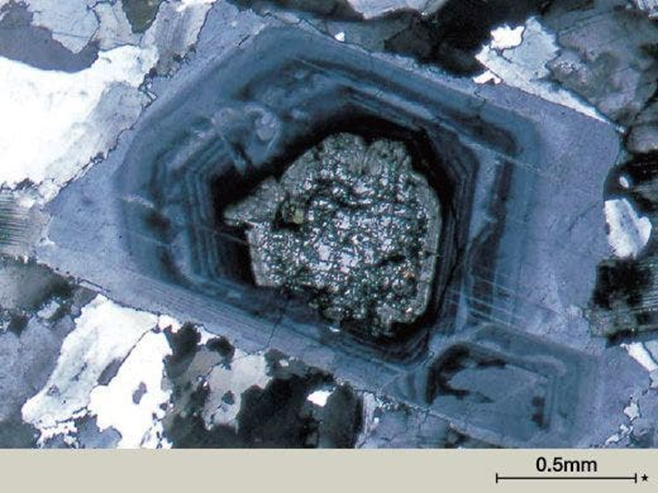
Zonal structure of plagioclase in quartz diorite. *Scales Indicate actual size of samples.
Specialized Applications
Metallurgical microscopes support a range of specialized applications. In the electronics and semiconductor industries, they are used to inspect microstructures, evaluate thin layers, and detect wafer defects, with near-infrared imaging capabilities offering visibility beneath surfaces. For ceramics and composites, they enable detailed microstructure evaluation, essential for understanding material strength and durability. In corrosion studies, they help track corrosion progression at the micro level to assess material performance. In additive manufacturing, they are used to examine the microstructure of 3D printed parts, helping ensure quality. With polarized light, these microscopes are used to analyze birefringent materials, including minerals, polymers, and crystals, and to reveal stress patterns in metals and plastic.
Metallurgical Microscope Resources
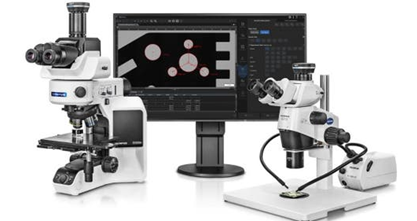
Speed Up Your Metallurgical Image Analysis Using This Simple Setup
PRECiV software enables you to upgrade your manual microscope into a comprehensive imaging and measurement platform. Explore seven ways that this simple setup can speed up your metallurgical image analysis.
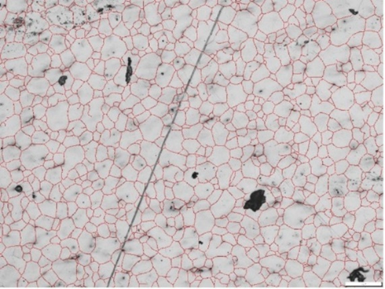
The Potential of AI-Based Image Analysis in Metallography
In metallography, artificial intelligence (AI) opens a new world of easier and more accurate image analysis. Find examples of AI-assisted image analysis and learn how to properly train a neural network in just four steps.
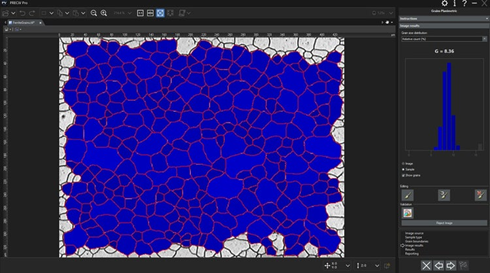
Grain Size Analysis in Metals and Alloys
In the metallographic laboratory, analyzing grains in metallic and alloy samples is important for quality control. Explore image analysis methods, equipment, and procedures to analyze grains in compliance with ASTM E112 and other standards. industry.