6th Annual Image of the Year Global Winner Brilliantly Connects Our Inner and Outer Worlds

Evident Image of the Year Award 2025: Global Winner.
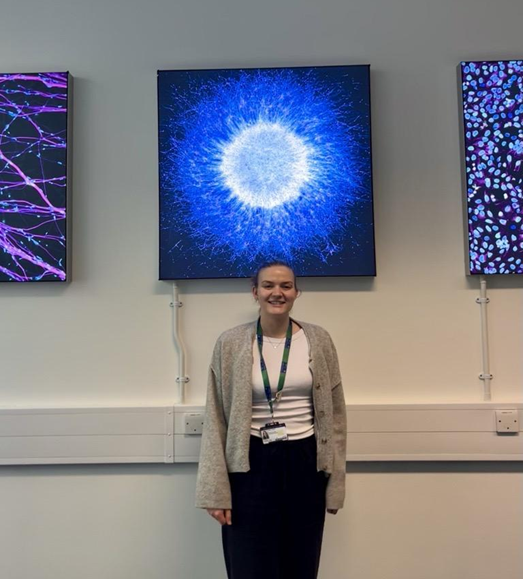
Induced pluripotent stem cell-derived neurospheres captured by Katie Holden, United Kingdom.

We recently announced the winners of Evident’s sixth annual Image of the Year contest, where participants from around the world illuminated the unseen by submitting their best light microscopy images.
This year, Katie Holden of the United Kingdom was selected as the global winner for her striking confocal image titled “Neuronal Cosmos.” For the grand prize, Katie will receive her choice of an Evident SZX7 stereo microscope with a DP23 digital camera or a set of X Line™ objectives.
To celebrate her winning image, we’re shining a spotlight on its beautiful star-like pattern and the inspiring message behind it. For Katie, microscopy is a powerful way to spark interest in science, especially when it reveals what’s invisible to the naked eye.
Illuminating the Unseen: A Global Spotlight on Star-Like Neurospheres
The stunning image showcases induced pluripotent stem cell-derived neurospheres consisting of neuronal cells, which self-organize into structures resembling the layered architecture of the human brain. Their star-like appearance also resembles something from space, highlighting striking parallels between our inner and outer worlds at vastly different scales.
Live time-lapse imaging of iPSC-derived neurosphere growth, imaged over two days. DNA is labeled in magenta, tubulin in blue.
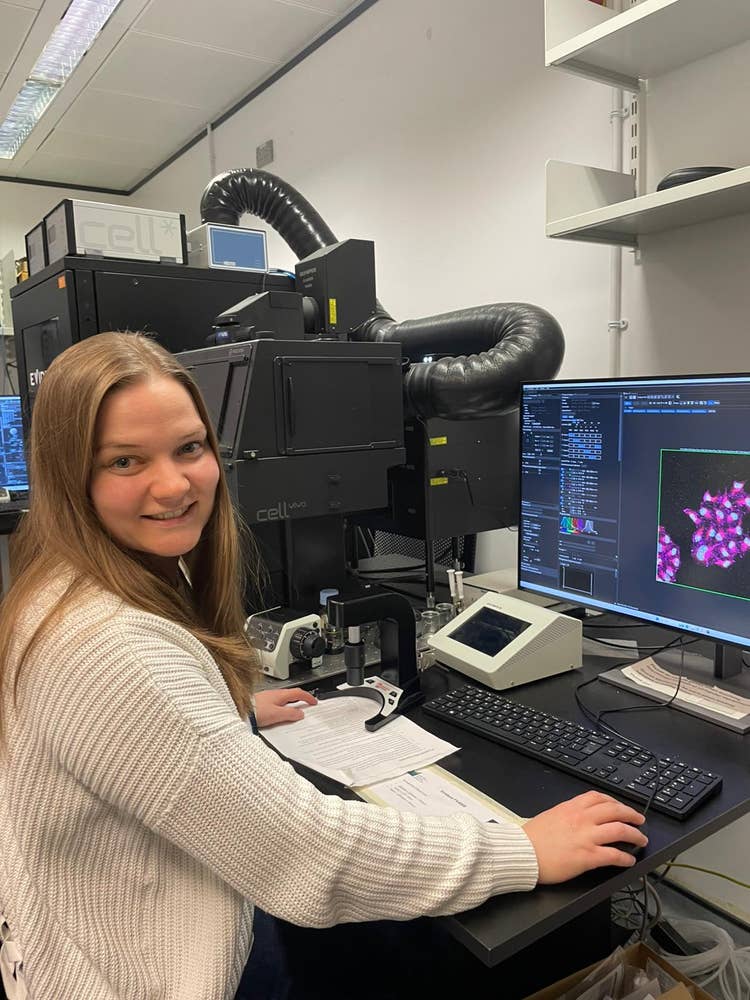
Katie captured the image with the Evident IXplore™ IX83 SpinSR spinning disk confocal super-resolution microscope. Since 2021, she has been studying neurons and microglia under confocal microscopes at the University of Oxford.
In fact, the IXplore IX83 SpinSR was the first confocal system she learned to use. She now works at the university’s Cellular Imaging Core Facility, where she provides user training and support for advanced confocal systems, including high-content imaging, live-cell imaging, slide scanning, and super-resolution microscopy.
Katie, congratulations on being named our global winner! What do you find personally exciting about this image?
Every time I see this image, I am struck by both the scientific advances, such as induced pluripotent stem cells and confocal imaging technologies, that made it possible and the teamwork involved in creating and capturing it. All of this comes together in an image that I think perfectly illustrates how biology can be inherently beautiful.
I have generated many similar samples, and as is often the case in biology, they can vary widely in shape and structure. This one stood out because it was almost perfectly round, with migrating neurons arranged in a particularly striking pattern. It even reminded me of something from space, and I thought it was fascinating that you get similarities between things so large and small.
How did you create the image?
This image was acquired using an Evident IXplore IX83 SpinSR spinning disk confocal super-resolution microscope with a 10X 0.4 NA objective. The sample was imaged live as the final timepoint in a 72-hour time-lapse experiment. Cells were stained with live probes labeling tubulin (cyan) and DNA (magenta).
The final image is a maximum intensity projection of Z-stacks collected across a 3 × 3 tiled region, with the tubulin channel displayed using a cyan “hot” lookup table.
How did you find the sample you used to create this image?
This sample was generated using induced pluripotent stem cells (iPSCs), which are derived from human skin cells that have been reprogrammed to differentiate into many cell types. In this case, neuronal precursor cells, which develop into neurons.
These cells can self-organize into structures resembling the layered organization of the human brain, making them a powerful platform for studying brain biology. To create this sample, iPSCs were cultured and treated with a series of compounds over a 25-day period to induce neuronal differentiation.
A 3D spheroid was formed by allowing the cells to aggregate into a spherical structure, which was placed in a dish for imaging. Over 72 hours, the migration of neuronal progenitors was captured as they moved outward from the spheroid.
All cell culture and imaging were carried out in the iPSC facility and the Cellular Imaging Core Facility at the Centre for Human Genetics.
Did you face any challenges when creating this image?
Generating these samples is complex and doesn’t always work as expected, often requiring many hours in the cell culture lab. I also faced challenges during image acquisition due to the large size of the dataset. Interestingly, creating the final image itself was the simplest and most enjoyable part!
Why did you choose this image as your entry for the competition?
It’s one of my favorite images I’ve ever captured. I find it fascinating that brain cells grown in a dish can self-organize into such intricate and pretty patterns.
Is there a message inspired by this image?
“Your brain is beautiful! We all experience challenges with how our brains function and how we feel, but inside all of us is something truly remarkable.” — Katie Holden, global winner of Evident’s sixth annual Image of the Year contest
When did you first learn to use a microscope?
My first experience with microscopes was using basic light microscopes for tissue culture, during my time working as a research assistant in an iPSC facility. We used them daily to check on our cells and decide how to proceed with experiments.
I first learned to use confocal microscopes when I started at the University of Oxford in 2021, working with neurons and microglia—both visually stunning and scientifically fascinating samples. I now work in the Cellular Imaging Core Facility, where I use multiple microscopes every day!
When did you become inspired to use microscopes to create art?
Relatively recently. I think microscopy is a powerful way to inspire interest in science—it certainly had that effect on me. Seeing images of structures invisible to the naked eye was incredibly compelling.
I also enjoy sharing these images with non-scientist friends to help explain my work. Now, I’m always on the lookout for visually interesting samples that can create engaging and beautiful images.
How long have you been creating art with a microscope?
Approximately 18 months!
What do you find most fascinating about microscopy?
I like the combination of visual beauty and scientific power. It can be visually stunning but also generate incredibly powerful data through image analysis. We can learn so much about cells, tissues, and diseases. We always talk about how microscopy is “not just pretty images,” but I think that aspect is important too!
Where do you think this fascination stems from?
I think it stems from a natural curiosity about how things work, combined with being a visual learner. I find it much easier to understand something when I can see it.
What do you do professionally?
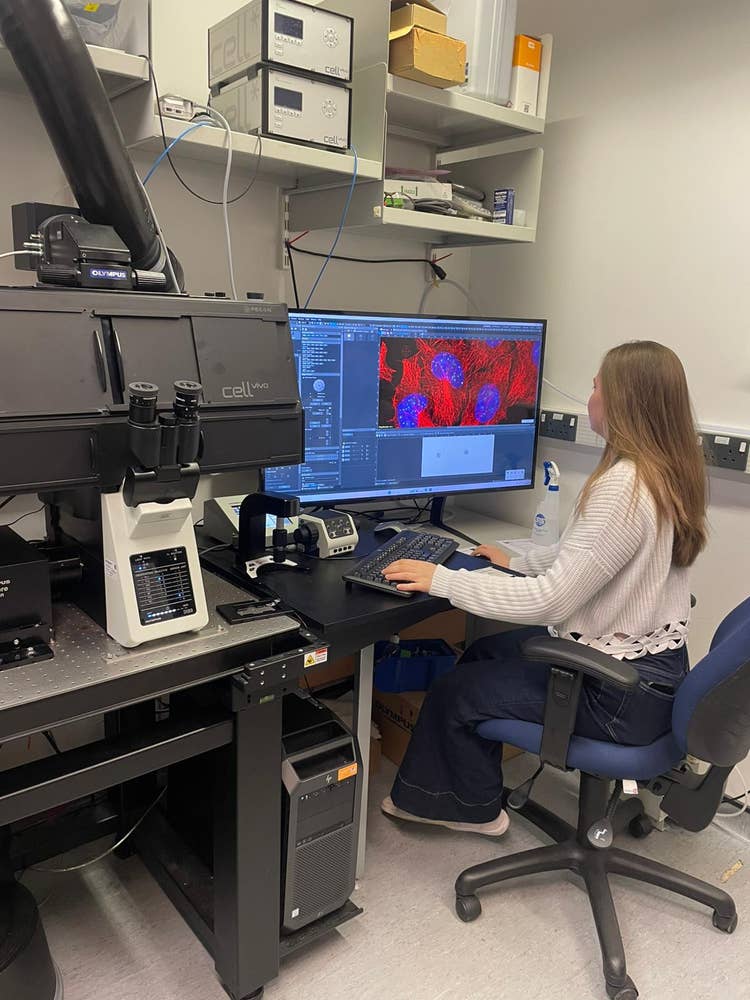
I am an imaging specialist at the Cellular Imaging Core Facility, Centre for Human Genetics, University of Oxford.
We provide microscopy services across scales from whole tissues to single molecules! I provide user training and support on advanced confocal systems, including high-content imaging, live-cell imaging, slide scanning, and super-resolution microscopy.
I love collaborating with users on a huge variety of projects, running assays, and developing analysis pipelines across diverse disciplines, such as neuroscience (obviously, the favorite), cancer biology, cardiovascular biology, microbiology, and immunology. I have particular expertise in imaging 3D complex samples.
Does your professional work in imaging intersect with your own artistic work?
Yes. When one of our users or collaborators has some interesting samples, I often look for opportunities to create visually engaging images that can be used in presentations or outreach. We also share images through our facility’s Instagram, which I enjoy contributing to.
What kind of experience do you have with Evident microscopes?
Quite extensive! The IXplore IX83 SpinSR spinning disk system is the first confocal microscope that I learned to use. In our facility, we have the IX83 SpinSR spinning disk, the FLUOVIEW™ FV4000 confocal laser scanning microscope, and the SLIDEVIEW™ VS200 slide scanner. I routinely train users, perform quality control, and run imaging experiments on these systems. The spinning disk is our most widely used system, and very popular with users. I currently have a soft spot for the FV4000—this was brand new to the facility at the same time as I was, so we spent a lot of time together!
View Recent Press Coverage
Discover more award-winning images from our Image of the Year competition and see how microscopy continues to reveal new perspectives on science and the natural world. Plus, stay tuned as we highlight the stories behind the other winning images.
- EVIDENT Announces 6th Annual Image of the Year Award Winners—News Medical
- 17 Award-Winning Microscope Photos Reveal the World’s Hidden Wonders—PetaPixel
- EVIDENT Announces 6th Annual Image of the Year Award Winners—AZoM
- Neuronal Cosmos Wins 6th Annual Image of the Year Award—LABMATE
- Microscopy & Analysis Magazine
- Amazing Winners of This Scientific Microscopic Imaging Contest Capture the Unseen Beauty of Life
- EVIDENT Announces 6th Annual Image of the Year Award Winners—The Scientist
- See 17 Intricate Microscope Photographs That Make the Miniature World Immense. They Won the Evident Image of the Year Contest—Smithsonian Magazine
- International Contest Highlights the World’s Best in Scientific Microscopic Imaging—Wiley Analytical Science
- Germany - Image of the Year Award 2026 - Bildergalerie mit allen im Wettbewerb ausgezeichneten mikroskopischen Aufnahmen—LABO
- Microscopic Art and Celadon Fragments Reveal Hidden Beauty—Artmag
- Korea - Illuminate the Unseen: EVIDENT 제6회 올해의 이미지 어워드
- Korea - Illuminate the Unseen: EVIDENT 제6회 올해의 이미지 어워드
- China - EVIDENT公布第六届年度图像大赛获奖名单!
Featured Products
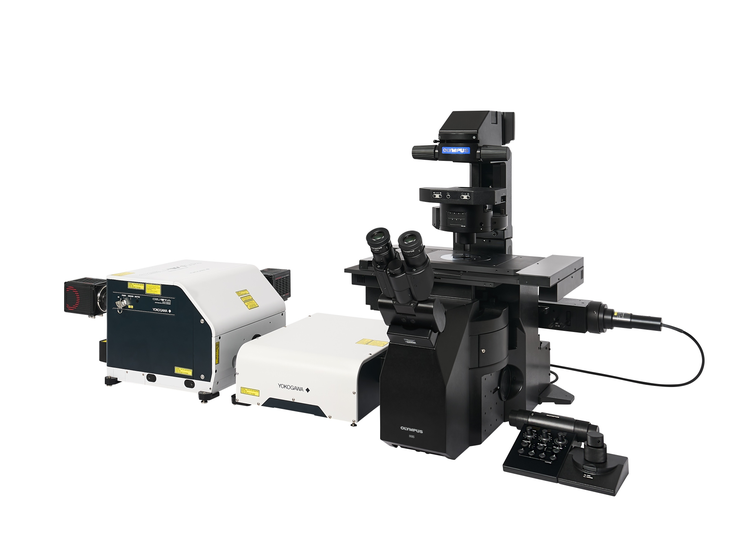
IXplore IX85 SpinSR
Super-resolution imaging of ultra-small cellular dynamics.
- High-speed imaging in resolution down to 120 nm
- Stunning detail empowers faster insights from cellular dynamics
- Designed for prolonged cell viability in long-term time-lapse experiments
- Powered by Yokogawa spinning disk technology
- Enhanced with the IXplore™ IX85 platform and Evident’s TruSight™ SR super-resolution algorithm
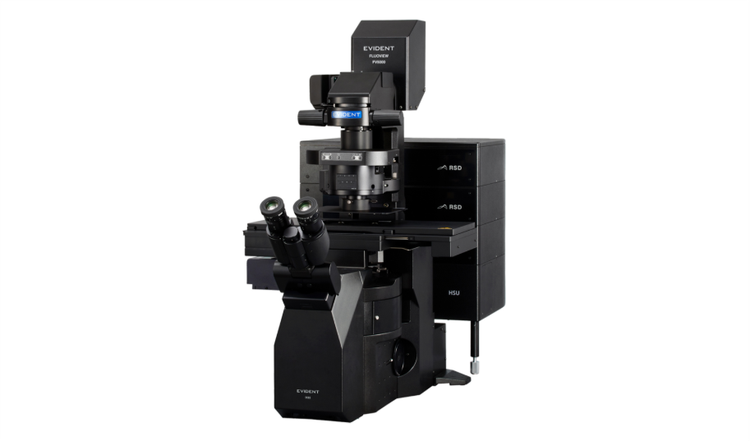
FV5000
Confocal Laser Scanning Microscope
- Extraordinary clarity, speed, and reliability driven by groundbreaking innovations
- SilVIR™ detectors deliver photon-level quantitation, exceptional sensitivity, and ultra-high signal-to-noise
- Unmatched dynamic range captures the full signal spectrum and prevents saturation
- High-speed 2K resonant scanning and high-density 8K galvo scanning in one platform
- FLUOVIEW Smart™ software simplifies operation with intuitive controls and AI-powered automation
- TruResolution™ auto correction collar optimizes focus for over 20 objectives
- Modular design supports up to 10 laser lines and future multiphoton upgrades
- Laser Power Monitor (LPM) ensures stable illumination and reproducible results over time