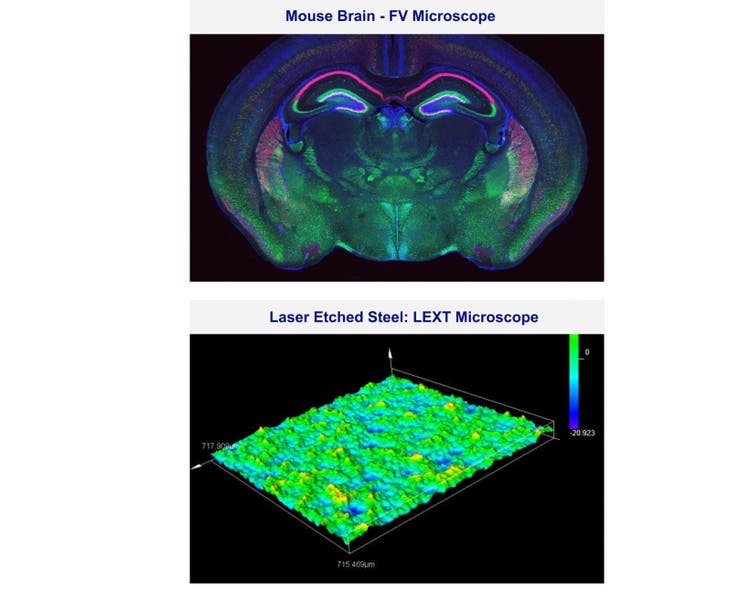
La microscopia a scansione laser viene utilizzata nella ricerca biologica e nelle scienze dei materiali per ottenere immagini ad alta risoluzione e ad alto contrasto di un campione. I microscopi laser sono in grado di scansionare i campioni punto per punto, consentendo una sezionatura ottica che può essere utilizzata per ricostruire immagini 3D precise.
I nostri microscopi a scansione laser sono progettati con un’ampia gamma di modalità di imaging per affrontare alcune delle sfide più complesse nelle scienze della vita e dei materiali. Grazie all’elevata sensibilità e velocità, i nostri microscopi a scansione laser consentono l’imaging di cellule vive, l’osservazione dei tessuti in profondità e la misurazione e l’analisi precise dei campioni. Scegliete tra una gamma di sistemi a scansione laser adatti a una varietà di applicazioni scientifiche, tra cui l’imaging di campioni biologici nei campi di ricerca sul cancro e sulla biologia dello sviluppo, nonché la valutazione della rugosità superficiale metallurgica e il controllo qualità di componenti elettronici quali semiconduttori e batterie per veicoli elettrici. Evident ha una soluzione per soddisfare le vostre esigenze specifiche.
Life Science Solutions
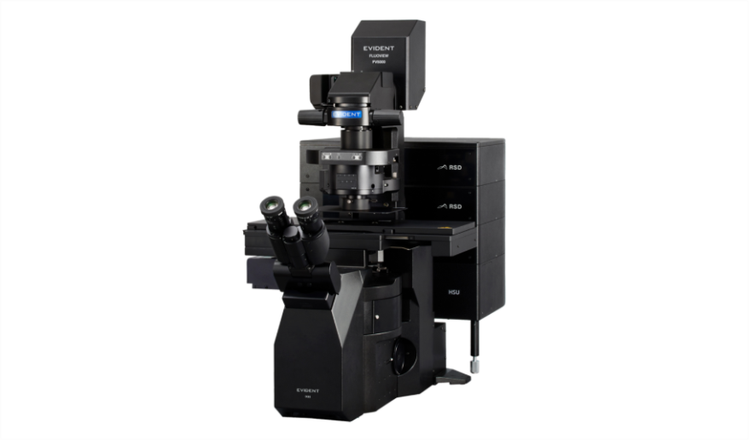
FV5000
Microscopio a scansione laser confocale
- Straordinaria chiarezza, velocità e affidabilità grazie a innovazioni rivoluzionarie
- I rilevatori SilVIR™ forniscono quantificazione a livello di fotoni, sensibilità eccezionale e rapporto segnale/rumore ultra elevato.
- Gamma dinamica senza pari cattura l'intero spettro del segnale e previene la saturazione
- Scansione risonante 2K ad alta velocità e scansione galvanica 8K ad alta densità in un'unica piattaforma
- Il software FLUOVIEW Smart™ semplifica il funzionamento con controlli intuitivi e automazione basata sull'intelligenza artificiale.
- Il collare di correzione automatica TruResolution™ ottimizza la messa a fuoco per oltre 20 obiettivi
- Il design modulare supporta fino a 10 linee laser e futuri aggiornamenti multifotone
- Il Laser Power Monitor (LPM) garantisce un'illuminazione stabile e risultati riproducibili nel tempo.
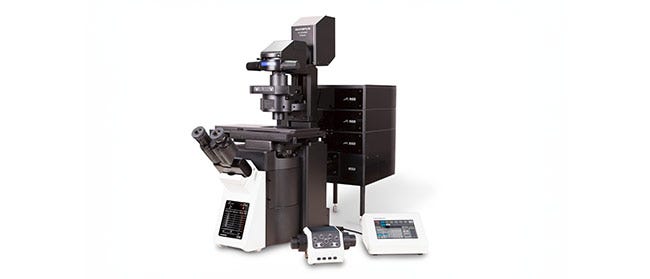
FV4000
Confocal Laser Scanning Microscope
- Game-changing dynamic range for imaging from the macro scale to subcellular structures
- Multiplex up to six channels simultaneously with TruSpectral technology
- Redesigned high-speed, high-resolution scanners for fixed and live cell imaging
- Improved depth and photosensitivity with pioneering NIR capabilities and renowned optics
- Peace of mind with the reliable, repeatable SilVIR detector
- Industry leading * ten laser lines with a broader spectral range from 405 nm to 785 nm
*As of October 2023.
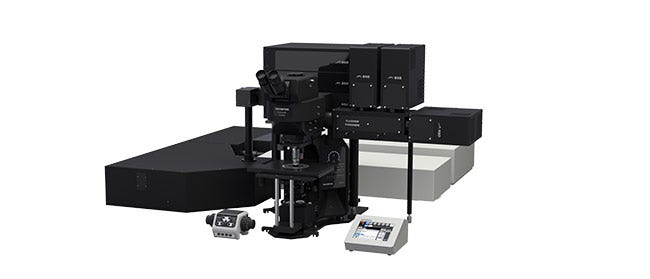
FV4000MPE
Multiphoton Laser Scanning Microscope
- Acquire accurate, quantitative image data from the macro scale to subcellular structures
- Obtain more information from a single multicolor image
- Monitor neuron and other essential dynamics with high-speed imaging
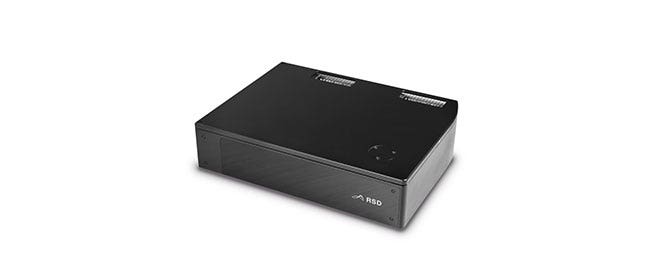
SilVIR detector
FLUOVIEW Laser Scanning Microscope Solutions
- Combines a silicon photomultiplier and patented * fast signal processing for lower noise, higher sensitivity, and improved photon resolving capabilities
- High detection efficiency provides superior signal-to-noise to bring weak fluorescence to life
- Capture vivid fluorescence images with no offset adjustments
- Precisely quantify image intensity for more reliable data
*Patent number US11237047
Industrial Solutions
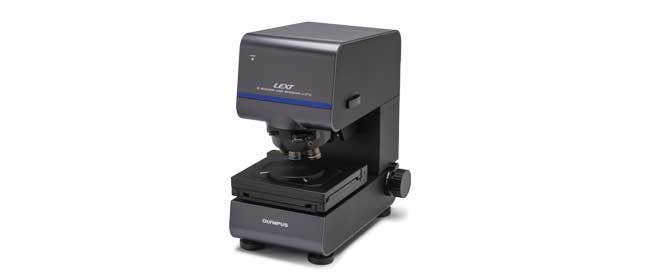
LEXT OLS5100
Confocal Laser Scanning Microscope for Material Analysis
- Guaranteed measurement accuracy of 3D surface shape at the submicron level*
- High-performance optics reduce aberration throughout the entire field of view
- High-resolution image stitching and fast scanning speeds to quickly acquire images
- User-friendly interface and intuitive software enabling operation by all user types
Related Applications
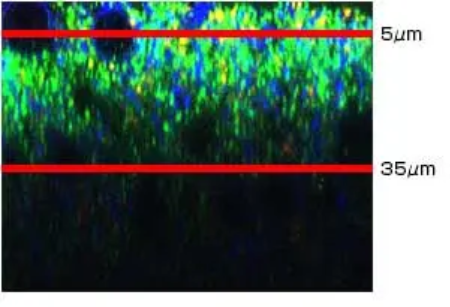
Using silicone oil immersion objectives with a confocal laser scanning microscope for deep tissue observation in cleared specimens
One of the first studies involving the use of "Sca l e," a clearing technique for rendering biospecimens transparent, was published in the August 2011 issue of Nature Neuroscience.* Since then, various techniques for rendering samples transparent, such as SeeDB, Clarity, Sca l eS, and Clear See, have been developed. These techniques are used in conjunction with a two-photon microscope to observe inside tissues to a depth of 8 mm. Currently, two-photon microscopes are only available at a limited number of research institutes, so new methods to observe cleared specimens using widely available laser confocal microscopes were developed.
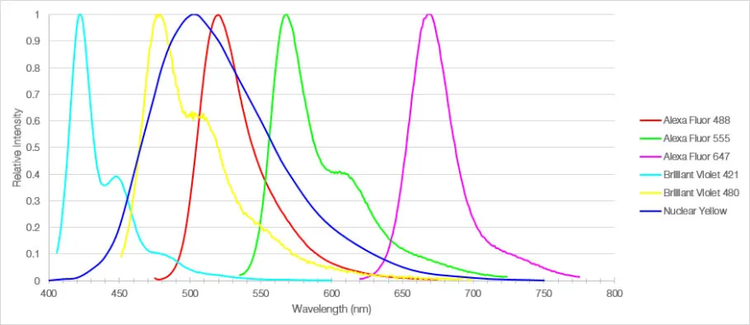
Multiplexing with the FLUOVIEW FV3000 Confocal Microscope
Studying cognitive impairment mechanisms requires the ability to associate morphological changes with physiological responses. To understand how the states and treatments of diseases relate to and affect brain morphology, it is important to be able to identify multiple morphological structures within the same sample. In this study, the FV3000 confocal microscope with TruSpectral detectors was used to successfully image six different structures in mouse medial prefrontal cortex (mPFC): astrocytes, pyramidal neurons, inhibitory neurons, neuronal membranes, axon initial segments, and nuclei.
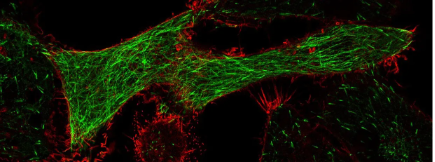
Innovations in Microscopy: Redefining the Boundaries of Confocal and Multiphoton Imaging
Life science research is entering a transformative era. Across imaging labs and core research facilities, scientists are facing growing demands for high-resolution, quantitative data to answer increasingly complex biological questions. Precision imaging is everything to the individuals leading the fields of neuroscience, cell biology, drug discovery, cancer research, and developmental biology.

Using the Olympus OLS5000 Laser Confocal Microscope to Measure Dross in Laser Cutting Applications
Evident’s Customized Solutions team can co-create solutions with you to solve specific microscopy problems or enhance the functions of our standard microscopes. Here, we demonstrate how we provide capability beyond the conventional by supporting microscopy training in remote locations.
Related Categories
Laser Scanning Microscope FAQs
Laser scanning confocal microscopes are used in life science research across a broad range of live and fixed specimens for molecular and cellular anatomical, physiological, and biochemical studies. Their inherent ability to optically section light enables laser scanning microscopes to achieve accurate high-resolution and high-contrast reconstruction of 3D structures from a series of images obtained at different depths.
To learn more about the uses of confocal microscopy, visit our microscopy resource center.
Confocal microscopy offers several advantages over conventional widefield optical microscopy, including the ability to control depth of field, elimination or reduction of background information away from the focal plane (high signal-to-noise ratio), and the capability to collect serial optical sections from thick specimens. The basic key to the confocal approach is the use of spatial filtering techniques to eliminate out-of-focus light or glare in specimens outside the immediate field of view.
A point-scanning laser confocal microscope creates optical sections of a specimen by scanning a focused laser spot point by point across a field of view. The microscope’s objective then focuses this light on the sample. The photons emitted from the fluorophores in the sample located at the focus point are collected by the objective and relayed back through the scanner, passing through a pinhole that is conjugate to the objective focal plane, causing only the in-focus photons to be detected by the photomultiplier tube. By imaging the photons at each point of the laser position, an image can be reconstructed pixel by pixel.
To learn more about confocal microscopy, visit our microscopy resource center.
Multiphoton microscopy is an excellent technique for deep imaging in thick specimens, especially during in vivo experiments. Strongly focused near-infrared laser pulses penetrate deeper into biological tissues than visible light, as near-infrared light experiences less absorption and scattering. For imaging, a pulsed laser is scanned across the specimen, typically using wavelengths from 700 to 1300 nm for excitation. Multiphoton excitation is inherently localized to the focal plane, thus reducing phototoxicity. More importantly, a confocal pinhole is not required for optical sectioning, so more light signal—including scattered fluorescence photons—can be collected. The results are bright, detailed 3D images from deep within thick specimens.
Discover the Olympus FVMPE-RS™ multiphoton laser scanning microscope.
Overall, resolution is significantly improved in confocal microscopy compared to traditional widefield microscopy techniques. Because resolution in laser scanning microscopy is dependent on the objective’s numerical aperture (NA), it is critical to use high NA objectives to achieve a high-resolution image. Olympus offers a suite of high NA objectives, including our X Line™ objectives, which offer high numerical aperture (NA), image flatness, and chromatic correction to improve image resolution over a larger field of view. For deep tissue imaging, our A Line™ silicone immersion objectives provide a close refractive index match to that of live cells, enabling brighter and higher resolution 3D imaging with minimal spherical aberration.
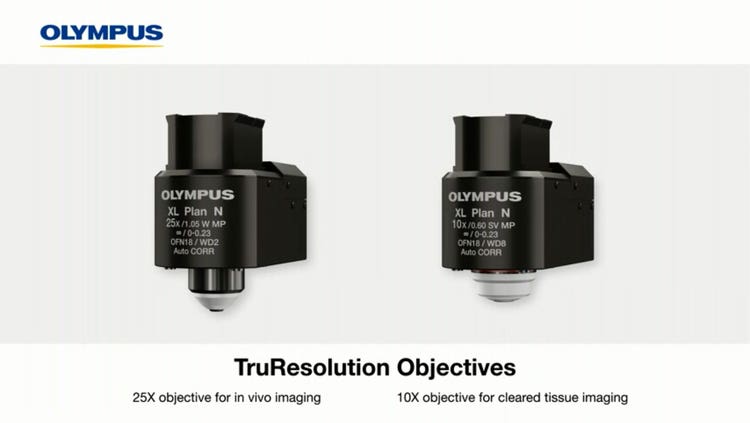
For increased resolution during deep imaging with our FVMPE-RS multiphoton system, TruResolution™ objectives have an automated correction collar that dynamically compensates for spherical aberration while maintaining accurate focus position. They automatically adjust at every plane of a volume image, delivering sharper and brighter 3D images at depth.
To remove image blur for clearer, sharper high-resolution images during image processing, Olympus has developed specialized TruSight™ 2D and 3D deconvolution algorithms for laser confocal and Olympus Super Resolution (OSR) images.
For studies requiring higher resolution, such as colocalization analysis, the Olympus Super Resolution (OSR) imaging module for the FV3000 system can acquire four fluorescent signals either sequentially or simultaneously with a lateral (X-Y) resolution of approximately 120 nm, nearly doubling the resolution of typical confocal microscopes.
Want to learn more about Olympus Super Resolution?
Laser scanning microscopes can be built into a system according to your budget and application. If you have a limited target object that you want to observe, it is possible to limit the number of lasers, detectors, and types of objectives at an affordable price. It is also possible to upgrade the system by adding necessary units as your research objectives change and develop over time.
Contact your local Olympus representative to discuss our laser scanning confocal systems and get a quote.
Laser Scanning Microscopy Resource Videos
TruResolution ObjectivesMaximize Resolution in Deep Imaging
This video shows you how TruResolution objectives automatically compensate spherical aberration in every plane of a volume image, delivering sharper and brighter 3D images at depth.
FV3000 Microscope in Cancer Research
In this video, Dr. Yuji Mishima of the Japanese Foundation for Cancer Research explains fluorescent imaging as a tool for research.